Chapter 05 of 9
Legacy Coexistence: The Five Patterns
Five architectural patterns for deploying AI alongside the enterprise systems that will not be replaced — starting from the premise that most AI strategies ignore.
Overview
Legacy Coexistence is the third pillar of the LegacyForward.ai framework — five architectural patterns for deploying AI alongside the enterprise systems that will not be replaced. It starts from a premise that most AI strategies ignore: the enterprise environment that will host your AI is not the one in the vendor demo, and pretending otherwise is how integration failures happen in production.
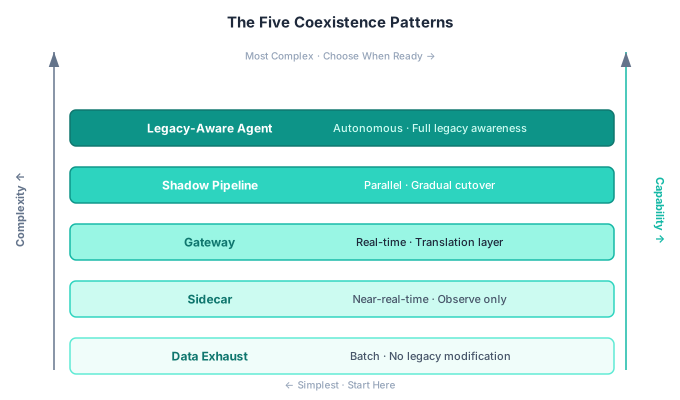
The five patterns — Data Exhaust, Sidecar, Gateway, Shadow Pipeline, and Legacy-Aware Agent — span a range of complexity and latency requirements. They are not mutually exclusive, and most real initiatives combine more than one.
The Legacy Reality
Every enterprise AI strategy that ignores existing systems is a fantasy.
Legacy systems are not technical debt waiting to be retired. They are load-bearing walls that process trillions in transactions, encode decades of business logic, and will outlive most of the AI initiatives being built alongside them. Here is what the real enterprise environment looks like:
The mainframe is still running. It processes every transaction. It has been running for thirty years. It will be running in ten more. The business logic encoded in its COBOL programs is the actual source of truth for how the organization operates — not the documentation, not the wiki, not the architecture diagrams. The mainframe.
The integration layer is held together with duct tape: SOAP endpoints, flat file transfers, batch jobs that run at 2 AM, FTP drops, MQ queues, and point-to-point integrations that nobody fully maps because the person who built them retired in 2014.
The data is everywhere and nowhere. Customer data lives in six systems that do not agree with each other. The "golden record" project from three years ago covers sixty percent of the data and has not been updated since the team was reassigned. The data warehouse is eighteen months behind the operational systems.
The "modern" systems are already legacy. That microservices platform deployed four years ago has its own technical debt, its own integration patterns, and its own undocumented behaviors. Legacy is not an age — it is a state. Any system that is in production, has accumulated institutional knowledge, and cannot be easily replaced is legacy.
This is the real enterprise environment — not the demo environment — into which enterprises are actually deploying AI.
Why Rip-and-Replace Fails
The instinct when confronting legacy is to replace it. Modernize. Migrate. Re-platform. This instinct has a poor track record.
The scope expands until it collapses. A mainframe modernization project starts with one application, but discovery reveals dependencies that connect it to forty others. The project scope triples, the timeline stretches, and eventually the initiative is killed, descoped to meaninglessness, or declared a success while the mainframe continues running in parallel — which is the definition of the outcome modernization was supposed to prevent.
The business logic is the system. Legacy systems do not just store data and execute transactions. They encode decades of business rules, regulatory requirements, exception handling, and edge case logic that was never formally documented. Replacing the system means reverse-engineering all of that logic — and the organization discovers that nobody fully understands what the system does until they try to replicate it and fail.
The risk is existential. When a legacy system processes every transaction or serves as the system of record for regulatory reporting, failure is not an inconvenience. It is an existential event. No CIO should bet the enterprise on a big-bang migration.
The economics do not work. Full modernization of a complex legacy landscape costs hundreds of millions and takes years. The ROI calculation assumes the new system will be complete before the old one is decommissioned — but that assumption rarely holds, and the result is running two systems in parallel indefinitely.
| Dimension | Rip-and-Replace | Legacy Coexistence |
|---|---|---|
| Starting assumption | Legacy is a problem to solve | Legacy is a permanent fixture to design for |
| Timeline | Years before value is realized | Value achievable in months by working alongside legacy |
| Risk profile | Existential risk if migration fails | Bounded risk — legacy system remains authoritative |
| Business logic | Must be reverse-engineered and replicated | Remains encoded in the legacy system |
| ROI timing | Deferred until modernization completes | Achievable during coexistence |
| Outcome if modernization never happens | Sunk cost with no value | Coexistence patterns remain operational indefinitely |
| AI value capture | Blocked until modernization | Enabled immediately through coexistence patterns |
The organizations that succeed with AI are not the ones that modernize first. They are the ones that learn to create value alongside the systems they already have.
The Five Coexistence Patterns
Pattern
Data Exhaust
What it is. The legacy system produces data — batch extracts, log files, report outputs, database snapshots — as a byproduct of its normal operation. This data exhaust becomes the input for AI analysis without requiring any modification to the legacy system.
When to use it. The legacy system produces data regularly. The AI use case does not require real-time access. The value hypothesis involves analyzing historical patterns that are captured in the data exhaust.
Example. A mainframe processes millions of insurance claims daily. Nightly batch extracts feed an AI system that identifies fraud patterns, anomalous processing times, and systemic errors across the full claims history. The mainframe is untouched. The AI operates on data that was already being produced.
Constraints. Latency is bounded by the extraction schedule — daily extracts mean daily insights, at best. Not suitable for real-time use cases. Data format translation is required: flat files, fixed-width records, EBCDIC encoding.
Why it matters. The highest-value AI opportunities are often Data Exhaust patterns. Decades of transactional data have never been analyzed holistically because no human team could process them at scale. This is where transformation lives — in data that has been sitting in legacy systems for thirty years, waiting for something that could actually read it.
Pattern
Sidecar
What it is. An AI system operates alongside the legacy system, receiving the same inputs or observing the same events, and providing supplementary outputs — recommendations, risk scores, quality checks — to human operators or downstream systems. The legacy system remains the system of record and the primary execution path.
When to use it. AI needs to augment a legacy process in near-real-time without modifying the legacy system. The value hypothesis involves providing AI-generated insight alongside — not instead of — legacy-generated outputs.
Example. A loan processing system runs on a legacy platform. A sidecar AI receives the same application data and produces a risk assessment that includes factors the legacy rules engine cannot evaluate — unstructured data from applicant communications, market signals, and cross-portfolio patterns. The loan officer sees both outputs.
Constraints. Requires a mechanism to observe or receive events from the legacy system — message queues, database change capture, API events. The sidecar must never block or interfere with the legacy system's operation. If the sidecar is unavailable, the primary process continues uninterrupted.
Pattern
Gateway
What it is. An integration gateway sits between the AI system and the legacy environment, translating requests and responses between modern and legacy protocols. The gateway encapsulates legacy complexity, presenting a clean interface to the AI system.
When to use it. AI needs to interact with legacy systems through a controlled interface. The legacy system does not expose a modern API. The translation logic is complex enough to warrant a dedicated integration component.
Example. An AI agent needs to query customer account status from a CICS mainframe application. The gateway accepts a REST call from the agent, translates it into a 3270 terminal interaction with the mainframe, captures the screen response, extracts the relevant data, and returns structured JSON. The AI never knows it is talking to a forty-year-old system.
Constraints. Gateway development requires deep knowledge of the legacy system's interface. Performance depends on the legacy system's response characteristics. Error handling must account for legacy failure modes that modern systems do not expect — batch windows, session timeouts, abend codes.
Think of it like this: The Gateway pattern is a skilled interpreter who speaks both modern English and ancient Latin. The AI speaks modern English. The legacy system speaks Latin. The gateway translates, in real time, in both directions. Without the interpreter, neither side can communicate. But the interpreter is not a permanent replacement for the Latin speaker — the mainframe keeps running, the interpreter keeps working.
Pattern
Shadow Pipeline
What it is. The AI system runs in parallel with the legacy system, processing the same inputs and producing its own outputs. Both outputs are compared, and over time, as confidence builds, production traffic is gradually shifted to the AI system.
When to use it. AI will eventually replace a legacy process, but the transition must be gradual and evidence-based. The value hypothesis involves demonstrating that AI output is equivalent to or better than legacy output, validated against the legacy system's known-correct results.
Example. A legacy system calculates insurance premiums using a complex rules engine built over twenty years. An AI system is trained to produce premium calculations from the same inputs. Both systems run in parallel for six months. Every discrepancy is investigated. When the AI system reaches 99.7% agreement with the legacy system — and the 0.3% disagreements are understood and acceptable — production traffic begins shifting.
Constraints. Running two systems simultaneously has cost and operational implications. The comparison logic must distinguish meaningful disagreements from acceptable variance. Timeline to cutover is typically longer than leadership expects.
Pattern
Legacy-Aware Agent
What it is. AI agents are designed with explicit knowledge of the legacy landscape — protocols, batch schedules, data formats, reversibility constraints, failure modes — and their reasoning and action planning account for legacy constraints as first-class considerations.
When to use it. AI agents need to operate autonomously across both modern and legacy systems within a business process. The business process requires interaction with legacy systems that have non-standard interfaces, asynchronous processing, or significant operational constraints.
Example. An AI agent handles supplier onboarding across seven systems — three modern and four legacy (mainframe ERP, AS/400 procurement system, legacy document management, homegrown contracting system accessible only through terminal emulation). The agent knows that the ERP requires batch submission with 24-hour processing, the AS/400 has a four-field limitation on vendor names, and the document management system accepts only TIFF format. Its action plan sequences steps accordingly.
Constraints. Requires comprehensive mapping of legacy system behaviors, constraints, and failure modes. Agent design must include fallback paths for legacy system unavailability. Testing must cover the full matrix of legacy system states, including partial failures. This is the most complex coexistence pattern — do not default to it when a simpler pattern will suffice.