Chapter 07 of 9
How the Pillars Connect: Feedback Loop and Core Principles
How Signal Capture, Grounded Delivery, and Legacy Coexistence form a closed feedback loop — and the six principles that underpin everything.
Overview
The three pillars of LegacyForward.ai are not independent modules to be applied selectively. Signal Capture, Grounded Delivery, and Legacy Coexistence form a closed feedback loop — each pillar informs the others, and the evidence produced in one continuously sharpens the inputs to the next.
Understanding how the pillars connect is what separates organizations that apply the framework as a checklist from those that use it to build genuine learning systems around AI delivery.
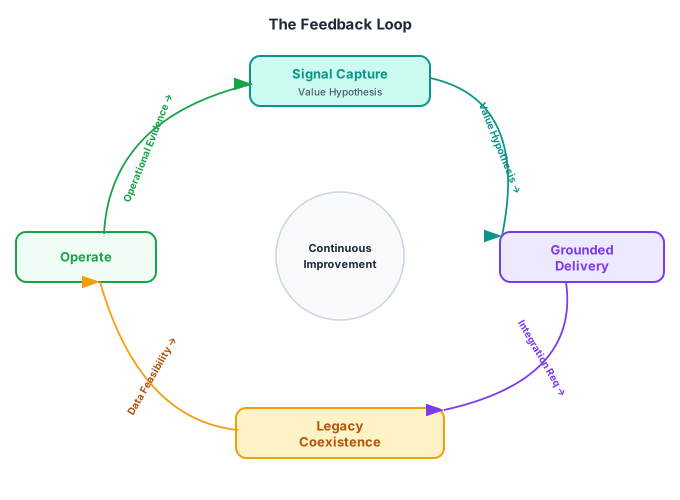
The Feedback Loop
The three pillars are not a linear process. They form a closed feedback loop that continuously improves the organization's ability to identify, deliver, and operate AI value.
Signal Capture → Grounded Delivery. The Value Hypothesis produced in Signal Capture becomes the primary input to the Frame phase of Grounded Delivery. Frame does not define what to build — it defines what value to pursue and how to validate it. Value Tracking feeds the probabilistic quality gates in Grounded Delivery: quality is not measured by feature completion, it is measured by progress toward value capture.
Grounded Delivery → Legacy Coexistence. The Explore phase must include legacy integration discovery. Teams that defer integration testing to Harden discover too late that the legacy system cannot support the required access patterns. The Shadow Pipeline coexistence pattern maps directly to the Harden phase: probabilistic quality gates evaluate AI output against legacy system baselines. The dual-track governance in Grounded Delivery extends to hybrid architectures — deterministic components including legacy integrations use conventional engineering rigor; non-deterministic components use probabilistic evaluation.
Legacy Coexistence → Signal Capture. The highest-value AI opportunities often exist precisely because legacy systems contain decades of data that has never been analyzed holistically. Legacy Coexistence patterns determine what data is accessible, at what latency, in what format — directly informing whether a value hypothesis is feasible. Data validation in the Value Assessment Framework must account for legacy constraints. A value hypothesis that assumes real-time access to mainframe data is a fundamentally different proposition than one that works with nightly batch extracts.
Operate → Signal Capture. Operational evidence from deployed AI systems feeds back into Signal Capture at the portfolio level. What did the system actually deliver, versus what was hypothesized? What signals did operational monitoring surface that suggest new value opportunities? What did the organization learn about legacy data quality that opens new hypotheses? The feedback loop makes each iteration smarter than the last.
Red Flags by Pillar
When practitioners observe these signals, the corresponding pillar requires immediate attention.
Signal Capture — Five Red Flags:
- The AI portfolio is organized by technology category (chatbots, agents, ML models) rather than by value outcome.
- AI success is reported in adoption metrics — users, queries, departments — without reference to business outcomes.
- No AI initiative has documented kill criteria. Every initiative has been active for more than twelve months.
- The value hypothesis for an initiative cannot be stated in one sentence by the team building it.
- A demo has been shown to leadership before data validation has been completed.
Grounded Delivery — Five Red Flags:
- The team cannot state success criteria in probabilistic terms with specific thresholds.
- The evaluation dataset was generated by the AI system being evaluated, not by ground-truth human judgment.
- Sprint velocity is the primary progress metric reported to leadership.
- The system has been deployed to production but has no defined governance cadence for quality review.
- A phase gate occurred without a genuine PIVOT or KILL option — the outcome was GO before the review began.
Legacy Coexistence — Five Red Flags:
- The integration design was produced after development began.
- Legacy system testing uses mocked environments that do not replicate production behavior.
- The coexistence pattern was selected as "temporary until modernization" without a defined modernization timeline.
- Screen scraping is the primary integration mechanism with no engineering rigor or monitoring.
- The architecture does not define a fallback for legacy system unavailability.
Core Principles
These six principles are the philosophical foundation of the LegacyForward.ai framework. Every pillar, every phase, every pattern is an expression of one or more of them.
1. Kill Early
The most expensive AI initiatives are the ones that should have been killed in month two but were allowed to run for two years. Killing early is not failure — it is discipline. An initiative that cannot demonstrate progress toward its value hypothesis within a defined timeframe is consuming resources that could fund an initiative that can. Kill criteria must be established before funding, documented in writing, and enforced without sentiment.
The hardest kill decision is the one where an executive sponsor is invested in the initiative. Create organizational structures — value review boards, explicit criteria, portfolio-level accountability — that provide cover for the kill decision. The alternative is a portfolio of zombie initiatives that consume resources, occupy talented people, and damage organizational trust in AI.
2. Non-Deterministic by Default
AI systems are not software — they do not fail the same way, and they do not succeed the same way. Every process, tool, and governance model that touches an AI system must be designed with non-determinism as the baseline assumption, not as an exception to handle.
Quality is a distribution, not a binary. Testing is evaluation, not assertion. Done is an ongoing state, not a completion event. Progress is measured in evidence, not story points. These are not philosophical preferences. They are engineering requirements for systems whose outputs cannot be predicted with certainty.
3. Legacy Is a Feature
Stop treating legacy systems as obstacles to AI deployment. They are repositories of thirty years of business logic, transactional data, and operational truth that no greenfield system can replicate. The highest-value AI opportunities are often Data Exhaust opportunities — AI that can finally read and synthesize the data that legacy systems have been accumulating for decades.
Design for permanence. The mainframe will be running when the current AI initiative reaches end-of-life. Build coexistence architectures that do not depend on modernization. The organizations that thrive in AI are not the ones that modernize fastest — they are the ones that extract the most value from the systems they already have.
4. Value Before Technology
Every AI initiative begins with a business problem, not a technology capability. The question is never "what can we do with AI?" The question is always "what value do we need to create, and can AI create it in a way nothing else can?"
Technology-first portfolios produce impressive demos and disappointing returns. Value-first portfolios produce boring demos and compelling ROI. Choose boring demos.
5. Operate Forever
Deploying an AI system without operating it is not deployment — it is abandonment with a delayed start date. AI systems degrade over time: models drift, data distributions shift, and prompt performance erodes. An AI system in production without ongoing monitoring, evaluation, and governance will produce subtly wrong outputs that nobody formally notices until the damage is significant.
The operational commitment must be made before deployment, not after. If the organization is not willing to maintain an AI system in production as a permanent operational discipline, the system should not be deployed.
6. Coexist Deliberately
Legacy integration is not a secondary concern to be addressed after the interesting AI work is done. It is a primary design input that determines whether the value hypothesis is feasible. Integration patterns must be selected deliberately, based on the specific characteristics of each legacy system and each AI interaction.
Accidental integration — wrappers, screen scraping, undocumented batch jobs, API calls that silently time out — is technical debt that compounds in production. Deliberate integration — documented patterns, explicit fallbacks, defined governance, production-representative testing — is infrastructure that pays returns for the life of the initiative.