Chapter 16 of 24
AI Doesn't Replace the Stack — It Runs on Top of It
The most important thing to understand about enterprise AI is that it does not replace your existing technology landscape. It runs on top of it. Everything else follows from this.
Overview
There is a version of the enterprise AI story that goes like this: AI arrives, legacy systems are replaced, and the organization emerges transformed, running on modern, intelligent infrastructure that is nothing like what came before. This story is told at conferences, in vendor presentations, and in business publications. It is not how enterprise AI actually works.
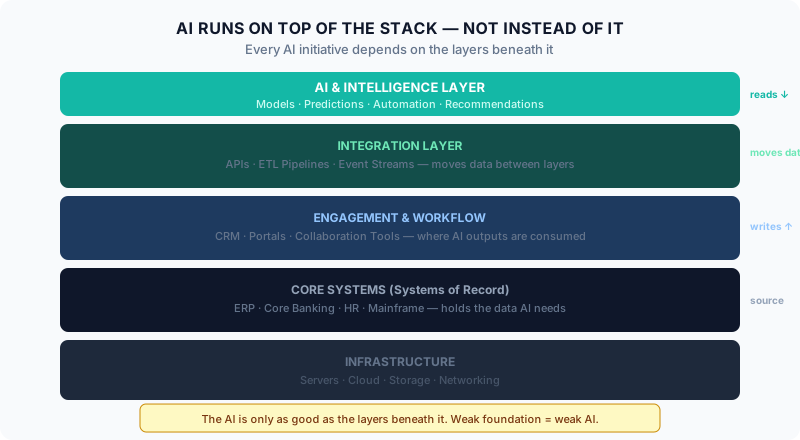
The reality is almost exactly the opposite. AI is additive, not replacement. It runs on top of the existing technology stack, reads from existing systems, writes back into existing processes, and depends on data that has been sitting in databases and data warehouses for years or decades. The stack does not disappear when AI arrives. The stack becomes the foundation on which AI either succeeds or fails.
Understanding this is the single most important conceptual shift for anyone working on enterprise AI.
Why AI Runs on Top, Not Instead Of
The reasons AI does not replace the stack are the same reasons legacy systems persist at all.
Existing systems store the data that AI needs. Years of transaction history, customer behavior, operational records, and financial data are all in existing systems. AI models are trained on historical data. The quality and depth of the historical data determines what the AI can and cannot learn. You cannot replace the system that holds that data without first migrating the data. Migration is complicated, expensive, and risky.
Existing systems enforce the business rules that the organization depends on. The pricing logic, the eligibility rules, and the compliance requirements are encoded in existing systems and have been refined over years. An AI system can learn from these rules, automate some of the decisions they produce, and augment the process of applying them. But it cannot simply replace the system that enforces them without first understanding every rule and replicating it. That is a massive undertaking for any significant system.
Existing processes are built around existing systems. People know how to use them. The workflows, the approvals, the reports, and the audits all assume the existing system is there. Changing the system means changing the process means organizational change management. This is slow, expensive, and risky regardless of how good the new technology is.
The Three Walls
When an AI project runs into trouble in an enterprise, it almost always runs into one of three walls.
The data wall. The data the AI needs is in an existing system but is not accessible in a form the AI can use. It is in the wrong format, it is incomplete, it has quality problems, or there is no practical way to extract it at the volume and frequency required. The AI cannot improve until the data problem is solved, and solving the data problem requires work in the existing system.
The integration wall. The AI system needs to read from or write to existing systems, but the integration is difficult. The existing system does not have a modern API. The API that exists is slow, unreliable, or poorly documented. The data formats are incompatible. Building and maintaining the integration takes longer and costs more than anticipated.
The process wall. The AI system produces a recommendation, a prediction, or an automated action. The existing process does not have a clean way to incorporate it. The recommendation has to be manually reviewed and entered into a different system. The automation triggers a workflow that the existing process was not designed to handle. The AI output is technically correct but organizationally unactionable.
These three walls are not bugs in the AI initiative. They are the normal friction of inserting new technology into an existing, deeply layered environment. The organizations that navigate them successfully are the ones that understood they were coming and planned accordingly.
What "Running on Top" Looks Like in Practice
Here is a concrete example of what it means for AI to run on top of the existing stack rather than replace it.
A large insurance company wants to use AI to speed up claims processing. Today, a claim is filed, an adjuster reviews it, and the decision takes several days.
The AI initiative does not replace the claims system. The claims system is a thirty-year-old platform with millions of historical claims, business rules encoded in COBOL, and a dozen downstream systems connected to it. Replacing it would take five years and hundreds of millions of dollars.
Instead, the AI initiative runs alongside it. The AI model is trained on historical claims data extracted from the existing system. It is deployed as a separate service that, when a new claim comes in, reads the claim details through an integration, generates a recommendation — low risk, approve; medium risk, fast-track to adjuster; high risk, detailed review — and posts that recommendation back to the adjuster's interface. The adjuster sees the recommendation, uses it to prioritize their work, and makes the final decision, which is recorded in the existing system as always.
The existing system is untouched. The AI does not replace it. The AI adds intelligence to the process that runs through it. The value is real: faster processing, better prioritization, and more consistent outcomes, without requiring a replacement of the underlying system.
This is what enterprise AI actually looks like in practice, and it is a useful mental model for almost every AI initiative at scale.
The Implication for AI Strategy
The most important implication of this reality is that AI strategy in the enterprise cannot be separated from data strategy, integration strategy, and process strategy.
An AI initiative that does not account for the data it needs, how it will access that data, and how its outputs will be incorporated into existing processes is not a complete strategy. It is a technology experiment that will hit walls.
The organizations that succeed at enterprise AI treat it as a layer on top of an existing landscape, designed to work with that landscape rather than despite it. They invest in the data infrastructure. They build and maintain the integrations. They redesign the processes. And they choose AI use cases that are achievable given the actual state of the systems underneath.