Chapter 03 of 24
What Is a Legacy System, Really?
Legacy doesn't mean old and broken. It means load-bearing. Understanding what makes a system legacy — and why it stays — is the first step to working with it.
Overview
Ask ten people to define "legacy system" and you will get ten different answers. Most of them will involve the word "old." Some will involve the word "outdated." A few will involve frustration.
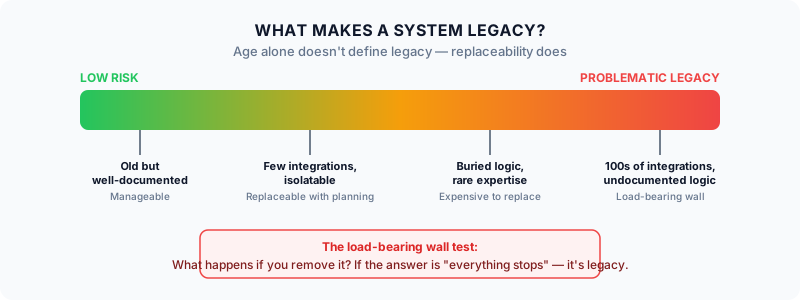
The problem with defining legacy as "old" is that age alone does not make something legacy. Some systems running on forty-year-old technology are perfectly fit for purpose and will continue running for another forty years. Some systems built last year are already legacy in the sense that matters: they are hard to change, hard to replace, and deeply embedded in how the organization functions.
The better definition has nothing to do with age. A legacy system is a system that the organization cannot easily replace or significantly modify without unacceptable risk or cost.
That is what matters. Not when it was built. The question is whether you are trapped.
Why Organizations Get Trapped
Being trapped by a system happens for several reasons, and they usually stack on top of each other.
The system is deeply integrated. Legacy systems often sit at the center of a web of connections. Other systems read from them. Other systems write to them. Reports are generated from them. Processes depend on the data they hold. When a system is this connected, changing it means changing everything connected to it. Understanding all those connections is a project in itself.
The business logic is buried in the code. Over decades, the rules that govern how the business operates get encoded in the system. Pricing rules. Eligibility rules. Calculation methods. Approval workflows. Some of these rules are documented. Many are not. They exist only inside the software, and the people who put them there are long gone. The system is not just storing data. It is running the business. Replacing it means understanding every rule it enforces, which often requires months of reverse-engineering.
The data is irreplaceable. Systems accumulate years or decades of transaction history, customer records, compliance data, and operational information. This data has to go somewhere when the system is replaced. Migrating it is always harder than expected. Not because migration tools are bad, but because data quality issues that have accumulated over years become visible all at once when you try to move the data somewhere new.
The skills to run it are rare. Some legacy systems require specialized knowledge to operate. The people who have that knowledge may be approaching retirement. Replacing the system requires training new people, but training them requires documentation that often does not exist, which requires working with the people who are about to retire, which creates a race against time.
The Load-Bearing Wall Metaphor
The most useful metaphor for a legacy system is a load-bearing wall.
In an old building, not every wall is structural. Some walls are just partitions. You can remove them relatively easily to open up a space. But some walls are holding the building up. Remove them without understanding what they are doing and the ceiling comes down.
Legacy systems are load-bearing walls. The fact that they are old, ugly, or inconvenient is beside the point. The question is: what happens if you remove them?
In most cases, the answer is that everything depending on them stops working. And because legacy systems tend to be at the center of things, everything means a lot.
This is why enterprises do not simply replace legacy systems when something new comes along. Not because the people making the decisions are incapable of seeing that the old system is imperfect. Replacing it requires a level of planning, risk management, and organizational alignment that is genuinely difficult. The cost of getting it wrong is high.
What Makes a System Legacy vs. Old
It is worth being precise about the distinction, because it matters for how you think about AI and modernization.
An old system that is stable, well-understood, well-documented, and not deeply integrated with other things is not really legacy in the problematic sense. It is just old. You can plan to replace it in an orderly way, or you can continue running it indefinitely if it serves its purpose.
A system becomes problematic legacy when:
- It is hard to change because the underlying technology or code is poorly understood
- It is hard to integrate with modern systems because it uses protocols, data formats, or interfaces that modern tools do not speak natively
- The organization depends on it for something critical but the expertise to manage it is disappearing
- Regulatory or security requirements cannot be met without changing it, but changing it is risky
When AI projects run into legacy systems, the issue is almost always one of these four things. The data is in the legacy system but getting it out cleanly is hard. The legacy system needs to be part of the AI workflow but it does not have a modern API. The business logic in the legacy system needs to be replicated in the AI model but nobody can fully document what that logic is.
The Right Posture
The right posture toward legacy systems is not dismissal and not reverence. It is realism.
These systems are there for a reason. They have survived not because no one noticed they were old, but because they are doing something valuable and the cost of replacing them has consistently exceeded the benefit. That is important information.
At the same time, legacy systems create real constraints for modernization and AI. Those constraints need to be understood and planned around, not wished away.
The practitioner who understands legacy, what it actually means, why it persists, and how to work with it rather than against it, has a significant advantage over the one who simply says "we need to rip and replace" and is then surprised when it takes five years and three times the budget.