Chapter 06 of 9
Legacy Coexistence: Data Challenges and Anti-Patterns
Data challenges in legacy environments and the anti-patterns that cause AI integration to fail in production.
Overview
Selecting the right coexistence pattern is necessary but not sufficient. The data flowing across the legacy boundary carries its own set of challenges — format mismatches, consistency gaps, access constraints, and governance questions that cannot be resolved by the integration pattern alone. These must be addressed architecturally before the integration design is locked.
This chapter covers the data challenges endemic to legacy environments and the anti-patterns that cause AI integration to fail in production even when the coexistence pattern was chosen correctly.
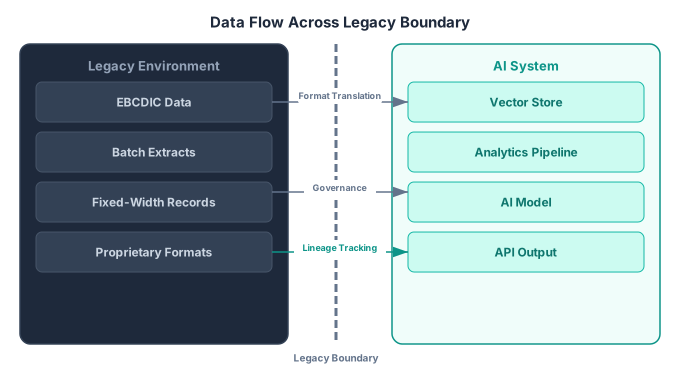
Data Challenges in Legacy Environments
AI value depends on data. Legacy environments present data challenges that must be addressed architecturally, not ad hoc.
Data format translation. Legacy systems store and export data in formats that modern AI pipelines do not natively consume: EBCDIC encoding, fixed-width records, packed decimal fields, proprietary binary formats, hierarchical databases, flat file structures with implicit schemas. Translation must preserve semantic meaning — including business rules embedded in field lengths, value ranges, and record relationships.
Data consistency across eras. When AI synthesizes data from legacy and modern systems, inconsistencies emerge: different field definitions for the same concept, different granularity levels, different temporal resolutions, different quality standards. The architecture must define a reconciliation strategy — not necessarily a single golden record, but explicit rules for how conflicts are resolved based on the use case.
Data access constraints. Legacy systems were not designed for the access patterns that AI requires. A mainframe optimized for transaction processing may not tolerate full-table scans, extraction windows are limited, and API exposure is often unavailable. Integration must respect these operational constraints while still providing AI with the data it needs.
Data governance across boundaries. When data flows between legacy and AI systems, governance becomes complex. Which system is the system of record? Who owns data quality? How is lineage tracked across the boundary? What regulatory requirements apply to data collected under legacy-era policies but now analyzed by AI? These questions must be answered architecturally.
Key Questions: Legacy Coexistence
- Which legacy systems participate in the targeted business process?
- What are the interface types — API, batch, terminal, file — for each legacy system?
- What data format translation is required, and where does that translation happen?
- Which coexistence pattern is appropriate for each AI-to-legacy interaction, and why?
- What is the data access latency for each legacy system, and does it satisfy the value hypothesis's requirements?
- What happens when a legacy system is unavailable — what is the fallback?
- How long will the coexistence architecture be in production? Is it designed for permanence, or is it a bridge to modernization that may never happen?
Anti-Patterns: Legacy Coexistence
The Greenfield Fantasy. "Once we modernize, we can deploy AI properly." This is a strategy for never deploying AI. Modernization takes years while AI value is needed now — organizations that wait for a greenfield environment will be outcompeted by those that learn to coexist with what they have. Modernization is a separate initiative, and AI deployment should not be held hostage to it.
The Wrapper Illusion. "We will put an API wrapper around the legacy system." Wrappers hide complexity — they do not eliminate it. The wrapped system still has batch processing schedules, concurrency limitations, data format constraints, and failure modes that the wrapper does not surface. AI systems that interact through wrappers without understanding the underlying legacy behavior will fail in production in ways the wrapper cannot diagnose.
The Integration Afterthought. "We will figure out legacy integration later." No. Legacy integration determines whether the value hypothesis is feasible. An initiative that requires real-time access to data locked in a batch-processing mainframe has a fundamentally different feasibility profile than one that works with nightly extracts. Integration must be assessed during Signal Capture — not after development begins.
The Screen Scraping Default. When all else fails, teams resort to screen scraping — automating terminal interactions to extract data from legacy systems. This works in demos but breaks in production: screen layouts change without notice, response timing varies under load, and error screens go unhandled. Screen scraping is a last resort, not a pattern. If it is the only option, it must be engineered with full rigor: error handling, retry logic, layout change detection, and continuous monitoring.
The Strangler Fig Misconception. The Strangler Fig pattern — gradually replacing legacy system functionality — is valid for deterministic modernization. It is dangerous for AI integration because AI does not replace legacy function-for-function. AI creates net new capabilities around legacy systems. Applying Strangler Fig to AI integration conflates modernization with transformation. They are different problems with different solutions.