Chapter 00 of 9
From Chaos to Clarity
Why most enterprise AI initiatives fail — and the three-pillar framework that changes the outcome.
Overview
The majority of enterprise AI initiatives fail to deliver meaningful returns — not because the technology does not work, but because the organizations deploying it are making predictable, avoidable mistakes and repeating them at scale. The capabilities are genuine and the value is achievable, yet five recurring failure patterns continue to define the current state of enterprise AI.
LegacyForward.ai is a practitioner framework built to break that pattern — three pillars that address each failure mode directly, in the environment enterprises actually operate in rather than the one they wish they had.
The Problem Is Not AI. It Is How Enterprises Are Approaching It.
The capabilities are genuine and the value is achievable. And yet, the majority of enterprise AI initiatives fail to deliver meaningful returns — not because the technology does not work, but because the organizations deploying it are making predictable, avoidable mistakes and repeating them at scale.
Here are the five failure patterns that define the current state of enterprise AI:
1. Hype exceeds value. Organizations measure AI success by deployment volume — users on platform, queries per day, departments with copilots — not by business outcomes. An internal chatbot that fields ten thousand queries a month is meaningless if those queries would have been answered faster by a well-organized wiki. Vanity metrics crowd out honest value assessment, and leadership mistakes activity for progress.
2. Wrong delivery method. Traditional Agile was designed for deterministic systems: the same input produces the same output, every time. AI systems are non-deterministic. A prompt that produces a correct answer ninety-four times can produce a wrong answer on the ninety-fifth with no warning, no error code, and no traceable root cause. Sprint velocity, binary acceptance criteria, and regression testing — the foundations of Agile — all break against this reality. Teams apply the wrong tools and wonder why their AI projects behave differently from their software projects.
3. Legacy reality is ignored. Every vendor pitch, every conference demo, every agent framework tutorial makes the same assumption: you are building on a clean slate — fresh APIs, cloud-native infrastructure, and modern data stores. This world does not exist inside any enterprise that has been operating for more than a decade. The mainframe is still running. The integration layer is held together with FTP drops and batch jobs. The data lives in six systems that do not agree with each other. AI strategies that do not account for this reality fail when they collide with it — which is always in production, and always late.
4. Agent fantasy. A senior leader watches two demos, reads three articles, and concludes that autonomous AI agents will replace half the workforce by next quarter. They sponsor initiatives with no value hypothesis, no integration plan, and no understanding of what it actually takes to deploy, govern, monitor, and trust an autonomous system in a production environment. The result is a series of expensive, high-visibility failures that damage organizational trust in AI broadly.
5. Vibe coding creates false momentum. AI-assisted development has compressed idea-to-demo from weeks to hours. This feels like progress. It is a trap. Faster demos mean faster arrival at the wrong destination. The demo becomes the organizational commitment before anyone validates whether the initiative captures real value. Speed without a value hypothesis is just a faster route to waste.
These are not random failures. They form a pattern. And LegacyForward.ai exists to break it.
What LegacyForward.ai Is
LegacyForward.ai is a practitioner framework for enterprise AI transformation. It does not exist to generate excitement about AI. It exists to help enterprises capture real, measurable value from AI — in the environment they actually operate in, not the one they wish they had.
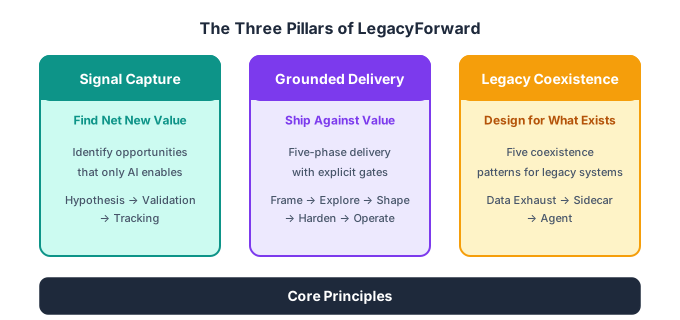
The framework rests on three pillars that address each failure mode directly:
Signal Capture addresses the value problem. Before a dollar of development budget is committed, Signal Capture requires every AI initiative to answer one question: Where does this create net new value that we cannot achieve any other way? It distinguishes between genuine transformation and mere automation, provides a structured Value Assessment Framework, and establishes the portfolio discipline that prevents organizations from accumulating portfolios of technically interesting but operationally meaningless projects.
Grounded Delivery addresses the delivery problem. It replaces Agile's deterministic assumptions with a five-phase methodology built for non-deterministic systems: Frame, Explore, Shape, Harden, Operate. Each phase has explicit activities, gate criteria, and decision rules — including the hardest decision in delivery: when to kill an initiative before it consumes more than it will ever return.
Legacy Coexistence addresses the reality problem. It provides five architectural patterns — Data Exhaust, Sidecar, Gateway, Shadow Pipeline, Legacy-Aware Agent — for deploying AI alongside the systems an enterprise already has, without ripping them out, without pretending they are temporary, and without designing integrations that collapse the first time the mainframe has a bad night.
These three pillars are not independent modules. They form a closed feedback loop. Signal Capture identifies what to build and why. Grounded Delivery defines how to build and validate it. Legacy Coexistence defines how to deploy it in the real enterprise environment. And the evidence produced in delivery feeds back into Signal Capture, sharpening the next hypothesis.
Who This Is For
The LegacyForward.ai framework is for every role that participates in enterprise AI transformation — not just technologists, but every role that influences, funds, builds, or operates AI initiatives.
Technology leaders and architects use Signal Capture to challenge AI proposals before they reach development, Grounded Delivery to design delivery processes that account for non-determinism, and Legacy Coexistence to build integration architectures that actually survive production.
Product managers and business analysts use Signal Capture to write defensible value hypotheses, Grounded Delivery to structure initiatives with honest gate criteria, and Legacy Coexistence to scope integration requirements early enough to affect feasibility decisions.
AI engineers and data scientists use Grounded Delivery to structure their experimental work as legitimate delivery phases rather than open-ended research, and Legacy Coexistence to understand the data access constraints that determine what they can actually build.
Executive sponsors and program leaders use Signal Capture to govern AI portfolios by value rather than by activity, Grounded Delivery to understand what constitutes real progress in AI initiatives, and Legacy Coexistence to set realistic expectations about timelines and constraints.
Business leaders who are not technologists use the framework to ask better questions of their AI teams — to distinguish genuine transformation proposals from automation dressed up in transformation language, and to understand why their enterprise AI initiatives take longer and cost more than the demos suggested.
This framework is the foundation of the LegacyForward.ai Series — seven practitioner books that apply these three pillars to specific enterprise roles and contexts. Each book assumes the framework. This guide is where to start.