Chapter 01 of 9
Signal Capture: Finding Net New Value
The core question every AI initiative must answer — and the distinction between transformation and automation that most organizations get wrong.
Overview
Signal Capture is the first pillar of the LegacyForward.ai framework — the discipline for identifying where AI creates outcomes that are genuinely impossible by any other means, and for killing initiatives that cannot make that case before they consume development budget.
Most enterprise AI portfolios fail not because the technology is wrong, but because no one asked a hard enough question at the start. Signal Capture exists to ask it: not "how can we use AI here?" but "where does AI create net new value that nothing else can?"
The Core Question
Signal Capture is a discipline for identifying where AI creates outcomes that are impossible by any other means — and for killing initiatives that cannot make that case.
The discipline begins with one question, applied to every AI initiative before it receives funding:
Where does this create net new value that we cannot achieve any other way?
Not: how does this make an existing process faster? Not: how does this reduce headcount? Not: how does this automate a manual task? Those are automation questions. They have their place, but they do not justify AI-scale investment or AI-scale governance.
The Signal Capture discipline is not a one-time assessment. It is a continuous practice applied across the full lifecycle of every initiative. Most organizations discover they have been measuring the wrong things. Signal Capture replaces those vanity metrics with a rigorous, honest answer to the only question that matters.
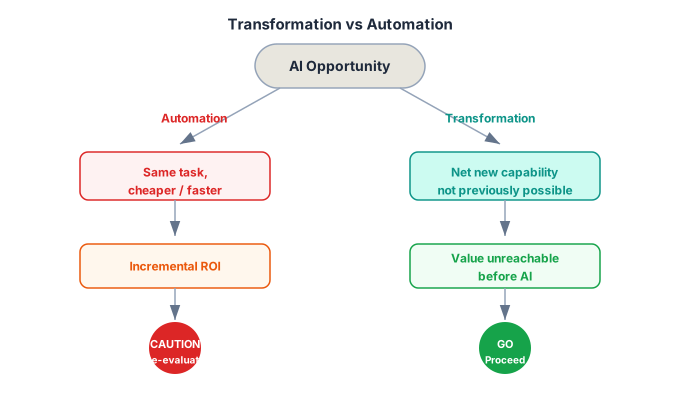
Transformation vs. Automation
The most important distinction in Signal Capture is between transformation and automation. Getting this wrong is the foundation of almost every enterprise AI portfolio failure.
| Dimension | Automation | Transformation |
|---|---|---|
| Definition | AI performs a task previously done by humans, faster or cheaper | AI produces an outcome that was previously impossible at any cost |
| Test | Remove the AI. Could enough humans achieve the same result? | Remove the AI. The outcome ceases to exist entirely. |
| Example | AI reads invoices and extracts fields into a spreadsheet | AI analyzes 15 years of invoice data, contracts, vendor communications, and payment patterns to identify systematic 4% overcharging — a pattern spanning too much data across too many systems for any human to detect |
| Value ceiling | Bounded by the cost of the human labor it replaces | Unbounded — net new value that did not exist before |
| Funding model | ROI based on labor cost reduction | ROI based on new value created or risk eliminated |
| Portfolio role | Efficiency gains, proportionate governance | High-risk, high-reward bets, investment-grade governance |
Automation is not bad. It has a legitimate place in enterprise portfolios. But it must be funded, measured, and governed as automation — not dressed up as transformation to justify AI-scale investment. The sin is not doing automation. The sin is calling automation transformation.
Think of it like this: Hiring more clerks to process invoices faster is automation. Building a system that reads every invoice your company has ever paid alongside every contract, every vendor email, and every payment, then surfaces a systematic overbilling pattern that no individual clerk — or any team of clerks — could ever find in a lifetime, is transformation. The first improves throughput. The second creates something that did not exist before.
Where AI Creates Net New Value
Non-deterministic AI capabilities create genuine transformation opportunities in four categories. These are the territories where Signal Capture looks first.
Pattern recognition across unstructured data. Identifying signals in volumes of text, images, audio, or mixed media that no human could process at scale. Detecting fraud patterns across millions of transactions and communications. Identifying regulatory compliance gaps across thousands of documents. Surfacing emerging risks from unstructured market intelligence.
Natural language reasoning over complex documents. Synthesizing meaning across large, heterogeneous document sets that would take teams of humans months to review. Analyzing an entire regulatory framework against an organization's policies and controls. Extracting actionable intelligence from years of customer feedback across channels.
Cross-system synthesis. Connecting patterns across data that lives in different systems, formats, and time horizons — data that was never designed to be analyzed together. Correlating vendor performance, contract terms, payment history, and market benchmarks to identify renegotiation opportunities across an entire procurement portfolio.
Probabilistic decision support. Providing decision recommendations for scenarios with high uncertainty, many variables, and insufficient precedent for rule-based systems. Evaluating acquisition targets by synthesizing financial data, market signals, cultural indicators, and risk factors that a purely quantitative model would miss.
When an initiative falls clearly into one of these four categories, there is a genuine transformation hypothesis worth testing. When it does not — when the honest description of the initiative is "it does what humans do, faster" — that is automation. Name it correctly.