Chapter 04 of 17
AI Competitive Positioning
When every company has access to the same foundation models and APIs, what actually differentiates your AI feature? This chapter walks product managers through the build-vs-buy-vs-integrate decision, how to evaluate vendor AI claims critically, where defensible moats exist in AI products, and why first-mover advantage is more nuanced in AI than in traditional software.
Overview
The Commodity Trap
Here is the competitive situation most product teams face in 2025 and beyond: your company wants to add an AI feature, your primary competitor also wants to add an AI feature, and both of you are going to use the same handful of foundation model APIs to build it. You will both call the OpenAI API, or the Anthropic API, or Google's Gemini API. You will both be working from the same underlying model capabilities.
So what is your moat?
This question, asked honestly before you commit to a build-and-release strategy, is one of the most important competitive positioning conversations a PM can lead. The companies that answer it poorly end up shipping AI features that are roughly equivalent to competitors and compete entirely on price, marketing, and distribution. The companies that answer it well build AI features that are genuinely hard to replicate, not because they have access to better models, but because they have built on top of an asset that the model API itself cannot provide.
That asset is almost always proprietary data, proprietary workflow integration, or a network effect that improves with usage.
Think of it like this: Two restaurants can order from the same food supplier and still serve wildly different meals. The commodity inputs (ingredients) are not the moat. The moat is the recipe, the kitchen, the chef's judgment, and the loyal customer base who trusts the restaurant enough to come back. In AI features, the foundation model is the ingredient supplier. Your data, your workflow, and your users' trust are the restaurant.
Build vs. Buy vs. Integrate: The PM's Decision Framework
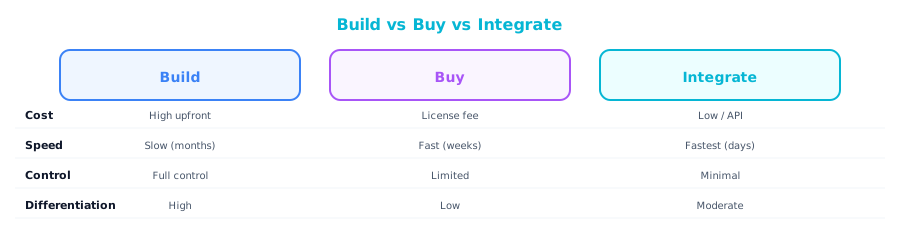
Before any competitive positioning discussion, you need to make a fundamental architectural decision: are you building the AI capability, buying a packaged AI product, or integrating an AI API into your own product? These are not technical decisions delegated to engineering. They have major product, commercial, and strategic implications that the PM needs to own.
Buying a Packaged AI Product
You purchase an AI-powered product from a vendor and use it as-is or with limited configuration. The vendor maintains the models, the infrastructure, the evaluation, and the quality. Your product integrates with or is replaced by theirs.
Best when: The capability is adjacent to but not central to your core value proposition. The vendor is clearly best-in-class and unlikely to be displaced. Data privacy requirements allow data to flow to the vendor. Your competitive differentiation does not depend on this capability.
Watch out for: Vendor lock-in that makes it hard to switch if the vendor's quality drops or pricing changes. The vendor becoming a competitor by expanding their product scope. Loss of product surface control that affects your user experience quality.
Integrating an AI API (Prompting)
You connect to a foundation model API and craft the prompts, instructions, and workflow logic that shape its outputs. The model provider maintains the underlying intelligence; you maintain the product layer on top of it.
Best when: You need the flexibility of a general-purpose model but with specific domain focus. Your differentiation is in how you present and integrate the AI output, not in the model's raw capability. You need to move fast and the prompting approach can achieve sufficient quality. Your data can flow to the provider or you are using retrieval to avoid sending sensitive data.
Watch out for: The API pricing and availability you do not control. The model provider's policy changes that affect what you can do. The risk that a competitor builds exactly the same prompting pattern and you have no differentiation below the product surface. The lack of specialization for your domain that a more targeted approach would provide.
Building Custom AI
You train, fine-tune, or develop AI models specifically for your use case. The model is yours, the training data is yours, and the specialization provides capability that generic models cannot match.
Best when: Your use case requires specialized capability that foundation models do not provide well. You have proprietary labeled data that represents a genuine advantage. The model's performance is central to your competitive differentiation and needs to be optimized continuously. You have the ML engineering resources to do this properly.
Watch out for: The cost and time of custom model development, often 3–5x the investment of prompting approaches. The ongoing maintenance burden of model versioning, retraining, and evaluation. The risk of falling behind foundation model capability improvements that happen faster than your custom development cycle.
The Decision Matrix
| Factor | Buy | Integrate API | Build Custom |
|---|---|---|---|
| Time to first value | Weeks | Weeks–months | Months–years |
| Ongoing cost | License fee (predictable) | Usage-based (scales with volume) | Infrastructure + ML team (fixed + variable) |
| Data control | Shared with vendor | Shared with provider | Fully owned |
| Quality control | Vendor-dependent | Prompt-layer control | Full control |
| Competitive differentiation | Low (competitors can buy same product) | Medium (depends on workflow integration) | High (if data asset is proprietary) |
| Switching cost | Medium–high | Low–medium | Very high |
| Best for | Adjacent capabilities | Core features with speed priority | Core differentiating features with data advantage |
A practical rule of thumb: start with Integrate API for most features. Move to Build Custom only when you have (1) a meaningful proprietary data advantage and (2) clear evidence that the API approach cannot reach your quality threshold. Use Buy for capabilities that are clearly commodity and where owning the capability does not serve your competitive strategy.
Evaluating AI Vendor Claims
When buying a packaged AI product or evaluating an AI API, you will encounter vendor claims that range from accurate to optimistic to technically misleading. As a PM, you need to evaluate these claims without necessarily having deep ML expertise. Here is how.
The Benchmark Question
Vendors love to cite benchmark scores. "Our model scores 92% on [industry benchmark]." Before accepting this as meaningful, ask:
Is the benchmark representative of your use case? Industry benchmarks are often designed for general capability, not for the specific task your feature performs. An LLM that scores well on general reasoning benchmarks may perform poorly on your specific domain documents.
Is the benchmark evaluation methodology sound? Some benchmarks are contaminated: the model was trained on data that overlaps with the test set. Ask how the benchmark was constructed and whether the vendor can demonstrate results on a fresh evaluation set.
What is the benchmark measuring? Accuracy on a balanced test set is different from accuracy on the long-tail edge cases your users will actually submit. Ask to see performance on adversarial or edge case examples.
The Demo Question
Vendor demos are, by definition, their best-case scenario. Ask these questions to stress-test demo results:
What data is the demo using? Is it carefully curated example data or production-representative data? Ask to see the demo on your own examples.
What fails? Ask the vendor explicitly: "Show me a case where this does not work well." A vendor who cannot show you failure modes has not tested their own product thoroughly. A vendor who shows you failure modes honestly and explains the mitigations is significantly more credible.
What's the latency in production? Demo environments are often not production-representative on latency. Ask for production latency percentiles (P50, P95, P99), not average latency.
The Reference Question
References are your best source of unfiltered signal. Ask for references specifically in your industry or use case. Ask references:
- What were the first 90 days like? Did quality meet expectations?
- What failure modes have you encountered in production that were not obvious in the demo?
- How has the vendor responded to quality issues?
- How has the product pricing evolved since you started?
- Knowing what you know now, would you make the same buy decision?
The answers to the last two questions in particular reveal vendor trustworthiness in ways that demos and benchmarks never will.
Moat Analysis: What's Defensible About Your AI Feature?
In traditional software, moats come from network effects, switching costs, brand, and distribution. In AI-powered features, those moats still apply, but there is an additional dimension: the AI quality advantage that accumulates from proprietary data and feedback loops.
The Four AI Moat Sources
Proprietary data. Your AI is trained on, retrieves from, or is fine-tuned with data that competitors do not have access to. This can be historical transaction data, user behavior data, proprietary document libraries, or labeled training data that you have invested significantly in creating. The key test: if a competitor deployed the same model architecture with different data, would they reach the same quality? If no, if your data genuinely encodes information that produces better outcomes, that is a real moat.
Feedback loops. Your AI improves as users interact with it, and that improvement compounds over time. Every correction a user makes to an AI output, every rating, every implicit signal of quality: if you are capturing and using that signal to improve the model, you are building a quality advantage that grows with usage. Competitors who start later start with less signal. This is the "data flywheel" and it is genuinely defensible when it works.
Workflow integration depth. Your AI is embedded in the workflow at a level of depth that would require significant switching costs to replicate. The AI knows the user's history, preferences, and context because it has been integrated with your CRM, your document repository, your communication tools. A competitor's AI starts from scratch. The integration is the moat, not the model.
Domain specialization. Your AI has been fine-tuned, prompted, or evaluated specifically for a domain where generic models underperform. You have invested in domain expert labeling, domain-specific evaluation criteria, and iterative quality improvement in a narrow area that is hard to replicate quickly. The moat is not the domain knowledge itself. Foundation models increasingly have broad domain knowledge. The moat is the evaluation infrastructure and quality standard you have built for the specific task.
The Moat Analysis Table
For your primary AI feature, fill out this table honestly:
| Moat Source | Do You Have It? | How Strong? | How Long to Replicate? |
|---|---|---|---|
| Proprietary data | Yes / Partial / No | Strong / Moderate / Weak | [Timeframe estimate] |
| Feedback loops | Yes / Planned / No | Strong / Moderate / Weak | [Timeframe estimate] |
| Workflow integration | Yes / Partial / No | Strong / Moderate / Weak | [Timeframe estimate] |
| Domain specialization | Yes / Partial / No | Strong / Moderate / Weak | [Timeframe estimate] |
A feature with no moats, one that any competitor could build to equivalent quality in 60 days using the same API, is not a competitive advantage. It is a feature parity play that might be necessary but should not consume disproportionate investment. A feature with strong moats in two or more categories is genuinely defensible and worth significant investment.
First-Mover vs. Fast-Follower in AI Features
The conventional wisdom in software is that first-mover advantage is real but often overstated. Distribution, execution, and resources matter more than who ships first. In AI features, this dynamic is more nuanced.
When First-Mover Matters More in AI
Feedback loop moats. If your feature benefits from a data flywheel, quality improves as more users interact with it, then being first gives you a real compounding advantage. Every month of production usage is a month of quality improvement that a later entrant does not have. The question is whether your feature has a feedback loop, not whether being first matters in general.
Trust establishment. Users' trust in AI features is partly a function of category experience. If your product is the first AI tool a user trusts for a specific category of task, you benefit from anchoring effects. Users develop mental models around your feature's behavior and compare subsequent competitors to you, not to their pre-AI baseline. This is a real advantage in high-trust domains (medical, legal, financial) where user skepticism is high.
Dataset creation window. In some domains, the training and evaluation data you can create early in the market is difficult for later entrants to replicate because the raw signal is time-bounded (historical conversations, historical market data, historical events). Being first means you have data that was created under conditions that no longer exist.
When Fast-Follower Wins in AI
Foundation model rapid improvement. The foundation models underlying most AI features are improving rapidly. A feature built on a less capable model in 2023 can be replicated and exceeded by a fast-follower who builds on a more capable 2025 model with less effort. First-mover advantage evaporates when the technology improvement rate is faster than the moat accumulation rate.
Learning from first-mover mistakes. Early AI feature launches are often cautious, under-featured, or calibrated for the wrong user segment. Fast-followers observe what works, what fails, and what users actually need, and can build a better version of the category without the exploratory investment. This is especially true in categories where user requirements are genuinely complex and take time to understand.
Avoiding adoption friction. First-movers in AI categories often face the hardest user education challenges. Users do not yet know how to use the category, what to expect, or how to integrate it into their workflow. Fast-followers enter when the category is established and users have been educated, partly by the first-mover's marketing and user support investment.
The Practical Implication
The relevant question is not "should we be first?" It is "will the moats we build as first-mover compound faster than our competitors can replicate them?" If the primary moat is a feedback loop and your feature will have meaningful scale within 12 months, being first matters. If the primary moat is workflow integration depth and your competitor has better distribution to the integration points, being second with better integration may be the stronger position.
Positioning When Everyone Uses the Same Model
If your feature and your competitor's feature both call the same foundation model API with similar prompts and produce similar outputs, the product differentiation has to come from elsewhere. Here are the four positioning strategies that work in this scenario:
Position on context depth. Your AI knows more about the user, the workflow, and the specific domain context because you have invested in the integration infrastructure that provides that context. "Our AI knows your CRM history, your product usage data, and your communication patterns. The competitor's AI only knows what you typed in today."
Position on reliability and safety. Many AI features are roughly equivalent in average-case quality. Differentiation comes from how they handle edge cases, adversarial inputs, and failure modes. If you have invested in robust evaluation, conservative outputs in high-stakes situations, and transparent uncertainty communication, you can position on trustworthiness rather than raw capability.
Position on workflow integration. The AI is a component of a workflow product, not a standalone tool. Your differentiation is that the AI output feeds directly into the next step of the user's work without a copy-paste journey, and that the workflow provides the feedback mechanism that makes the AI better over time.
Position on the human+AI combination. The feature is not a replacement for human judgment. It is a force multiplier for the expertise your users already have. Position on the quality of the human-AI collaboration your product enables, rather than on the AI's standalone capability.
Summary
The commodity trap is real: when foundation model APIs are equally available to all competitors, raw model capability is not a moat. Defensible AI competitive positioning comes from proprietary data, feedback loops, workflow integration depth, and domain specialization. These need to be analyzed honestly before committing to a feature.
The build-vs-buy-vs-integrate decision should follow a practical framework: start with API integration for speed, move to custom builds when proprietary data creates a genuine quality advantage, and buy packaged AI for capabilities that are adjacent rather than central. Vendor claims need to be stress-tested through representative benchmarks, honest failure-mode conversations, and reference checks.
First-mover advantage in AI is real when feedback loops compound quality over time. Fast-followers win when foundation model improvements outrun moat accumulation or when the first-mover's user education investment benefits the entire category. The most durable positioning strategy is building the context depth, workflow integration, and reliability standards that make your AI feature genuinely harder to replicate, regardless of which model is underneath it.