Chapter 09 of 15
AI Agents & Your Workforce
AI agents are already taking autonomous action in your business — and your employees are already asking whether AI is coming for their jobs. Here is how to govern agents before they govern you, and how to lead your workforce through the transition honestly.
Overview
The AI landscape shifted in late 2024 and accelerated through 2025. The shift was not a new model, a new chip, or a new company. It was a change in the fundamental mode of operation: AI stopped waiting to be asked and started taking action.
This is the transition from AI as a tool, you ask and it answers, to AI as an agent: it receives a goal, makes a plan, takes a sequence of actions, checks its own work, and continues until the goal is complete or it gets stuck.
At the same time, there is a question circulating in every break room, every Slack channel, and every one-on-one in your organization. People may not be asking their managers directly. But they are asking each other, asking the internet, and reading the headlines.
The question is: is this coming for me?
Your employees are not wrong to ask it. And you cannot answer the workforce question honestly without understanding what AI agents actually are and what they actually do. The two topics are inseparable: agents are the primary mechanism through which AI affects roles, workflows, and headcount. This chapter addresses both.
Part One: AI Agents
What an AI Agent Actually Is
An AI agent is an AI system that has been given:
- A goal or task expressed in natural language
- Access to tools — the ability to search the web, read files, send emails, call APIs, make purchases, or execute code
- A feedback loop — the ability to check whether its actions achieved the intended result and try again if they did not
The combination of these three elements produces a system that can pursue a multi-step objective without a human approving each step.
Think of it like this: Traditional AI is a very capable research intern. You give them a question, they write you a memo. That is it. An AI agent is an employee with a corporate card, email access, a login to your CRM, and instructions to "grow the enterprise pipeline in the Northeast by 15% this quarter." They will research prospects, send outreach emails, schedule meetings, update the CRM, and report back — and you will find out what they did when you check in.
Whether that sounds exciting or alarming depends on how well you have defined their scope of authority, their spending limits, and their escalation instructions. The technology is the same either way. The governance is what makes it safe or dangerous.
What Agents Can Do Today: Real Use Cases
The following are not experiments or pilot programs. They are in production at enterprise organizations in 2026.
Customer Operations
Tier-1 through Tier-2 support resolution: Agents handle the full resolution workflow — diagnose the issue, look up account history, process a refund or replacement, update the record, send a confirmation email, and close the ticket. Human agents see only escalated cases.
Proactive retention: An agent identifies customers showing churn indicators, drafts and sends personalized retention offers within defined parameters (discount ceiling, product category, customer segment), and logs outcomes. No human touches the workflow unless a customer responds with a complaint or a request outside the offer parameters.
Finance and Procurement
Invoice processing and exception routing: Agents match invoices to purchase orders, flag discrepancies, approve within pre-authorized tolerances, route exceptions to human approvers with a pre-drafted response, and update the ERP. End-to-end cycle time drops from days to hours.
Vendor monitoring: Agents monitor vendor news, credit ratings, delivery performance data, and contract compliance on an ongoing basis. When a risk threshold is crossed, they generate a briefing document and schedule a review meeting.
Legal and Compliance
Contract review and redline: Agents read incoming contracts, flag non-standard clauses against a pre-approved playbook, propose standard redlines, and draft the response to opposing counsel. A lawyer reviews and approves the output rather than starting from scratch.
Regulatory monitoring: Agents track regulatory developments across jurisdictions, map new requirements to existing policy documents, and flag gaps requiring human decision. One legal operations manager with an agent system can maintain coverage that previously required a team.
Sales and Marketing
Outbound research and personalization: Agents research target accounts, identify relevant trigger events (new funding, executive changes, product launches, regulatory changes), and draft personalized outreach. Sales reps review and send, or approve for automatic sending within defined parameters.
Campaign execution: Agents manage multi-channel campaigns — create variants, schedule sends, monitor performance, reallocate budget toward higher-performing variants, and produce weekly performance summaries with recommended adjustments.
The Governance Gap
Here is the problem: most organizations deploy agent capabilities before they build governance for agent capabilities.
This happens for understandable reasons. The tools are easy to activate. The early results look impressive. The productivity gains are real. The governance questions feel abstract until something goes wrong.
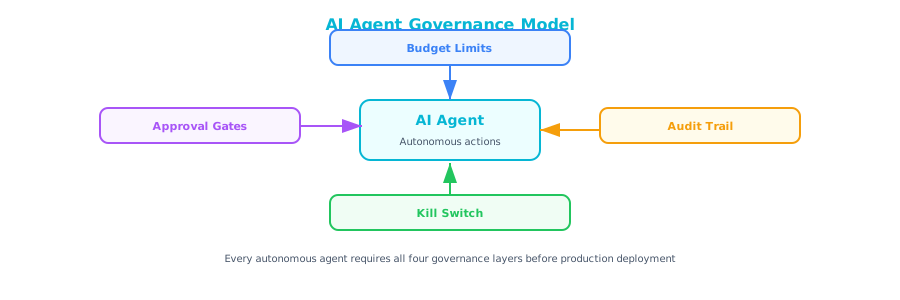
What goes wrong tends to fall into four categories.
1. Runaway Costs
Agents can trigger API calls, cloud compute, or third-party service charges at a rate no human operator would. An agent with a poorly defined termination condition — or one that enters a loop while trying to complete a failing task — can generate tens of thousands of dollars in compute or service costs overnight.
One company's sales prospecting agent, triggered by a misconfigured automation, sent 14,000 outbound emails over a weekend before anyone noticed. The cost was not just the compute — it was the brand damage and the CAN-SPAM compliance exposure.
Governance response: spending limits, rate limits, human approval thresholds, and mandatory monitoring alerts for unusual activity patterns.
2. Unauthorized Actions
An agent given broad tool access will use whatever tools are available to accomplish its goal, often in ways the designer did not anticipate. An agent told to "schedule a meeting with the prospect" that also has access to the company calendar may schedule meetings across executive calendars to find availability. An agent told to "follow up with overdue accounts" that has both email and SMS access will use both.
The gap between "what we intended" and "what we authorized" is where unauthorized actions live.
Governance response: Principle of least privilege applied to agent tool access. Explicit enumeration of permitted actions, not just goals. Regular audit of agent action logs.
3. Data Exposure
Agents that have access to multiple systems will, in pursuing their goals, move data between those systems in ways your data governance framework never contemplated. An agent doing competitive research that has external search access may inadvertently expose internal strategic documents in its queries.
Governance response: Data classification review before granting system access. Explicit data handling rules as part of agent instructions. Regular review of data flows created by agent activity.
4. Liability Without Accountability
When an AI agent takes an action that causes harm — sends incorrect information to a customer, makes a purchasing commitment that turns out to be unauthorized, files a document with a regulatory error — the question of accountability is unresolved in most organizations. The vendor will point to their terms of service, which typically disclaim liability for autonomous agent actions.
Governance response: Named human accountability for every agent deployment. Pre-deployment legal review for agents with external-facing or financial authority. Incident response plan established before go-live.
The Risk Spectrum
Not all agents are equal. Your governance approach should be calibrated to the risk level of the specific deployment.
| Risk Level | Characteristics | Example | Governance Requirement |
|---|---|---|---|
| Low | Read-only; internal only; no financial authority; easily reversible | Research agent summarizing internal reports | Basic monitoring, usage logging |
| Medium | Writes to internal systems; bounded financial authority; customer-facing communication | Invoice approval within pre-set limits; templated customer email | Human approval thresholds, spending caps, weekly audit |
| High | External financial commitments; customer-facing decisions; regulated domain | Contract redlining sent to counterparty; insurance claim processing | Legal review pre-deployment; human-in-the-loop for material actions; daily monitoring |
| Critical | Autonomous decisions with legal, financial, or safety consequences | Loan approval; medical triage; safety system control | Executive sign-off; continuous monitoring; mandatory human review; regulatory pre-clearance |
The Decision Framework: Should We Deploy an Agent?
Before approving any agentic AI deployment, work through this framework.
Step 1: Define the Goal and Scope
Write a single paragraph describing: what specific goal the agent is pursuing, what systems it will have access to, what actions it is permitted to take, what actions it is explicitly prohibited from taking, and what triggers a human escalation. If you cannot write this paragraph clearly, the deployment is not ready.
Step 2: Classify the Risk Level
Using the table above, assign a risk level. Be conservative. If you are uncertain between medium and high, choose high.
Step 3: Identify the Accountability Owner
Name the individual — not the team, the individual — who is accountable if the agent causes harm. This person should understand what the agent does, have the authority to suspend it immediately, and be reachable at any hour if needed.
Step 4: Define the Kill Switch
Every agent deployment needs a defined, tested mechanism for immediate suspension. This is not optional, and it is not the vendor's responsibility. Your team must be able to suspend any agent within 15 minutes of making the decision to do so.
Step 5: Set the Monitoring Threshold
Define the specific conditions that trigger human review: spending above $X per day, more than Y actions taken without a success confirmation, any action in category Z, any user complaint referencing the agent. These thresholds should be in a monitoring system that sends an alert.
Step 6: Plan the First 30 Days
All new agent deployments should run in a heightened observation period: daily review of agent action logs for the first two weeks, weekly review for weeks three and four, and an explicit go/no-go decision at day 30 before moving to standard monitoring.
The Governance Architecture: Minimum Viable Controls
You do not need a fifty-page policy document to govern agentic AI. You need five structural controls.
1. Agent Registry. A maintained list of all deployed agents: name, purpose, owner, access permissions, risk level, and review date. Reviewed quarterly.
2. Access Control Framework. Every agent deployment requires documented approval of its tool access from the system owner of each connected system. The agent should have the minimum access needed to accomplish its task.
3. Spending Guardrails. Any agent with direct or indirect financial authority must have a hard spending limit enforced at the infrastructure level, not just in instructions.
4. Audit Logging. Every action taken by every agent must be logged in a format that is searchable, attributable, and retained for a period consistent with your data retention policy.
5. Incident Response Plan. A documented, tested plan for what happens when an agent does something it should not have done: who is notified, who has authority to suspend, what customer/regulatory notification obligations are triggered, and how root cause analysis is conducted.
A Word on Multi-Agent Systems
The next evolution — already in deployment at larger organizations — is multi-agent systems: networks of agents that communicate with and delegate to each other. A managing agent breaks down a goal, assigns subtasks to specialized agents, collects their outputs, and synthesizes a result.
Multi-agent systems multiply the capability of agentic AI and multiply the governance complexity. When Agent A instructs Agent B to take an action that Agent B's owner did not anticipate, accountability becomes genuinely difficult to assign.
If your organization is evaluating or already running multi-agent architectures, the governance controls above are necessary but not sufficient. You additionally need: explicit definition of which agents are permitted to instruct which other agents, logging of inter-agent communications (not just end-actions), a single accountability owner for the orchestrating system, and escalation paths that work across the entire agent network.
How to Brief Your Board
When your board asks about agentic AI, and they will, the framing that serves you best is this: "Agentic AI is AI that takes action, not just answers. We are deploying it in [two or three specific areas]. We have established [specific governance controls]. The owner is [name]. The value case is [specific metric]. The risk controls are [specific]. We review this quarterly."
That is twelve sentences. It demonstrates that you are capturing the opportunity, that you understand the risks, and that someone accountable is watching. The alternative, "we are experimenting with AI agents across several initiatives," sounds like you do not know what you have deployed or who is responsible for it. Boards notice.
Part Two: AI and Your Workforce
What the Data Actually Shows
Researchers have been studying the labor market impact of AI since large language models went mainstream in 2022-2023. The results are more nuanced than either the catastrophist headlines or the "AI just creates new jobs" reassurances suggest.
The Tasks-Not-Jobs Framework
The most important finding from labor research in this period is that AI disrupts tasks more than it disrupts jobs. Most jobs contain a mix of tasks — some highly amenable to AI automation, some requiring human judgment, creativity, relationship management, or physical presence that AI cannot replicate.
Think of it like this: When ATMs were introduced in the 1970s, most economists predicted mass bank teller unemployment. Instead, the number of bank tellers increased over the following two decades. Why? Because ATMs lowered the cost of operating a branch, so banks opened more branches. And as the transaction-counting tasks shifted to machines, tellers shifted toward higher-value work — relationship management, financial advice, cross-selling. The job title stayed the same; the mix of tasks changed dramatically. AI is playing out a similar, though faster, version of this dynamic.
This does not mean zero displacement. It means that the disruption tends to look like: the same number of employees doing different work, a slower hiring pace for roles heavy in automatable tasks, and in some cases genuine reduction in headcount for roles where the task mix is almost entirely automatable.
Where the Risk Is Concentrated
Labor economists have identified task categories most amenable to AI disruption:
- Routine information processing: data entry, form processing, basic research, summarization, transcription
- Templated written communication: standard contracts, routine correspondence, report generation, basic content production
- Rule-based decision making: credit pre-screening, insurance triage, compliance checks against defined criteria
- Pattern recognition on structured data: fraud flags, quality inspection, predictive scoring
The jobs with the highest concentration of these tasks — which vary by industry but often include claims adjusters, paralegals, data analysts, customer service agents, and certain accounting roles — face the most meaningful disruption risk.
Where Humans Retain Strong Advantage
Conversely, AI remains weak in areas that require:
- Novel problem-solving: situations that do not fit patterns the model was trained on
- Stakeholder trust and relationship capital: a client who has worked with your VP for eight years is not going to accept being transferred to a chatbot for high-stakes conversations
- Ethical judgment under ambiguity: decisions that require weighing values, not just rules
- Physical dexterity and contextual judgment: most skilled trades and many healthcare functions
- Leadership and organizational change: getting humans to change behavior, which requires human understanding of human resistance
The Augmentation Data
The most robust finding across multiple studies is that workers who learn to use AI tools effectively become meaningfully more productive — and that this productivity gain does not automatically translate to headcount reduction. Organizations that redeploy freed capacity toward higher-value work end up with a more capable workforce doing more valuable things. Organizations that simply cut headcount equal to the efficiency gain often find they have eliminated the human judgment that was making the AI outputs usable.
Augmentation vs. Replacement: A Cleaner Framework
Rather than the binary "replaced or not," use a four-category framework for each role in your organization:
| Category | Description | Implication |
|---|---|---|
| Augmented | AI handles the routine portions; humans do more of the high-judgment work. Net employment roughly stable, but role composition changes significantly. | Reskilling investment required; role definitions need updating. |
| Elevated | AI handles the entry-level version of the work; human roles shift upmarket to more complex, strategic functions. Fewer junior positions; more senior ones. | Hiring profile shifts; pipeline development needed. |
| Compressed | AI enables the same output with meaningfully fewer people. Some attrition or redeployment required. | Attrition management strategy; honest communication; potential labor relations implications. |
| Resilient | Role requires capabilities AI cannot yet replicate. Limited near-term disruption risk. | Lower urgency; still worth monitoring. |
The value of this framework is that it forces specificity. "AI will augment our workforce" is a corporate communication. "These 12 roles are in the Augmented category, these 4 are in Compressed, and here is our plan for each" is a workforce strategy.
The Employee Communication Playbook
The most common mistake executives make in AI-related workforce communication is either saying nothing, letting anxiety fill the vacuum, or saying everything is fine, eroding trust when people can see it is not fully true.
The communication approach that maintains trust has four characteristics:
It is honest about uncertainty. Nobody knows exactly how fast AI will develop or exactly which roles will be affected most. Employees know this. Communicating certainty you do not have will destroy credibility faster than acknowledging you are navigating uncertainty alongside them.
It is specific about what you do know. Even in uncertainty, you know your current plans for AI deployment, your approach to retraining, and your commitment to handling any headcount changes humanely.
It is repeated, not once. A single all-hands message about AI and jobs will be forgotten or reinterpreted within two weeks. A rhythm of quarterly updates builds trust over time.
It offers agency. Employees who feel they have no control over what is happening to them experience the most anxiety. Communication that includes concrete things individuals can do — specific training programs, internal mobility paths, skills development opportunities — gives people a sense of agency that reduces anxiety even in genuinely uncertain situations.
For an all-hands or town hall:
- Acknowledge the question directly: "I know many of you are wondering what AI means for your jobs here. I want to give you the most honest answer I can."
- Share what you know: "We are deploying AI in [specific areas]. The honest impact in those areas is [description]. We expect [X] roles to change significantly in the next 18 months."
- Share your commitments: "We are committed to [specific retraining investment, specific timeline, specific internal mobility support]. No one will be surprised."
- Acknowledge what you do not know: "I cannot tell you with certainty what AI will look like in five years or exactly how every role will evolve. What I can tell you is how we will manage through that uncertainty together."
- Open the conversation: "I want to hear your questions and concerns directly."
For managers: Managers will be asked the questions their teams are afraid to ask leaders. Equip them with a clear brief on what the company is and is not deploying, explicit guidance on what they can and cannot promise about job security, a process for escalating concerns they cannot answer, and training on how to have these conversations without either dismissing concerns or amplifying anxiety.
The manager conversation is the most important communication lever you have. Invest in it.
The Change Management Architecture
Phase 1: Awareness and Assessment (Months 1-3)
- Complete the role-category analysis (Augmented / Elevated / Compressed / Resilient) for affected functions
- Share findings with relevant business leaders before any external communication
- Conduct listening sessions or surveys to understand employee concerns in affected areas
- Establish the internal communication rhythm
Phase 2: Skill Development (Months 3-18)
- Launch the retraining program for Augmented and Elevated roles
- Identify high-potential employees in Compressed roles and prioritize them for internal mobility programs
- Create visible success stories: employees who have moved into higher-value work enabled by AI
Phase 3: Structural Adjustment (As Required)
If Compressed roles result in headcount reduction:
- Voluntary attrition programs first. Offer voluntary separation packages before involuntary reductions. In most contexts, a meaningful portion of the natural attrition in Compressed roles will be filled by AI capacity, reducing the need for forced reductions.
- Generous transition support. Severance, extended benefits, outplacement, and skills development allowances signal organizational values to the employees who remain, not just those who leave.
- Honest attribution. If AI is the primary driver of a workforce reduction, say so. Employees and media will connect the dots anyway, and being caught not saying it destroys trust.
Phase 4: New Workforce Model (Ongoing)
- Update job descriptions, career pathways, and performance management to reflect new AI-augmented roles
- Build AI collaboration skills into the standard onboarding program
Legal Considerations Your HR Team Needs Now
AI-related workforce changes intersect with employment law in ways that are still evolving.
Algorithmic Employment Decisions
If AI is involved in decisions about hiring, performance evaluation, promotion, or termination — even as one input among many — you may have obligations under emerging algorithmic accountability laws. Several jurisdictions (including New York City, Colorado, Illinois, and the EU under the AI Act) already require disclosure, impact assessments, or employee notification when AI is used in consequential employment decisions.
Do not assume that using AI as a "recommendation tool" that humans approve insulates you from these requirements. The standard is evolving toward: if the AI output materially influences the decision, disclosure obligations may apply.
Disparate Impact
AI systems trained on historical data can perpetuate or amplify historical biases. If your AI-assisted performance management system recommends lower performance ratings for employees in a protected class, you may have disparate impact liability even if no human consciously discriminated. Conduct disparate impact analysis on any AI system involved in employment decisions before deployment and annually thereafter.
Collective Bargaining Obligations
If any portion of your workforce is covered by a collective bargaining agreement, the introduction of AI that materially changes the nature of the bargaining unit work is likely a mandatory subject of bargaining in most jurisdictions. Get labor relations counsel involved before deploying AI in unionized environments, not after.
Documentation and Record-Keeping
Maintain clear records of what AI systems are used in employment decisions, what training data was used, what bias testing was conducted, what human oversight was in place, and what outcomes resulted. This documentation is both a governance best practice and a legal defense posture.
The Metrics That Matter for Workforce Transition
| Metric | Why It Matters | Measurement Approach |
|---|---|---|
| Internal mobility rate | Are people in Compressed roles finding new paths internally? | Quarterly HR tracking |
| Retraining completion and application | Are employees developing AI skills AND using them? | Training completion + post-training productivity delta |
| Manager confidence score | Do managers feel equipped to lead through the transition? | Quarterly manager survey |
| Employee anxiety index | Is the communication program reducing or inflating uncertainty? | Pulse survey in affected functions |
| Voluntary attrition in AI-affected roles | Are you losing people you want to keep because of fear? | Monthly HR analysis; compare to non-affected roles |
| AI productivity delta by role category | Is augmentation actually producing output per person? | Quarterly, by role category |
What Leadership Owes the Workforce
There is a reasonable debate about how much disruption organizations owe their workforces protection from versus how much is simply the nature of competitive markets and technological change. Reasonable executives land in different places on that spectrum.
What is not debatable is this: the organizations that handle AI-driven workforce transitions honestly, specifically, and with genuine investment in their people emerge with more organizational capability, more employee trust, and more resilience than the organizations that handle it poorly.
The half-measure, vague reassurances followed by surprise restructurings, produces the worst of all outcomes: the harm of the restructuring plus the trust damage of the deception.
This principle applies equally to agent governance. The organizations that deploy agents carefully — with named owners, tested kill switches, and honest accounting of what the technology is doing — get the value of the productivity gains without the liability exposure of uncontrolled automation.
Whatever your organization's commitments are, make them explicitly, make them early, and keep them. In both agent governance and workforce management, the discipline is the same: understand what you have deployed, be honest about its effects, and be accountable for the outcomes.