Chapter 04 of 15
Making AI Investment Decisions
How much to spend, what it really costs, how to calculate ROI without being misled, and how to build an AI investment portfolio that balances quick wins with strategic bets.
Overview
The most common question executives ask when they start taking AI seriously is: "How much should we be spending?" It is a reasonable question with a frustrating answer: it depends, and most of the factors it depends on are not the ones most commonly cited.
The second most common question is: "What kind of return should we expect?" The honest answer is that the ROI frameworks most organizations use for AI investments are almost perfectly designed to mislead them.
This chapter addresses both questions head-on, with specific figures, honest caveats, and a framework for thinking about AI investment as a portfolio rather than a series of individual bets.
How Much Should We Spend on AI?
 Industry benchmarking on AI investment has become more reliable over the past two years as organizations move past early pilot spending into sustained programs. The following figures represent current market data for organizations with active AI programs (not those still in the evaluation phase).
As a percentage of total technology budget:
| Company Stage | Typical Range | High-Performing Range |
|---|---|---|
| Early stage (first AI initiatives) | 5-10% | 10-15% |
| Active program (2-4 deployed use cases) | 10-18% | 18-25% |
| Scaled program (5+ use cases in production) | 18-30% | 25-35% |
By industry sector (annual AI spend, companies with $1B+ revenue):
| Sector | Median Annual AI Investment | Range |
|---|---|---|
| Financial services | $45M | $12M - $200M+ |
| Healthcare and life sciences | $38M | $8M - $150M+ |
| Retail and consumer goods | $22M | $5M - $80M |
| Manufacturing | $18M | $4M - $70M |
| Professional services | $15M | $3M - $60M |
| Media and entertainment | $12M | $2M - $50M |
Important caveats on these figures:
First, they represent total AI-related investment, not just software licensing. They include personnel, infrastructure, data preparation, vendor fees, governance, and implementation costs. The software licensing component is typically 25-40% of the total.
Second, the "right" number for your organization has much more to do with the density of AI-addressable opportunity in your specific business than with these benchmarks. A financial services firm with poor data infrastructure may be better served by spending 50% of their AI budget on data before spending on AI systems. A manufacturing company with excellent operational data and clear efficiency opportunities may justify spending above benchmark.
Third, the most consistent finding across industry surveys is that organizations that spend below the lower end of these ranges tend to get fragmented results — they fund individual tools without the surrounding infrastructure and governance to make them work together. There is a minimum viable investment level below which AI programs typically produce pilots rather than value.
Total Cost of Ownership: It Is Not Just the API Bill
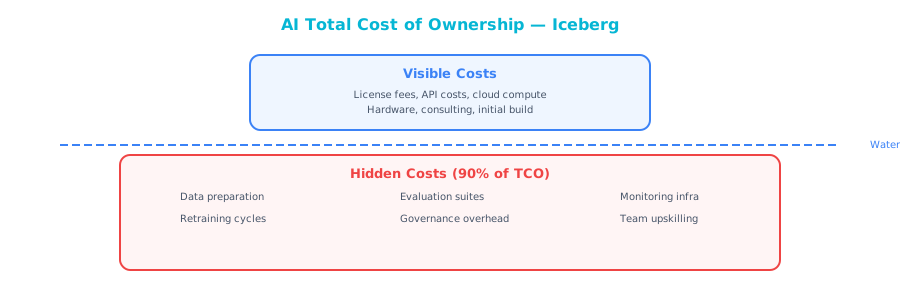
The most common error in AI budgeting is treating the vendor's subscription or API cost as the total cost. In practice, the vendor fee is typically 20-40% of actual total cost. Understanding the full cost picture before committing prevents the most common form of AI investment surprise.
Here is the full cost structure:
Direct Technology Costs
- Model/platform licensing: The vendor's annual contract or API usage fees. For a mid-size enterprise deployment, this typically ranges from $200K to $5M per year depending on scale and vendor.
- Cloud infrastructure: AI workloads require compute, storage, and networking capacity. For production AI systems, infrastructure costs often equal or exceed model licensing costs.
- Integration development: Connecting AI systems to your existing CRM, ERP, data warehouse, and other systems requires software development. This is a one-time cost with ongoing maintenance.
Data Costs
- Data preparation and cleaning: Before AI can use your data, it typically needs to be extracted, standardized, cleaned, and organized. This is frequently the largest underestimated cost in AI projects. Budget 30-50% of total project cost for data work in first-generation deployments.
- Data infrastructure: If your data is fragmented across systems that don't share a common structure, building the data layer that AI can access requires investment in data architecture.
- Ongoing data maintenance: Data quality degrades over time. Production AI systems require ongoing data monitoring and maintenance.
Human Costs
- Implementation resources: Either internal staff time (which has opportunity cost) or external consultants ($150-400/hour for qualified AI practitioners, depending on specialization).
- Evaluation and testing: Before and after deployment, someone needs to evaluate AI outputs for quality and accuracy. This is typically a permanent cost for systems that remain in production.
- Change management: Training users, managing workflow transitions, and driving adoption. Routinely underestimated. For enterprise-wide deployments, budget $500-1,500 per affected employee.
Ongoing Operational Costs
- Monitoring: Production AI systems require continuous monitoring for output quality, performance degradation, and anomalous behavior.
- Retraining and updates: As your business changes, AI systems need to be updated to reflect new information, new processes, and new requirements. This is not a one-time cost.
- Governance: Compliance review, audit trail maintenance, and governance processes have ongoing resource requirements.
Cost Components: What Most Companies Miss
| Cost Component | Typical Range (Annual) | What Most Companies Miss |
|---|---|---|
| Model/platform licensing | $200K - $5M | Usage-based pricing can scale unpredictably |
| Cloud infrastructure | $100K - $3M | Often starts small and grows significantly with usage |
| Data preparation (year 1) | $200K - $2M | Usually a one-time intensive cost, often the largest single item |
| Integration development | $150K - $1.5M (year 1) | Ongoing maintenance after initial build |
| Human evaluation/QA | $100K - $800K | Permanent cost; grows with deployment scope |
| Change management | $50K - $500K | Often not budgeted at all |
| Monitoring and operations | $75K - $400K | Scales with number of systems in production |
| Governance and compliance | $50K - $300K | Frequently omitted in early-stage budgets |
| Retraining and updates | $100K - $500K | Underestimated in year 2+ |
| Total Year 1 | $1M - $14M+ | Vendor fee typically represents 25-40% of this |
ROI Frameworks for AI (And Why Traditional ROI Calculations Mislead)
Traditional return-on-investment analysis works well for investments with predictable, linear cash flows — a piece of equipment that reduces labor cost by a measurable amount, or a marketing campaign with a measurable lift in conversion rate.
AI investments frequently violate the assumptions that make traditional ROI calculations reliable, in three specific ways.
The value is often non-linear. Traditional ROI assumes that doubling the investment roughly doubles the return. AI investments frequently have threshold effects. Below a certain level of capability or adoption, value is minimal. Above that threshold, value increases significantly. A fraud detection system that catches 40% of fraudulent transactions is worth much less than twice the value of one that catches 80%, because the remaining 20% represents the highest-volume, highest-damage incidents.
Many benefits are indirect or enabling. The most transformative AI investments create value by enabling something that itself creates value, rather than directly producing a measurable outcome. A data infrastructure investment may not produce direct ROI, but it may enable three subsequent AI initiatives that each produce significant ROI. Traditional ROI analysis cannot capture this attribution correctly.
The time horizon is longer than it appears. AI systems typically underperform expectations in the first six to twelve months as organizations work through data issues, adoption challenges, and refinement cycles. They then outperform expectations as the compound effects of improved data, refined models, and increased adoption accumulate. A traditional ROI analysis taken at the twelve-month mark will consistently produce pessimistic conclusions. The same analysis taken at the thirty-six-month mark may be significantly more positive.
A Better Framework: Value Zone Analysis
Rather than calculating a single ROI figure, evaluate AI investments across three value zones:
Zone 1: Direct efficiency value. This is the measurable reduction in cost or time. It is the most straightforward to calculate and should be estimated conservatively. If a system reduces claims processing time from eight hours to two hours, and you have a team of twenty claims processors at an average fully-loaded cost of $85,000 per year, the direct efficiency value is approximately $1.27M annually.
Zone 2: Quality and accuracy value. This is the measurable improvement in outcomes from better decisions or fewer errors. A fraud detection system that reduces fraud losses by $3.2M annually has $3.2M in quality value. A customer churn prediction system that enables your team to retain 15% more at-risk customers, worth $180K in annual revenue each, has a calculable value in retention improvement.
Zone 3: Strategic option value. This is the value of capabilities that enable future opportunities. It is the hardest to quantify but often the most significant. A customer data platform that enables personalization at scale may not produce measurable direct ROI for twelve months, but it creates the option to launch personalized products and services that competitors without that capability cannot match. Standard ROI frameworks do not capture this value.
The most defensible AI business cases quantify Zones 1 and 2 conservatively, acknowledge Zone 3 qualitatively without over-claiming, and build the investment case on the conservative figures alone. If Zone 1 and Zone 2 value alone does not justify the investment, Zone 3 optimism should not rescue the case.
The Portfolio Approach: Balancing Quick Wins With Strategic Bets
One of the most important structural decisions in AI investment strategy is portfolio balance. Organizations that invest only in quick wins — high-confidence, short-return-horizon initiatives — build tactical capability without strategic position. Organizations that invest only in long-horizon strategic bets run out of organizational patience before seeing results.
A balanced portfolio has investments across three categories:
Quick wins (return horizon: 3-6 months)
These are initiatives where the value case is clear, the data requirements are manageable, and the technology risk is low. Typical examples: document summarization for a specific workflow, customer support routing and classification, first-level report generation.
The purpose of quick wins is not primarily their individual ROI. It is to build organizational confidence in AI, demonstrate that investment produces results, and fund the more significant initiatives in the portfolio. Budget guidance: 30-40% of portfolio investment.
Strategic initiatives (return horizon: 12-24 months)
These are initiatives addressing significant business problems where AI creates material advantage. They require more data work, more organizational change, and more time to mature, but their potential value justifies the investment.
Typical examples: predictive customer churn models at scale, AI-enhanced underwriting or pricing, intelligent supply chain optimization, AI-assisted new product development.
Budget guidance: 40-50% of portfolio investment.
Capability investments (return horizon: 24-36 months)
These are the investments that create the foundation for future AI advantage — data infrastructure, machine learning platforms, governance frameworks, and AI talent development. They produce no direct business value in the near term but are the prerequisite for everything else in the portfolio operating at its potential.
Budget guidance: 15-25% of portfolio investment.
Think of it like this: A commercial real estate developer balancing their portfolio holds a mix of properties: income-generating assets providing current cash flow, development projects in progress that will generate returns in 18-24 months, and land holdings that represent long-term option value. An organization that held only development projects would run out of cash. One that held only income-generating assets would fail to grow. AI investment works the same way. The three categories — quick wins, strategic initiatives, and capability investments — are the equivalent of income properties, development projects, and land holdings.
The Budget Conversation You Need to Have
The most common point of failure in AI investment decisions is not the size of the budget — it is the absence of a clear accountability structure for the money being spent.
Before any AI investment is approved, three commitments should be on record:
A named business owner. Not a technology owner. A business executive who is accountable for the business outcome, and whose performance evaluation will reflect whether the outcome was achieved.
A value commitment. A specific, measurable statement of what the investment is expected to deliver, expressed in business metrics and dollar figures, by a specific date. For example: "We expect this initiative to reduce claims processing cost by $1.4M by Q3 of next year, measured by average cost per claim processed."
A stage-gate structure. Large AI investments should not be approved all at once. A stage-gate structure releases funding in tranches contingent on hitting defined milestones. If Phase 1, typically a data assessment and pilot, does not demonstrate that the value hypothesis is credible, Phase 2 funding is not released. This structure is standard in R&D and product development investment and should be applied to AI with the same rigor.
These three commitments do not make AI investments risk-free. But they create the accountability architecture that distinguishes organizations that extract value from AI from those that fund vendor case studies.
A Practical Budget-Sizing Framework
If you need to arrive at a budget figure before detailed initiative scoping is complete, this framework provides a reasonable starting point.
- Identify your top three AI opportunity areas from your strategy canvas.
- For each, estimate: what would it be worth to us if this initiative succeeded completely? Use conservative, back-of-envelope figures.
- Sum those three figures. Call it your addressable value pool.
- A defensible AI investment to capture that value is typically 15-25% of the addressable value pool in Year 1, declining to 8-15% as a steady-state annual spend once systems are in production.
Example: A mid-size logistics company identifies three AI opportunities:
- Automated freight pricing optimization: estimated value $4.2M annually
- Predictive equipment maintenance: estimated value $2.8M annually
- Customer service automation: estimated value $1.1M annually
Total addressable value pool: $8.1M
Defensible Year 1 investment: $1.2M - $2M
This is a rough sizing tool, not a substitute for detailed business case development. But it provides a sanity check against budgets that are either too small to produce results or disproportionately large relative to the value opportunity.
When Not to Invest
The discipline of AI investment strategy includes knowing when not to invest. These are the indicators that the timing is wrong or the investment is unlikely to produce value:
- Your data infrastructure is fundamentally inadequate and has no funded remediation plan. AI systems cannot outperform their data.
- Your organization has active, urgent priorities competing for the same leadership attention AI would require. Distracted sponsorship is a consistent predictor of failure.
- You are evaluating AI because a competitor announced something, with no independent analysis of whether that announcement reflects a genuine strategic threat.
- The total cost of ownership, honestly calculated, produces a payback period that does not meet your standard capital investment threshold.
- The initiative requires your organization to adopt AI and solve a significant change management challenge simultaneously. Phasing change reduces risk.
Saying "not yet" or "not this way" when the evidence warrants it is not a failure of ambition. It is the discipline that makes the investments you do make more likely to produce results.