Chapter 09 of 20
Data Quality for Knowledge Graphs
You have 50,000 nodes. Are they right? This chapter covers the six quality failure categories, automated checks for orphans and duplicates and type violations, semantic consistency rules, document coverage metrics, human review sampling strategies, drift monitoring, and a complete validation pipeline you can run after every ingestion batch.
Overview
Your knowledge graph has 50,000 nodes. How do you know they are correct? This chapter gives you the checks, metrics, and workflows to find out.
01. Why Graph Quality Is Different
In a relational database, the schema enforces correctness. NOT NULL constraints prevent empty required fields. Foreign keys prevent orphaned records. The database itself rejects a lot of bad data before it lands.
Graphs are different. There are no foreign keys: any node can connect to any other node. There is no NOT NULL constraint by default. A node can have any combination of properties. The most dangerous quality problems are not missing data but wrong relationships. A Person node connected by WORKS_AT to a Document node instead of an Organization node is syntactically valid — Neo4j accepts it without complaint. It is semantically wrong, and no automatic check will catch it unless you write one.
Testing a relational database is like proofreading a form: check that required fields are filled in and that dates look like dates. Testing a knowledge graph is like fact-checking a newspaper article: you need to verify not just that names and dates are present, but that the statements connecting them are true. "John Smith approved the vendor contract" is a claim. You need a way to verify it.
02. The Six Categories of Graph Quality Issues
Every quality problem in a knowledge graph falls into one of six categories:
| Category | What It Means | Example | Detection Difficulty |
|---|---|---|---|
| Orphan nodes | Nodes with no relationships | A Person node floating alone | Easy — simple query |
| Duplicate entities | Same real-world thing as multiple nodes | "IBM" and "International Business Machines" | Medium — requires fuzzy matching |
| Type violations | Relationships between wrong node types | Person -[:WORKS_AT]-> Document | Easy — schema check |
| Missing relationships | Entities that should be connected but are not | Two people from same department, not linked | Hard — requires domain knowledge |
| Incorrect relationships | Wrong relationship type or direction | MANAGES going from employee to manager | Hard — requires validation data |
| Stale data | Information that was true but no longer is | Former employee still shown as active | Medium — requires temporal checks |
03. Automated Quality Checks
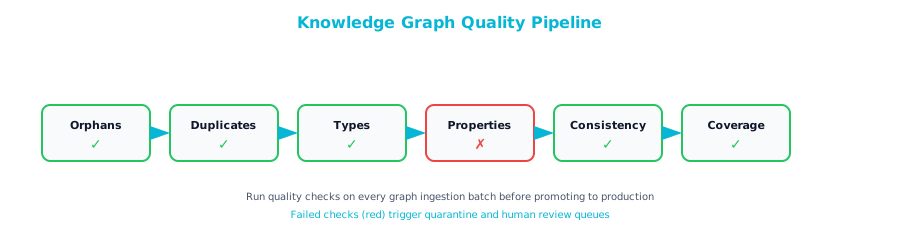
These checks can run automatically after every extraction batch. They catch the most common problems and serve as the first line of defense.
Check 1: Orphan Nodes
Nodes with no relationships are almost always errors. In a knowledge graph built from documents, every entity should connect to at least one other entity or to a source document node.
// Find all orphan nodes
MATCH (n)
WHERE NOT (n)--()
RETURN labels(n)[0] AS type,
       n.name AS name,
       n.source AS source
ORDER BY type, name

// Count orphans by type
MATCH (n)
WHERE NOT (n)--()
RETURN labels(n)[0] AS type, count(n) AS orphan_count
ORDER BY orphan_count DESC
Threshold: fewer than 5% of nodes should be orphans. If you see more, the extraction pipeline is creating entities without capturing their relationships.
Check 2: Duplicate Entities
// Find potential duplicates by normalized name
MATCH (a), (b)
WHERE id(a) < id(b)
  AND labels(a) = labels(b)
  AND toLower(trim(a.name)) = toLower(trim(b.name))
RETURN labels(a)[0] AS type,
       a.name AS name_a,
       b.name AS name_b,
       count{(a)--()} AS rels_a,
       count{(b)--()} AS rels_b

// Find near-duplicates using string similarity
MATCH (a:Organization), (b:Organization)
WHERE id(a) < id(b)
  AND apoc.text.levenshteinSimilarity(
        toLower(a.name), toLower(b.name)
      ) > 0.85
RETURN a.name, b.name,
       apoc.text.levenshteinSimilarity(
         toLower(a.name), toLower(b.name)
       ) AS similarity
ORDER BY similarity DESC
Check 3: Type Violations
These are relationships that connect node types the ontology says should not be connected. This check requires the ontology definition from Chapter 8.
from neo4j import GraphDatabase

driver = GraphDatabase.driver(
    "bolt://localhost:7687",
    auth=("neo4j", "password")
)

# Define valid relationship endpoints
VALID_RELATIONSHIPS = {
    "WORKS_AT": {
        "from": ["Person"],
        "to": ["Organization"]
    },
    "SUPPLIES": {
        "from": ["Organization"],
        "to": ["Component", "Product"]
    },
    "APPROVED_BY": {
        "from": ["Document", "Component"],
        "to": ["Person"]
    },
    "MANAGES": {
        "from": ["Person"],
        "to": ["Person", "Organization", "Component"]
    },
    "REFERENCES": {
        "from": ["Document"],
        "to": ["Document", "Regulation"]
    },
    "LOCATED_IN": {
        "from": ["Organization", "Person", "Event"],
        "to": ["Location"]
    },
    "COMPLIES_WITH": {
        "from": ["Component", "Organization"],
        "to": ["Regulation"]
    }
}


def check_type_violations() -> list[dict]:
    """Find relationships connecting wrong node types."""
    violations = []

    with driver.session() as session:
        for rel_type, rules in VALID_RELATIONSHIPS.items():
            valid_from = rules["from"]
            valid_to = rules["to"]

            from_check = " OR ".join(
                f"'{t}' IN labels(a)" for t in valid_from
            )
            to_check = " OR ".join(
                f"'{t}' IN labels(b)" for t in valid_to
            )

            result = session.run(f"""
                MATCH (a)-[r:{rel_type}]->(b)
                WHERE NOT ({from_check})
                   OR NOT ({to_check})
                RETURN a.name AS source,
                       labels(a)[0] AS source_type,
                       type(r) AS rel,
                       b.name AS target,
                       labels(b)[0] AS target_type
                LIMIT 100
            """)

            for record in result:
                violations.append({
                    "relationship": rel_type,
                    "source": f"{record['source']} "
                             f"({record['source_type']})",
                    "target": f"{record['target']} "
                             f"({record['target_type']})",
                    "expected_from": valid_from,
                    "expected_to": valid_to
                })

    return violations
Check 4: Property Completeness
Nodes missing critical properties are less useful in queries and often indicate extraction problems.
// Persons without a name (should never happen)
MATCH (p:Person)
WHERE p.name IS NULL OR trim(p.name) = ''
RETURN p, labels(p), keys(p)

// Documents without a source reference
MATCH (d:Document)
WHERE d.source IS NULL
RETURN d.name

// Count property completeness by node type
MATCH (n:Person)
RETURN
  count(n) AS total,
  count(n.name) AS has_name,
  count(n.title) AS has_title,
  count(n.email) AS has_email,
  count(n.department) AS has_department
Check 5: Relationship Direction
Some relationship types only make sense in one direction. REPORTS_TO should go from employee to manager, not from manager to employee.
// Find suspiciously bidirectional relationships
// (same type in both directions between same nodes)
MATCH (a)-[r1:REPORTS_TO]->(b)-[r2:REPORTS_TO]->(a)
RETURN a.name, b.name

// Find self-referential relationships
MATCH (n)-[r]->(n)
RETURN n.name, labels(n)[0] AS type, type(r) AS rel_type
04. Consistency Validation
Automated checks catch structural problems. Consistency validation catches logical problems: relationships that are structurally valid but do not make sense in context.
Semantic Consistency Rules
Define rules that encode domain knowledge:
CONSISTENCY_RULES = [
    {
        "name": "person_works_at_one_org",
        "description": "A person should WORKS_AT at most 2 "
                       "organizations (current + maybe previous)",
        "query": """
            MATCH (p:Person)-[:WORKS_AT]->(o:Organization)
            WITH p, count(o) AS org_count
            WHERE org_count > 2
            RETURN p.name, org_count
        """,
        "severity": "warning"
    },
    {
        "name": "no_circular_reporting",
        "description": "REPORTS_TO chains should not form cycles",
        "query": """
            MATCH path = (p:Person)-[:REPORTS_TO*2..10]->(p)
            RETURN [n IN nodes(path) | n.name] AS cycle
            LIMIT 10
        """,
        "severity": "error"
    },
    {
        "name": "documents_have_dates",
        "description": "Contracts and policies should have dates",
        "query": """
            MATCH (d:Document)
            WHERE d.doc_type IN ['contract', 'policy']
              AND d.effective_date IS NULL
            RETURN d.name, d.doc_type
        """,
        "severity": "warning"
    },
    {
        "name": "vendor_has_contract",
        "description": "Organizations marked as vendors should "
                       "have at least one contract relationship",
        "query": """
            MATCH (o:Organization)
            WHERE o.org_type = 'vendor'
              AND NOT (o)-[:BOUND_BY|CONTRACTED_WITH]->(:Document)
            RETURN o.name
        """,
        "severity": "warning"
    },
    {
        "name": "approval_has_approver",
        "description": "Documents with status 'approved' should "
                       "have an APPROVED_BY relationship",
        "query": """
            MATCH (d:Document)
            WHERE d.status = 'approved'
              AND NOT (d)-[:APPROVED_BY]->(:Person)
            RETURN d.name
        """,
        "severity": "error"
    }
]


def run_consistency_checks(
    rules: list[dict]
) -> list[dict]:
    """Run all consistency rules and collect violations."""
    results = []

    with driver.session() as session:
        for rule in rules:
            result = session.run(rule["query"])
            records = list(result)

            if records:
                results.append({
                    "rule": rule["name"],
                    "description": rule["description"],
                    "severity": rule["severity"],
                    "violation_count": len(records),
                    "sample": [dict(r) for r in records[:5]]
                })

    return results
05. Coverage Metrics
Coverage answers the question: what percentage of the information in your source documents is represented in the graph? High entity counts mean nothing if half your documents were skipped or only partially extracted. Coverage is the check that catches silent pipeline failures.
Document Coverage
def check_document_coverage(
    source_files: list[str]
) -> dict:
    """Check what percentage of source documents are in the graph."""
    with driver.session() as session:
        # Get all source references from the graph
        result = session.run("""
            MATCH (n)
            WHERE n.source IS NOT NULL
            RETURN DISTINCT n.source AS source
        """)
        graph_sources = {r["source"] for r in result}

    file_names = {Path(f).name for f in source_files}
    covered = file_names & graph_sources
    missing = file_names - graph_sources

    return {
        "total_documents": len(file_names),
        "covered": len(covered),
        "missing": len(missing),
        "coverage_pct": round(
            len(covered) / len(file_names) * 100, 1
        ) if file_names else 0,
        "missing_files": sorted(missing)[:20]
    }
Entity Density
How many entities per document? Too few suggests under-extraction. Too many suggests hallucination or spurious entities.
// Entity density by source document
MATCH (n)
WHERE n.source IS NOT NULL
RETURN n.source AS document,
       count(n) AS entity_count,
       count(DISTINCT labels(n)[0]) AS type_count
ORDER BY entity_count DESC
Expected ranges:
| Document Type | Entities per Page | Below This = Under-extraction |
|---|---|---|
| Contracts | 5-15 | < 3 |
| Policy documents | 3-10 | < 2 |
| Technical specifications | 8-20 | < 5 |
| Incident reports | 4-12 | < 3 |
| Meeting minutes | 6-15 | < 4 |
Relationship Density
The ratio of relationships to entities should generally fall between 1.0 and 3.0. Below 1.0, most nodes are islands. Above 3.0, the extraction may be creating spurious connections.
// Overall relationship-to-entity ratio
MATCH (n)
WITH count(n) AS nodes
MATCH ()-[r]->()
WITH nodes, count(r) AS rels
RETURN nodes, rels,
       round(toFloat(rels) / nodes * 100) / 100 AS ratio
06. Human Review Workflows
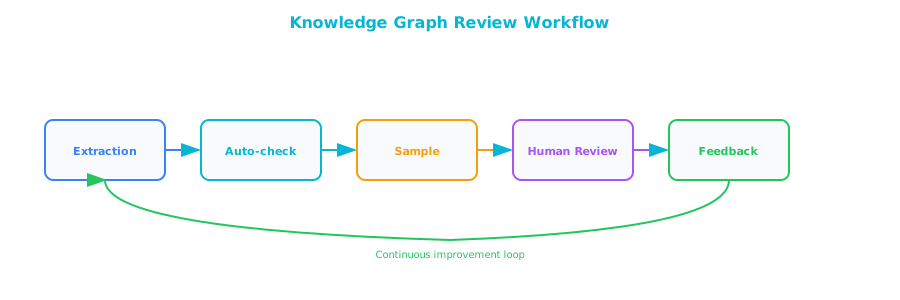
Automated checks catch structural problems. Humans catch meaning problems. Both are necessary — automated checks are fast, human review is accurate, and you need both.
Sampling Strategy
You cannot review every extraction. Sample strategically to get the most signal per reviewer-hour:
- Random sample — 5% of all extractions, reviewed for general accuracy.
- Low-confidence sample — extractions where the LLM expressed uncertainty (if you capture confidence scores).
- High-impact sample — entities and relationships that appear in the most queries or dashboards.
- Edge-case sample — extractions from document types that are rare or unusual.
def sample_for_review(
    sample_size: int = 50
) -> list[dict]:
    """Pull a stratified sample of entities for human review."""
    samples = []

    with driver.session() as session:
        # Random sample
        result = session.run("""
            MATCH (n)
            WHERE n.source IS NOT NULL
            WITH n, rand() AS r
            ORDER BY r
            LIMIT $limit
            RETURN n.name AS name,
                   labels(n)[0] AS type,
                   n.source AS source,
                   properties(n) AS props,
                   [(n)-[rel]-(m) |
                    {rel: type(rel), target: m.name,
                     target_type: labels(m)[0]}
                   ] AS relationships
        """, limit=sample_size // 2)
        for record in result:
            samples.append({
                "sample_type": "random",
                **dict(record)
            })

        # High-connectivity sample (most connected nodes)
        result = session.run("""
            MATCH (n)
            WITH n, count{(n)--()} AS degree
            ORDER BY degree DESC
            LIMIT $limit
            RETURN n.name AS name,
                   labels(n)[0] AS type,
                   n.source AS source,
                   degree,
                   properties(n) AS props
        """, limit=sample_size // 2)
        for record in result:
            samples.append({
                "sample_type": "high_connectivity",
                **dict(record)
            })

    return samples
Review Interface
A review does not need a complex UI. A spreadsheet with these columns works:
| Column | Purpose |
|---|---|
| Entity Name | The extracted entity |
| Entity Type | The assigned label |
| Source Document | Where it came from |
| Source Text Snippet | The chunk it was extracted from |
| Correct? (Y/N) | Reviewer's judgment |
| Corrected Name | If the name is wrong |
| Corrected Type | If the type is wrong |
| Notes | Additional context |
Feedback Loop
Review results should feed back into the pipeline:
def apply_review_corrections(corrections: list[dict]):
    """Apply human review corrections to the graph."""
    with driver.session() as session:
        for correction in corrections:
            if not correction.get("correct"):
                if correction.get("action") == "delete":
                    # Remove hallucinated entity
                    session.run("""
                        MATCH (n {name: $name})
                        WHERE $type IN labels(n)
                        DETACH DELETE n
                    """,
                        name=correction["entity_name"],
                        type=correction["entity_type"]
                    )
                elif correction.get("corrected_name"):
                    # Fix entity name
                    session.run("""
                        MATCH (n {name: $old_name})
                        WHERE $type IN labels(n)
                        SET n.name = $new_name
                    """,
                        old_name=correction["entity_name"],
                        type=correction["entity_type"],
                        new_name=correction["corrected_name"]
                    )
                elif correction.get("corrected_type"):
                    # Fix entity type (requires APOC)
                    session.run("""
                        MATCH (n {name: $name})
                        WHERE $old_type IN labels(n)
                        REMOVE n:$old_type
                        SET n:$new_type
                    """,
                        name=correction["entity_name"],
                        old_type=correction["entity_type"],
                        new_type=correction["corrected_type"]
                    )
07. Continuous Quality Monitoring
Quality is not a one-time check. As new documents are ingested and the graph grows, quality drifts. Monitor continuously to catch problems before they compound.
Quality Dashboard Metrics
Track these metrics over time:
def collect_quality_metrics() -> dict:
    """Collect all quality metrics for monitoring."""
    with driver.session() as session:
        metrics = {}

        # Total counts
        result = session.run(
            "MATCH (n) RETURN count(n) AS nodes"
        )
        metrics["total_nodes"] = result.single()["nodes"]

        result = session.run(
            "MATCH ()-[r]->() RETURN count(r) AS rels"
        )
        metrics["total_relationships"] = result.single()["rels"]

        # Orphan rate
        result = session.run("""
            MATCH (n) WHERE NOT (n)--()
            RETURN count(n) AS orphans
        """)
        orphans = result.single()["orphans"]
        metrics["orphan_count"] = orphans
        metrics["orphan_rate"] = round(
            orphans / max(metrics["total_nodes"], 1) * 100, 2
        )

        # Relationship-to-node ratio
        metrics["rel_node_ratio"] = round(
            metrics["total_relationships"] /
            max(metrics["total_nodes"], 1), 2
        )

        # Duplicate candidate count
        result = session.run("""
            MATCH (a), (b)
            WHERE id(a) < id(b)
              AND labels(a) = labels(b)
              AND toLower(trim(a.name)) = toLower(trim(b.name))
            RETURN count(*) AS dupes
        """)
        metrics["exact_duplicate_pairs"] = result.single()["dupes"]

        # Nodes by type
        result = session.run("""
            MATCH (n)
            RETURN labels(n)[0] AS type, count(n) AS count
            ORDER BY count DESC
        """)
        metrics["nodes_by_type"] = {
            r["type"]: r["count"] for r in result
        }

        # Relationships by type
        result = session.run("""
            MATCH ()-[r]->()
            RETURN type(r) AS type, count(r) AS count
            ORDER BY count DESC
        """)
        metrics["rels_by_type"] = {
            r["type"]: r["count"] for r in result
        }

        return metrics
Drift Detection
Compare current metrics against a baseline to catch degradation:
import json
from pathlib import Path
from datetime import datetime

METRICS_LOG = "quality_metrics_log.json"

def log_and_check_drift(
    current: dict,
    drift_threshold: float = 0.2
) -> list[str]:
    """Log metrics and alert on significant drift."""
    alerts = []

    # Load previous metrics
    log_path = Path(METRICS_LOG)
    if log_path.exists():
        with open(log_path) as f:
            history = json.load(f)
    else:
        history = []

    if history:
        previous = history[-1]["metrics"]

        # Check orphan rate drift
        if (current["orphan_rate"] >
                previous["orphan_rate"] * (1 + drift_threshold)):
            alerts.append(
                f"Orphan rate increased from "
                f"{previous['orphan_rate']}% to "
                f"{current['orphan_rate']}%"
            )

        # Check ratio drift
        prev_ratio = previous.get("rel_node_ratio", 1.0)
        curr_ratio = current["rel_node_ratio"]
        if abs(curr_ratio - prev_ratio) / max(prev_ratio, 0.1) > \
                drift_threshold:
            alerts.append(
                f"Rel/node ratio changed from "
                f"{prev_ratio} to {curr_ratio}"
            )

        # Check duplicate growth
        prev_dupes = previous.get("exact_duplicate_pairs", 0)
        curr_dupes = current["exact_duplicate_pairs"]
        if curr_dupes > prev_dupes + 10:
            alerts.append(
                f"Duplicate pairs grew from "
                f"{prev_dupes} to {curr_dupes}"
            )

    # Log current
    history.append({
        "timestamp": datetime.now().isoformat(),
        "metrics": current
    })
    with open(log_path, "w") as f:
        json.dump(history, f, indent=2)

    return alerts
08. The Complete Validation Pipeline
Here is the full pipeline that ties all checks together:
def run_full_validation(
    source_files: list[str] = None,
    ontology: dict = None
) -> dict:
    """Run the complete quality validation pipeline."""
    report = {
        "timestamp": datetime.now().isoformat(),
        "checks": {}
    }

    # 1. Collect basic metrics
    metrics = collect_quality_metrics()
    report["metrics"] = metrics
    print(f"Graph: {metrics['total_nodes']} nodes, "
          f"{metrics['total_relationships']} relationships")

    # 2. Check orphan nodes
    with driver.session() as session:
        result = session.run("""
            MATCH (n) WHERE NOT (n)--()
            RETURN labels(n)[0] AS type, count(n) AS count
        """)
        orphans = {r["type"]: r["count"] for r in result}
    report["checks"]["orphans"] = {
        "status": "pass" if metrics["orphan_rate"] < 5 else "fail",
        "orphan_rate": metrics["orphan_rate"],
        "by_type": orphans
    }
    print(f"Orphan rate: {metrics['orphan_rate']}% "
          f"({'PASS' if metrics['orphan_rate'] < 5 else 'FAIL'})")

    # 3. Check duplicates
    report["checks"]["duplicates"] = {
        "status": "pass" if metrics["exact_duplicate_pairs"] == 0
                  else "warn",
        "count": metrics["exact_duplicate_pairs"]
    }
    print(f"Duplicate pairs: {metrics['exact_duplicate_pairs']}")

    # 4. Type violations (if ontology provided)
    if ontology:
        from chapter08 import validate_schema
        violations = validate_schema(ontology)
        errors = [v for v in violations if v["severity"] == "error"]
        report["checks"]["type_violations"] = {
            "status": "pass" if not errors else "fail",
            "violations": violations
        }
        print(f"Schema violations: {len(violations)} "
              f"({len(errors)} errors)")

    # 5. Consistency rules
    consistency = run_consistency_checks(CONSISTENCY_RULES)
    errors = [c for c in consistency if c["severity"] == "error"]
    report["checks"]["consistency"] = {
        "status": "pass" if not errors else "fail",
        "issues": consistency
    }
    print(f"Consistency issues: {len(consistency)} "
          f"({len(errors)} errors)")

    # 6. Document coverage (if source files provided)
    if source_files:
        coverage = check_document_coverage(source_files)
        report["checks"]["coverage"] = {
            "status": "pass" if coverage["coverage_pct"] > 95
                      else "warn",
            **coverage
        }
        print(f"Document coverage: {coverage['coverage_pct']}%")

    # 7. Drift detection
    alerts = log_and_check_drift(metrics)
    if alerts:
        report["checks"]["drift"] = {
            "status": "warn",
            "alerts": alerts
        }
        for alert in alerts:
            print(f"DRIFT ALERT: {alert}")

    # Summary
    failed = [k for k, v in report["checks"].items()
              if v.get("status") == "fail"]
    warned = [k for k, v in report["checks"].items()
              if v.get("status") == "warn"]

    print(f"\nSummary: {len(failed)} failed, "
          f"{len(warned)} warnings, "
          f"{len(report['checks']) - len(failed) - len(warned)} "
          f"passed")

    return report
09. Quality Metrics Reference
| Metric | What It Measures | Green | Yellow | Red |
|---|---|---|---|---|
| Orphan node rate | % of nodes with no relationships | < 5% | 5-15% | > 15% |
| Exact duplicate rate | % of nodes with exact name matches | 0% | < 2% | > 2% |
| Near-duplicate candidates | Node pairs with > 85% name similarity | < 10 pairs | 10-50 | > 50 |
| Type violation count | Relationships between wrong node types | 0 | 1-5 | > 5 |
| Relationship-to-node ratio | Average relationships per node | 1.0-3.0 | 0.5-1.0 or 3.0-5.0 | < 0.5 or > 5.0 |
| Document coverage | % of source docs represented in graph | > 95% | 80-95% | < 80% |
| Property completeness | % of required properties populated | > 90% | 70-90% | < 70% |
| Self-referential relationships | Nodes connected to themselves | 0 | 1-3 | > 3 |
| Bidirectional duplicates | Same relationship in both directions | 0 | 1-5 | > 5 |
| Consistency rule violations | Failed semantic consistency checks | 0 errors | warnings only | errors present |
10. Chapter Checklist
Before moving to the next chapter, make sure you can answer these questions:
- Can you list the six categories of graph quality issues?
- Can you write Cypher queries to detect orphan nodes, duplicates, and type violations?
- Can you define consistency rules specific to your domain?
- Can you calculate document coverage and entity density metrics?
- Can you design a sampling strategy for human review?
- Can you set up continuous quality monitoring with drift detection?
With a quality foundation in place, the next part of the book explores how to use your knowledge graph to power AI systems. The first topic is GraphRAG, which combines graph traversal with retrieval-augmented generation.