Chapter 17 of 18
Capstone 4: AI-Powered Sprint Assistant
Planning poker drags on for an hour. Standup blockers get noted and forgotten. Retrospective action items live in a doc nobody reopens. This capstone builds a sprint assistant that automates the analytical grunt work — estimation, blocker detection, retro clustering, dependency mapping — so the actual conversations get better.
Part 5 — Capstones
Capstone 4: AI-Powered Sprint Assistant
Planning poker drags on. Standup blockers get noted and forgotten. Retrospective action items get written in a document that nobody opens again until the next retro. Cross-team dependencies surface during integration testing instead of during planning. These are not hard problems — they are tedious ones. The work is repetitive enough that an LLM handles it well.
This capstone builds an assistant that automates the analytical parts of sprint management so the actual conversations — the ones that require judgment — get more time and attention.
Building time: ~2 hours Chapters used: 6, 8, 11, 14
- A sprint planner that analyzes the backlog, estimates story complexity, and recommends sprint scope based on team velocity
- A standup summarizer that parses daily updates and flags blockers, risks, and cross-team dependencies
- A retrospective analyzer that clusters feedback themes, tracks action item completion, and identifies recurring patterns
- A dependency tracker that maps inter-team dependencies and alerts when coupled stories fall out of sync
- A sprint health dashboard that synthesizes all signals into an at-a-glance status report
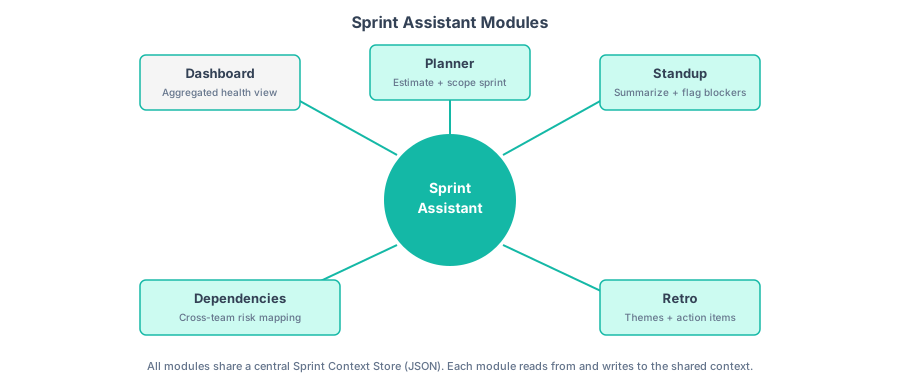
Figure C4.1 — Hub-and-spoke architecture. The Sprint Assistant connects five specialized modules through a shared context store.
Architecture Overview
Each ceremony has a dedicated module. A central sprint context store connects them, so the retrospective analyzer knows what was planned, the planner knows what went wrong last sprint, and the standup summarizer knows what was committed.
from pydantic import BaseModel, Field
from enum import Enum
from typing import Optional
from datetime import date

class StoryStatus(str, Enum):
    TODO = "todo"
    IN_PROGRESS = "in_progress"
    IN_REVIEW = "in_review"
    DONE = "done"
    BLOCKED = "blocked"

class RiskLevel(str, Enum):
    HIGH = "high"
    MEDIUM = "medium"
    LOW = "low"

class UserStory(BaseModel):
    id: str
    title: str
    description: str
    acceptance_criteria: list[str] = Field(default_factory=list)
    story_points: Optional[int] = None
    estimated_points: Optional[int] = Field(
        default=None, description="LLM-estimated story points"
    )
    status: StoryStatus = StoryStatus.TODO
    assignee: Optional[str] = None
    dependencies: list[str] = Field(default_factory=list)
    team: str = "default"

class StandupEntry(BaseModel):
    team_member: str
    date: str
    yesterday: str
    today: str
    blockers: list[str] = Field(default_factory=list)

class RetroFeedback(BaseModel):
    category: str = Field(description="went_well, to_improve, or action_item")
    text: str
    votes: int = 0
    author: Optional[str] = None

class SprintContext(BaseModel):
    sprint_number: int
    start_date: str
    end_date: str
    team_velocity: float = Field(description="Average points completed per sprint")
    stories: list[UserStory] = Field(default_factory=list)
    standup_entries: list[StandupEntry] = Field(default_factory=list)
    retro_feedback: list[RetroFeedback] = Field(default_factory=list)

class Dependency(BaseModel):
    from_story: str
    to_story: str
    from_team: str
    to_team: str
    status: str = Field(description="aligned, at_risk, or blocked")
    notes: str = ""
Step 1: Setup and Data Ingestion
Build three sample datasets to work with. In production these come from Jira, Azure DevOps, or Slack — but starting with local data lets you develop and test without API credentials.
The backlog has 6 user stories spanning Platform, Frontend, and Backend teams, with realistic cross-team dependencies: US-101 depends on US-105, which means the Frontend team is blocked until the Platform team delivers. The standup entries cover 5 team members across two days; 3 of the 5 have active blockers including "waiting for security team approval" and "Redis cluster not available in staging." The retrospective feedback has 10 items across went-well, to-improve, and action-item categories, each with vote counts that show relative priority.
Step 2: Core Processing Pipeline — Sprint Planning
The sprint planner estimates story complexity, checks dependencies, and recommends which stories fit into the sprint given the team's historical velocity.
"""modules/planner.py — Sprint planning with LLM-powered estimation."""
import json
import os
from openai import OpenAI

client = OpenAI(api_key=os.getenv("OPENAI_API_KEY"))

ESTIMATION_PROMPT = """You are an experienced scrum master estimating user stories.

For each story below, estimate the story points using the Fibonacci scale:
1, 2, 3, 5, 8, 13.

Consider:
- Technical complexity
- Number of acceptance criteria
- Integration points and dependencies
- Uncertainty and risk

Stories:
{stories_json}

Return a JSON array with story ID and estimated points:
[{{"id": "US-101", "estimated_points": 5, "rationale": "brief reason"}}]

Return ONLY the JSON array."""


def estimate_stories(stories: list[dict]) -> list[dict]:
    """Use an LLM to estimate story points for unestimated stories."""
    unestimated = [s for s in stories if s.get("story_points") is None]
    if not unestimated:
        print("  All stories already estimated.")
        return stories

    # Prepare stories for the LLM (remove noisy fields)
    clean = [
        {
            "id": s["id"],
            "title": s["title"],
            "description": s["description"],
            "acceptance_criteria": s.get("acceptance_criteria", []),
            "dependencies": s.get("dependencies", []),
        }
        for s in unestimated
    ]

    prompt = ESTIMATION_PROMPT.format(stories_json=json.dumps(clean, indent=2))

    response = client.chat.completions.create(
        model="gpt-4o-mini",
        messages=[
            {"role": "system", "content": "You are a scrum master. "
             "Respond only with a JSON array."},
            {"role": "user", "content": prompt},
        ],
        temperature=0.2,
        max_tokens=800,
    )

    raw = response.choices[0].message.content.strip()
    try:
        estimates = json.loads(raw)
    except json.JSONDecodeError:
        import re
        match = re.search(r"\[.*\]", raw, re.DOTALL)
        estimates = json.loads(match.group()) if match else []

    # Apply estimates
    est_map = {e["id"]: e for e in estimates}
    for story in stories:
        if story["id"] in est_map:
            story["estimated_points"] = est_map[story["id"]]["estimated_points"]
            story["estimation_rationale"] = est_map[story["id"]].get("rationale", "")
            print(f"  {story['id']}: {story['estimated_points']} points "
                  f"— {story.get('estimation_rationale', '')}")

    return stories


def recommend_sprint_scope(
    stories: list[dict],
    velocity: float,
    buffer: float = 0.85,
) -> dict:
    """Recommend which stories to include in the sprint."""
    capacity = int(velocity * buffer)  # Leave 15% buffer for interruptions
    print(f"\n  Team velocity: {velocity} | Sprint capacity (with buffer): {capacity}")

    # Sort by dependency order, then by value (fewer dependencies first)
    def sort_key(s):
        dep_count = len(s.get("dependencies", []))
        points = s.get("estimated_points") or s.get("story_points") or 5
        return (dep_count, -points)

    sorted_stories = sorted(stories, key=sort_key)

    included = []
    deferred = []
    total_points = 0

    for story in sorted_stories:
        points = story.get("estimated_points") or story.get("story_points") or 5

        # Check if dependencies are included
        deps = story.get("dependencies", [])
        deps_met = all(
            any(i["id"] == dep for i in included) or dep not in [s["id"] for s in stories]
            for dep in deps
        )

        if total_points + points <= capacity and deps_met:
            included.append(story)
            total_points += points
        else:
            reason = "capacity exceeded" if total_points + points > capacity else "unmet dependencies"
            deferred.append({**story, "defer_reason": reason})

    return {
        "included": included,
        "deferred": deferred,
        "total_points": total_points,
        "capacity": capacity,
        "utilization": round(total_points / capacity * 100, 1) if capacity else 0,
    }
The standup summarizer sends all daily entries to the LLM in a single batch call rather than processing them one by one. It asks for five components in the JSON response: an executive summary (2-3 sentences), active blockers with impact ratings and suggested actions, identified risks with affected team members, cross-team coordination flags, and progress concerns for anyone who appears stuck. The LLM returns JSON; the system parses and displays it with severity indicators.
Step 3: Output Generation — Retrospective Analysis and Sprint Report
The retrospective analyzer clusters feedback themes, compares against previous sprints to surface recurring issues, and tracks action item completion.
"""modules/retro.py — Analyze retrospective feedback for themes and patterns."""
import json
import os
from openai import OpenAI

client = OpenAI(api_key=os.getenv("OPENAI_API_KEY"))

RETRO_PROMPT = """Analyze this sprint retrospective feedback.

Feedback items:
{feedback_json}

Previous sprint action items (check if resolved):
{previous_actions}

Provide a JSON analysis:
1. "themes": Array of identified themes, each with:
   - "theme": short theme name
   - "category": "went_well" or "to_improve"
   - "count": how many feedback items relate to this theme
   - "summary": 1-sentence synthesis
2. "action_items": Array of recommended actions:
   - "action": specific, actionable task
   - "owner_type": "team_lead", "scrum_master", "developer", "ops"
   - "priority": "high", "medium", "low"
   - "addresses_theme": which theme this addresses
3. "recurring_patterns": Array of issues that appeared in previous sprints too
4. "team_morale_signal": "positive", "neutral", or "negative" with brief rationale

Return ONLY the JSON object."""


def analyze_retrospective(
    feedback: list[dict],
    previous_actions: list[str] = None,
) -> dict:
    """Analyze retro feedback for themes, patterns, and action items."""
    if previous_actions is None:
        previous_actions = []

    prompt = RETRO_PROMPT.format(
        feedback_json=json.dumps(feedback, indent=2),
        previous_actions=json.dumps(previous_actions) if previous_actions else "None available",
    )

    response = client.chat.completions.create(
        model="gpt-4o-mini",
        messages=[
            {"role": "system", "content": "You are an agile coach. Provide insightful, "
             "actionable retrospective analysis. Return only JSON."},
            {"role": "user", "content": prompt},
        ],
        temperature=0.3,
        max_tokens=1200,
    )

    raw = response.choices[0].message.content.strip()
    try:
        analysis = json.loads(raw)
    except json.JSONDecodeError:
        import re
        match = re.search(r"\{.*\}", raw, re.DOTALL)
        analysis = json.loads(match.group()) if match else {}

    # Print theme summary
    if analysis.get("themes"):
        print(f"  Identified {len(analysis['themes'])} themes:")
        for t in analysis["themes"]:
            print(f"    [{t.get('category', '?')}] {t.get('theme', '')}: "
                  f"{t.get('summary', '')}")

    morale = analysis.get("team_morale_signal", "unknown")
    print(f"  Team morale signal: {morale}")

    return analysis
The dependency tracker builds a relationship map from each story's dependencies field, linking the dependent story to its dependency and recording both teams. Status is determined automatically: "done" dependencies are "aligned," "blocked" dependencies are "blocked," and "todo" dependencies where the dependent story is already "in progress" are "at risk." An LLM call then assesses overall dependency risk, identifies specific risks, recommends actions, and surfaces the cross-team conversations that need to happen before integration.
The sprint health dashboard combines all module outputs into a single markdown report: a planning summary table (stories included/deferred, total points, utilization), a standup analysis section with blocker and risk tables, a cross-team dependencies section with status indicators, and retrospective insights organized by theme with prioritized action items. The same data also exports as JSON for programmatic consumption or upstream tooling.
Step 4: Validation and Quality
Before the dashboard is generated, the sprint plan runs through six validation checks.
Overcommitment (utilization above 100%) and high utilization (above 95%) both indicate a plan with no slack — one unexpected interruption breaks the sprint. Undercommitment (below 60%) wastes capacity that could be used to pull in backlog items. Missing estimates means stories are in the sprint without point values, making utilization calculations meaningless. Large stories — anything 8 points or above — carry real completion risk; they should be split before the sprint starts. Deferred dependencies is the most dangerous: an included story depends on another story that was pushed out, which means the included story is likely to block or slip regardless of what the team does.
Each issue surfaces with a severity level and a specific recommendation.
"""main.py — Orchestrate the AI-powered sprint assistant."""
from data.sample_sprint import BACKLOG, STANDUP_ENTRIES, RETRO_FEEDBACK
from modules.planner import estimate_stories, recommend_sprint_scope
from modules.standup import analyze_standup
from modules.retro import analyze_retrospective
from modules.dependencies import map_dependencies, analyze_dependency_risks
from modules.validate_sprint import validate_sprint_plan
from modules.dashboard import generate_dashboard


def run_sprint_assistant(
    sprint_number: int = 12,
    velocity: float = 25,
):
    """Run the full sprint assistant pipeline."""
    print("=" * 60)
    print(f"AI-Powered Sprint Assistant — Sprint {sprint_number}")
    print("=" * 60)

    # Stage 1: Sprint Planning
    print("\n[1/5] Estimating stories...")
    stories = estimate_stories(BACKLOG)

    print("\n[2/5] Recommending sprint scope...")
    plan = recommend_sprint_scope(stories, velocity=velocity)

    print(f"\n  Included: {len(plan['included'])} stories "
          f"({plan['total_points']} points)")
    print(f"  Deferred: {len(plan['deferred'])} stories")
    print(f"  Utilization: {plan['utilization']}%")

    # Stage 2: Standup Analysis
    print("\n[3/5] Analyzing standups...")
    standup_analysis = analyze_standup(STANDUP_ENTRIES)

    # Stage 3: Retrospective Analysis
    print("\n[4/5] Analyzing retrospective...")
    previous_actions = [
        "Improve code review turnaround time",
        "Set up automated deployment pipeline",
    ]
    retro_analysis = analyze_retrospective(RETRO_FEEDBACK, previous_actions)

    # Stage 4: Dependency Analysis
    print("\n[5/5] Mapping dependencies...")
    dependencies = map_dependencies(stories)
    dependency_analysis = analyze_dependency_risks(dependencies, stories)

    for dep in dependencies:
        status_label = dep["status"].upper()
        print(f"  {dep['from_story']} -> {dep['to_story']} "
              f"({dep['from_team']}/{dep['to_team']}): {status_label}")

    # Validation
    print("\nValidating sprint plan...")
    issues = validate_sprint_plan(plan, velocity)
    if issues:
        for iss in issues:
            print(f"  [{iss['severity']}] {iss['message']}")
    else:
        print("  No issues found.")

    # Generate dashboard
    print("\nGenerating sprint dashboard...")
    report_path = generate_dashboard(
        sprint_number=sprint_number,
        plan=plan,
        standup_analysis=standup_analysis,
        retro_analysis=retro_analysis,
        dependency_analysis=dependency_analysis,
        dependencies=dependencies,
    )

    print("\n" + "=" * 60)
    print("Sprint Assistant Complete!")
    print("=" * 60)

    return report_path


if __name__ == "__main__":
    run_sprint_assistant()
Extensions and Portfolio Tips
- Add Slack integration. Post the daily standup summary and blocker alerts to a Slack channel using webhooks. Send dependency risk alerts as DMs to the relevant team leads. This makes the assistant useful in real time, not just as a batch report.
- Build a velocity forecaster. Use historical sprint data to predict future velocity using both simple moving average and LLM-based analysis of team composition changes, holidays, and technical debt paydown. Show a confidence interval, not just a point estimate.
- Integrate with Jira or Azure DevOps. Pull backlog items, sprint data, and standup notes directly from your project management tool. Push the sprint plan back as a sprint in Jira with stories pre-assigned. This eliminates manual data entry entirely.
- Add a meeting prep generator. Before each ceremony, generate a focused agenda based on current sprint data. For planning: show the recommended scope and dependency warnings. For standup: highlight yesterday's blockers and today's risks. For retro: surface the themes and compare against last sprint's action items.
- Build a sprint comparison view. Compare metrics across the last 5-10 sprints: velocity trend, blocker frequency, action item completion rate, team morale signal. This turns the assistant from a single-sprint tool into a continuous improvement engine.
- Add natural language queries. Let users ask questions like "Which stories are at risk?" or "What blocked us most last sprint?" and have the LLM answer from the sprint context store. This turns structured data into a conversational interface.
Record a 3-minute video walkthrough for your portfolio. Show the tool running against sample data, then show the generated dashboard. Emphasize the cross-team dependency detection — it solves a problem that is painful, expensive, and almost never automated, and engineering managers notice immediately.