Chapter 16 of 17
Capstone: Board Presentation — AI Strategy
A worked example in executive communication: the board wants a 30-minute presentation on your AI product strategy. Walk through narrative structure, the metrics that matter to directors, handling the workforce replacement question, and a one-page AI strategy template.
Overview
The Scenario
You are the VP of Product at Meridian, a B2B SaaS company with $28M ARR serving mid-market HR teams. Your product helps companies manage employee onboarding, compliance training, and performance reviews.
The board has added a 30-minute item to next quarter's meeting: "AI Product Strategy Update." The request came from two board members who are also investors in AI-native competitors. They want to understand where Meridian is headed.
You have 30 minutes, a room of 8 board members with backgrounds in finance, operations, and enterprise software (not AI), and a company that has shipped two AI features in the last 12 months with mixed results.
Your job: structure a presentation that is honest, forward-looking, and inspires confidence without overpromising.
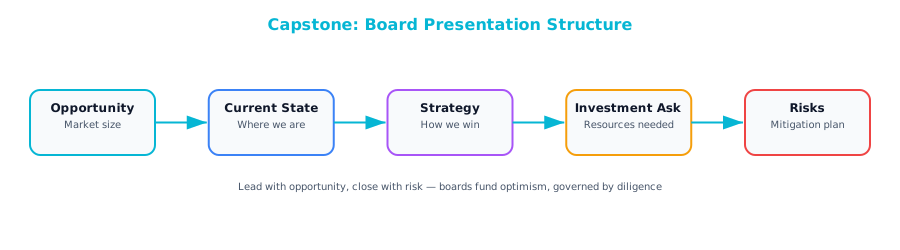
Part 1: Structure the Narrative
The worst AI strategy presentations do one of three things: they try to impress with technical depth the board doesn't need and can't evaluate. They over-commit to a roadmap of features that haven't been validated. Or they're defensive, spending most of the time on catching up to competitors rather than establishing a forward path.
A board-level AI strategy presentation tells a clear story in four acts.
Act 1: The Opportunity (3–4 minutes)
Frame the strategic context. Why does AI matter for Meridian specifically — not AI in general, not industry trends, but for your product and your customers.
For Meridian, the opportunity framing might be:
"HR teams in mid-market companies are drowning in repetitive administrative work — onboarding paperwork, compliance reminders, performance review cycles — while struggling to find time for the strategic work that actually moves their organizations forward. AI creates the opportunity to automate the administrative layer and surface the insights that make HR leaders more effective. Our thesis is that the companies that get this right will become indispensable to their HR teams, not just useful."
Keep Act 1 short. The board knows AI is important. They've asked you to present on it. You don't need 10 minutes on market context.
Act 2: Where We Are (7–8 minutes)
This is the honest accounting of current state. Two AI features shipped, lessons learned, where you stand today.
For Meridian, this might cover:
- AI Onboarding Assistant (launched 8 months ago): What it does, current adoption rate, user satisfaction score, business impact measured.
- Compliance Training Recommender (launched 4 months ago): What it does, early metrics, what you learned.
- The honest gap: Where you are relative to the opportunity framing in Act 1.
The key principle for Act 2: lead with business impact, not feature descriptions.
Board members don't need to understand how the AI Onboarding Assistant works. They need to understand that it reduced average onboarding completion time by 40%, that customers using it have 12% higher retention rates at 12 months, and that it has contributed to a meaningful improvement in NPS among customers who've adopted it.
| What not to say | What to say instead |
|---|---|
| "We built a RAG pipeline that retrieves onboarding documents and uses GPT-4 to answer employee questions" | "HR admins using our AI onboarding assistant spend 40% less time answering repetitive onboarding questions from new hires" |
| "Our recommendation engine uses collaborative filtering and content-based signals" | "Employees shown AI-recommended training are 2.3x more likely to complete it than those assigned courses manually" |
| "We've fine-tuned on our customer data for 6 months" | "Our AI accuracy has improved from 62% to 81% since launch, based on feedback from 340 pilot users" |
Act 3: Where We Are Going (10 minutes)
This is your forward strategy. Three to four strategic bets, each with a clear rationale, a description of what success looks like, and a realistic timeline.
Don't present a feature roadmap. A list of features with Q3 and Q4 dates is not a strategy. It's a delivery plan, and the board doesn't need that level of detail. What they need is confidence that you understand where value is created, that you're making deliberate bets, and that you have a framework for deciding what to build.
For Meridian, the strategic bets might be:
Bet 1: Make AI features a retention driver, not just an acquisition story
"Our AI features create switching costs when customers have been using them long enough to accumulate meaningful usage data. Our 12-month goal is to make AI engagement a leading indicator of renewal, and to build product decisions that increase AI adoption among at-risk accounts."
Bet 2: Expand AI to the performance review workflow
"Performance review is the highest-friction, lowest-loved workflow in our product. AI can help managers write better feedback faster and help HR teams identify patterns across the organization. We're investing in this over the next 12 months with a quality-gated approach — we won't expand until the AI is demonstrably better than what managers do manually."
Bet 3: Build the data moat
"Every customer interaction with our AI features generates labeled data that makes our models more accurate for HR-specific use cases. We're making deliberate product decisions to increase the volume and quality of this data — which means our AI will be meaningfully harder to replicate in 24 months than it is today."
Act 4: Investment and Risk (5–6 minutes)
Board members are thinking about capital allocation and risk. Be direct about both.
Investment ask (if any): If you're asking for incremental budget to accelerate AI development, state the ask clearly, explain what it buys, and provide a return framework. "We're requesting $800K in incremental R&D budget for 2026 to staff the performance review AI feature. Our model shows this feature, if it meets quality targets, adds 15 percentage points of retention improvement for at-risk accounts. At our current ARR, that's worth approximately $2.1M in retained revenue annually."
Risk acknowledgment: Boards respect honesty about risk more than optimism. Name the real risks:
- "Our AI features depend in part on model providers we don't control — a significant capability change or price increase from those providers would affect our cost structure."
- "We have two AI-native competitors who have more AI engineering resources than we do. Our defensive advantage is our 8 years of customer data and deep domain knowledge of HR workflows — but we need to ship quality faster to maintain differentiation."
- "AI regulation is evolving, particularly around data use and automated HR decisions. We have a compliance review process in place and monitor this actively."
Part 2: Metrics That Matter to the Board
What the Board Is Not Asking About
- Model accuracy (F1 score, precision/recall, BLEU score) — these are internal engineering metrics
- Number of AI features shipped
- API calls per day
- Token efficiency
- Number of prompts in the evaluation suite
What the Board Is Asking About
| Metric | What it measures | Example |
|---|---|---|
| AI feature adoption rate | What % of customers are actively using AI features? | "42% of active accounts use at least one AI feature monthly" |
| Retention differential | Are AI feature users more likely to renew? | "AI-engaged accounts renew at 88% vs. 74% for non-engaged" |
| Revenue attribution | How much ARR is influenced by AI feature adoption? | "AI features are a key stated reason-for-buy in 31% of new deals" |
| Time-to-value improvement | Are users getting value faster with AI? | "Onboarding completion rate at 30 days: 71% with AI vs. 54% without" |
| Support cost impact | Are AI features reducing the burden on support teams? | "AI Onboarding Assistant deflects 34% of new hire support tickets" |
| AI investment efficiency | What is the return on AI R&D spend? | "Each dollar of AI R&D in 2025 contributed $2.40 of retained revenue" |
| Competitive positioning | How do we compare to AI-native competitors? | User research: customers rank our AI features at parity with Competitor A for onboarding, below parity for performance review |
The board is not running the product — they're providing capital and oversight. The questions they're answering are: "Is this a good use of our capital? Is the team executing well? Are we winning in the market?" Every metric you present should be answerable to one of those three questions. If you can't connect a metric to capital allocation, execution quality, or competitive position, cut it from the presentation.
Part 3: Handling the Workforce Replacement Question
Every AI board presentation eventually reaches this moment. A board member, often the one with the most generalist background, asks some version of:
"When do you think AI will replace most of our customers' HR teams? Should we be worried about our market shrinking?"
This is a legitimate question and deserves a clear, confident answer. Being evasive or dismissive damages credibility. Panicking or over-reassuring does too.
The Prepared Answer
Frame your response around three points:
1. Distinguish task automation from role elimination.
"AI will automate a growing number of specific HR tasks — onboarding paperwork, compliance reminders, scheduling, data entry. It's already doing this. What it will not replace, in our planning horizon, is HR judgment: navigating a sensitive employee relations situation, designing a culture program, deciding how to handle a performance issue that requires balancing legal, interpersonal, and organizational considerations. Our product strategy is built on the premise that HR professionals who use AI will outperform those who don't — and our customers will need those professionals."
2. Point to what your data actually shows.
"We've been watching our customers' behavior closely. In companies where our AI Onboarding Assistant has been most adopted, HR team sizes have stayed flat or grown slightly — because the time freed from administrative tasks is being redirected to strategic work that wasn't getting done before. We're not seeing customers reduce headcount because of our AI; we're seeing them do more with their existing teams."
3. Acknowledge the long-term uncertainty honestly.
"Could AI change the composition and size of HR teams over a 10-year horizon? Yes, it could. We don't have certainty on that. What we're focused on is making sure our product is essential to however HR teams evolve — so that if their function changes, they change with Meridian, not away from it."
This answer is honest, grounded in your data, and forward-looking without over-committing. It addresses the question without being defensive.
Other Questions to Prepare For
"How do you know the AI features are actually driving business results and not just correlating with power users?"
"That's the right challenge. For the retention differential I cited, we've controlled for account size and product usage level in our analysis. The retention gap holds across segments, including accounts that were at similar usage levels before the AI feature launched."
"How much of our competitive differentiation is actually defensible, vs. something any competitor can replicate by calling the same API?"
"The model is a commodity — anyone can call the same API. Our moat is the domain-specific training data we've accumulated from 8 years of HR workflows, our evaluation rubrics built from HR expert review, and the product integration that makes AI outputs actionable inside our customers' workflows rather than just informational. Those take years to build."
"What happens if OpenAI / Google / Microsoft decides to build what you're building?"
"Platform risk from hyperscalers is real and we monitor it. Our view is that general AI assistants will not replace purpose-built HR workflow tools — just as general search didn't replace specialized HR software. The value we provide is integration with HR data, compliance with employment law requirements, and workflow integration that a general-purpose AI tool won't provide. But if a hyperscaler made a significant move into our space, that would be a scenario we'd need to respond to quickly."
The One-Page AI Strategy Template
Use this as a leave-behind for board members, or as the spine of your internal AI strategy document.
[Company Name] AI Product Strategy Date: [Quarter/Year] | Owner: [VP Product / PM Lead]
Our AI Thesis
[2–3 sentences: What specific user problem does AI unlock for your customers? Why is now the right time?]
Current State
| Feature | Launched | Adoption | Key business metric |
|---|---|---|---|
| [Feature 1] | [Quarter] | [X% of customers] | [Metric and value] |
| [Feature 2] | [Quarter] | [X% of customers] | [Metric and value] |
What we've learned: [2–3 honest bullet points about what worked, what didn't, and what you now know that you didn't before]
Strategic Bets (Next 12 Months)
| Bet | Rationale | Success looks like | Timeline |
|---|---|---|---|
| [Bet 1] | [Why this matters] | [Measurable outcome] | [Quarter range] |
| [Bet 2] | [Why this matters] | [Measurable outcome] | [Quarter range] |
| [Bet 3] | [Why this matters] | [Measurable outcome] | [Quarter range] |
Our Defensible Advantage
[Why our AI will be harder to replicate in 24 months than it is today: data moat, domain expertise, workflow integration, customer relationships]
Risks and Mitigations
| Risk | Likelihood | Impact | What we're doing |
|---|---|---|---|
| Model provider dependency | Medium | Medium | Multi-provider evaluation; quarterly pricing review |
| AI-native competitor gains | High | High | Accelerate domain specialization; customer lock-in through data |
| Regulatory changes | Medium | High | Legal review cadence; policy monitoring |
| Quality ceiling reached | Low | High | Quality-gated shipping discipline; alternative approaches in research |
Investment Ask
[If applicable: what incremental resources you are requesting, what they buy, and the expected return]
Key Metrics We Track
- AI feature adoption rate: [current] → [12-month target]
- Retention differential (AI vs. non-AI users): [current] → [target]
- Revenue influenced by AI features: [current %] → [target %]
- AI cost as % of gross margin: [current] → [target]
This one-pager should be able to stand alone. If a board member forwards it to a colleague who was not in the room, they should be able to understand your strategy, your current state, and your forward direction without the presentation deck.
The best board presentations don't just inform — they create alignment. When you leave the room, every board member should have the same understanding of where you're going, why you're going there, and what success looks like. That alignment, more than any individual slide, is what makes the 30 minutes worthwhile.