Chapter 09 of 17
Data Strategy for Product Managers
You don't need to write SQL to own AI data strategy. You need to ask the right questions before anyone writes a line of code — and know what the wrong answers mean.
Overview
The PM Who Didn't Ask About the Data
There's a pattern that plays out in AI product failures with remarkable consistency. A team gets excited about a feature. The idea is strong. The AI capability exists. Engineering scopes the work. The feature gets prioritized. Development begins. And then, somewhere around week four or six, a data engineer says: "Wait. Do we actually have what we need to power this thing?"
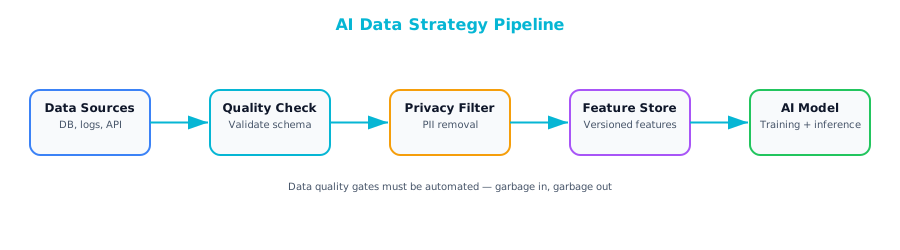
In the best case, the answer is "mostly yes, but we need three months of cleanup work first." In the worst case: "No. And the data we'd need doesn't exist and would take a year to collect."
Both outcomes are expensive. Both were avoidable. Both happened because no one asked the right questions at the beginning.
Data strategy for AI is not primarily a technical discipline. Engineers handle the pipelines, the schema design, the ETL jobs. What only you — the product manager — can do is ask the questions that determine whether the right data will ever exist in the first place, and make the product decisions that ensure it gets created. You don't need to write a single SQL query. But if you never ask about the plumbing, you'll design a kitchen with no sink.
Data Availability Checklist: Do You Have What the AI Needs?
Before any AI feature enters design or engineering, walk through this checklist. These are not questions for a data engineer to answer in isolation — they require the PM to understand the user journeys, the product's data model, and the business requirements.
Existence
- Does the data this AI feature needs actually exist anywhere in your systems?
- If it exists, is it stored in a structured, queryable format, or embedded in unstructured text, PDFs, images, or legacy systems?
- How far back does the data go? Is the historical depth sufficient for the use case?
- Is the data complete? What percentage of records have the fields the AI needs populated?
Quality
- Is the data clean enough to be useful, or does it require significant normalization?
- Has the data been collected consistently over time, or did the schema or collection method change?
- Are there known biases in how the data was collected that could affect AI behavior?
- Is there a ground truth label for training or evaluation? How was that label created, and how reliable is it?
Access
- Can the AI feature access this data at inference time, or only in batch?
- Does accessing the data require crossing organizational, legal, or system boundaries?
- Are there API rate limits or latency constraints that affect real-time access?
- Who owns the data, and do they have sign-off on using it for AI purposes?
Volume
- Is there enough data to build a useful model or retrieve meaningful context?
- Is there enough data to evaluate the AI feature's quality?
- Is data volume growing at a rate that will support the feature's long-term improvement?
Freshness
- How current does the data need to be? Real-time? Daily? Acceptable if a week old?
- Is the data refresh rate consistent with the feature's requirements?
Use this checklist as an input to a conversation with your data team — not as a solo assessment. The value is in the questions surfaced, not in checking boxes. Any "no" or "uncertain" answer is a risk that needs a mitigation plan before the feature is committed to a roadmap.
Data readiness scoring:
| Checklist completion | Readiness level | Recommendation |
|---|---|---|
| All critical items yes | High | Proceed to design |
| Most critical items yes, gaps identified | Medium | Proceed with data remediation plan |
| Several critical items no or unknown | Low | Discovery spike required before commitment |
| Multiple fundamental items no | Not ready | Do not commit; address data foundations first |
Privacy and Consent: What You Can and Cannot Use
The legal and ethical boundaries around data use for AI are not static, and they are not intuitive. What your product is technically capable of doing with data and what it is legally or ethically permitted to do are very different things. You are responsible for understanding this distinction before you build — not after a lawyer flags it during launch review.
This is not a comprehensive legal guide. You will need legal counsel for jurisdiction-specific analysis. But there are foundational principles every PM should internalize.
Consent Scope
Data collected with consent for one purpose cannot automatically be reused for a different purpose. If a user uploaded their documents to use your storage feature, and your privacy policy described the product as a storage tool, you may not be able to use those documents to train an AI model — even if you technically have access to them.
The question is not "do we have the data?" but "do we have the right to use it for this purpose?" In most modern privacy frameworks (GDPR, CCPA, and their successors), the answer depends on:
- The consent language your users agreed to when they signed up
- Whether AI training or inference constitutes a materially different use than the original purpose
- Whether you are in a jurisdiction that requires opt-in vs. opt-out for new data uses
A practical rule: if a reasonable user would be surprised to learn that their data is being used this way, you need explicit consent before you proceed. This is not a legal standard — it's a trust standard, and violating it has product consequences beyond the legal ones.
Categories of Data That Require Special Handling
| Data category | Why it requires care | Common AI pitfalls |
|---|---|---|
| Health and medical | HIPAA in the US, similar frameworks elsewhere; sensitive and highly regulated | Using clinical notes or wearable data without BAA; inferring health conditions from behavioral data |
| Financial records | PCI, various financial regulations; high-stakes errors | Using transaction history to infer creditworthiness; training on data that includes PAN or account numbers |
| Communications content | Email, messages, and documents often have elevated privacy expectations | Training on private messages; surfacing communications to unauthorized parties |
| Biometric data | Facial images, voice recordings, fingerprints; special category in many jurisdictions | Any AI model trained on or inferring biometric identifiers |
| Children's data | COPPA, GDPR Article 8, and similar frameworks restrict data use significantly | Any product where users could be minors |
| Employee data | Employment law considerations; power imbalance requires care | Using productivity data for AI-based performance assessment |
The Consent Layer in AI Features
When you add AI features that use data differently from the existing product, you often need to update consent. Do this early, not as an afterthought. The options are:
Updated Terms of Service: Appropriate when the new use is minor or falls within the reasonable expectations of your existing ToS. Notify users. Make changes visible.
In-product consent prompt: Appropriate when the new use is significant enough that users deserve an explicit moment of consent. Must be meaningful — not a dark pattern designed to obtain consent by exhausting users.
Opt-out mechanism: Appropriate in jurisdictions and contexts where opt-out is legally sufficient. Must be genuine. The user must be able to opt out of AI data use without losing access to core product functionality.
No retroactive use: In some cases, the cleanest answer is that existing data cannot be used for AI purposes, and you collect new data going forward with appropriate consent. Restrictive, but sometimes the only legally and ethically sound option.
The Cold Start Problem: Launching AI with No Training Data
The cold start problem: the AI needs data to be useful, but you don't have data because you haven't launched yet. Or you've just added a new feature, a new customer segment, or a new use case, and the historical data that powers your AI doesn't cover it.
This is a product problem, not a research problem. Your job is to bridge the gap between "no data" and "enough data" without making users suffer through a demonstrably bad experience in the meantime.
Cold Start Strategies
Synthetic data bootstrapping: Generate artificial training or evaluation data that represents the distribution you expect to see in production. Works well for structured tasks (classification, extraction) where you can define the space of inputs and outputs. Works poorly for tasks that require capturing the nuance of real user behavior.
Transfer from adjacent domains: If your specific use case has no data, a model trained on a related domain may be good enough to launch with. A customer service AI for a new product vertical can start with a general customer service model and improve over time with domain-specific data. Transparency with users about the feature being new and improving is appropriate here.
Human-in-the-loop bootstrapping: In the early stages, have humans do the work the AI will eventually do, while logging inputs and outputs as training data. You get a working feature from day one; the AI gradually takes over as data accumulates. Expensive but effective for high-stakes use cases where a bad AI output would cause real harm.
Curated seed data: Identify a small number of high-quality examples — sourced from experts, public datasets, or a beta cohort — that represent the ideal output. Use these as few-shot examples in prompts or as a fine-tuning seed. Small quantities of high-quality, representative data often outperform large quantities of noisy data.
Progressive rollout by data richness: Roll out to users and contexts where you already have data before expanding to contexts where you don't. A recommendation engine with no history for new users might start by only serving recommendations to users with at least 30 days of activity, showing a non-AI fallback to others.
Cold Start Failure Modes to Avoid
| Failure mode | Description | Prevention |
|---|---|---|
| Premature automation | Removing human review before AI quality is sufficient | Define minimum quality threshold before removing human oversight |
| Data desert feature | Shipping an AI feature with no pathway to collect the data it needs to improve | Ensure the product interaction generates feedback data from day one |
| Distribution mismatch | Training data does not match production data, often because seed data was too curated | Continuously compare production inputs to training distribution |
| Frozen model | Launching a model and never updating it as new data accumulates | Build model refresh into the operating cadence |
Build Your Data Moat: Product Decisions That Generate Training Data
The most durable competitive advantage an AI-powered product can have is not the model. Models are increasingly commoditized — anyone can access frontier model APIs. The advantage is proprietary data that no one else has, collected through the normal use of a product that users already love.
This is the data moat. Unlike technical moats, it compounds over time: the more users use the product, the more data you have. The more data you have, the better the AI. The better the AI, the more users use the product.
Building a data moat is a product design decision, not an engineering one. The features you build, the interactions you instrument, the feedback mechanisms you create — all of these determine what data you collect and therefore what AI capabilities you can develop.
The Feedback Loop Design Principle
Every user interaction that produces an outcome is an opportunity to generate training signal, if you design for it. For every significant AI feature, ask: "How will we know if this was good or bad?"
Explicit feedback signals are the ones users give you deliberately:
- Thumbs up / thumbs down on AI outputs
- Corrections to AI-generated text
- Accepting or rejecting AI suggestions
- Rating or scoring AI outputs
Implicit feedback signals are the ones users give you through behavior:
- Time spent reading an AI-generated summary
- Whether the user took the action the AI recommended
- Whether the user edited an AI-generated draft or deleted it entirely
- Whether a suggested next step was followed or ignored
- Return rate to an AI-assisted feature vs. one-and-done usage
Implicit signals require more careful interpretation. A user might spend a long time reading a summary because it was detailed and useful, or because it was confusing. But at scale, behavioral signals provide rich training data that explicit feedback alone cannot.
Product Decisions That Generate Data Moat Advantages
| Product decision | Data generated | AI capability unlocked |
|---|---|---|
| Provide an AI writing assistant that users can edit | Edit histories showing what users changed and why | Fine-tuning toward the voice and preferences of your user base |
| Show AI suggestions inline and track accept/reject | Acceptance rate by suggestion type and context | Improved suggestion relevance; reduced noise |
| Let users flag AI errors with a category | Labeled error data in production | Targeted model improvements; accuracy gains in high-error categories |
| Track what users do after an AI recommendation | Behavioral outcome data linked to AI outputs | Model optimization toward actions that produce real-world value |
| Require explicit confirmation for high-stakes AI actions | High-quality examples of appropriate vs. inappropriate AI invocation | Better guardrails; reduced false positives |
| Build a correction workflow into the AI feature | Human-corrected examples of AI outputs | Continuous fine-tuning dataset that grows with usage |
What Not to Do
The data moat opportunity tempts teams into choices that undermine user trust and ultimately destroy the moat they're trying to build.
Don't collect data you didn't disclose. If users discover you're using their data in ways they didn't consent to, the resulting loss of trust is more damaging than any competitive advantage the data provided.
Don't design dark patterns to force feedback. Requiring users to rate every AI output before they can continue will generate high-volume but low-quality signal. Users will click through without genuine engagement. The data will be worse than no data.
Don't optimize for the metric you can measure at the expense of the outcome that matters. A data moat built on optimizing for thumbs-up clicks may not translate into a model that actually serves users well. Design feedback mechanisms that capture what you actually care about.
And don't ignore the data you're generating. The most common data moat failure is that teams build feedback loops into the product but never use the data to improve the model. If the data isn't creating a feedback loop that closes — collection, analysis, model improvement, deployment — it's not a moat. It's a landfill.
Your Data Strategy One-Pager
Before any AI feature moves from ideation to planning, you should be able to fill out this table. If you can't, you're not ready to commit.
| Question | Your answer |
|---|---|
| What data does this AI feature need at inference time? | |
| Where does that data live, and who owns it? | |
| Do we have consent to use it for this purpose? | |
| What is the data quality, and what cleanup is required? | |
| How do we handle the cold start period? | |
| What feedback signals will we collect from users? | |
| How will collected feedback flow back to model improvement? | |
| What is our data retention and deletion policy for AI data? | |
| Who is accountable for data quality on an ongoing basis? |
These questions don't stop being relevant after launch. They get more important as your AI feature grows, your data accumulates, and the competitive advantage of your data moat either compounds or erodes.