Chapter 12 of 17
The AI Product Roadmap
AI features resist the commitments traditional roadmaps demand. The answer isn't looser deadlines — it's a different structure that's honest about what you're actually committing to.
Overview
The Problem With Promising Dates
A traditional product roadmap rests on a comfortable fiction: invest enough effort and time into a feature, and it will work as intended by the date you specify. Engineering estimates complexity. Design scopes the work. With enough sprints, you reach the destination.
AI features break this fiction. You can invest exactly the right amount of time and engineering effort and still not have something that works well enough to ship — because the quality of an AI feature is determined by factors that don't respond predictably to investment: the quality of your training data, the capability ceiling of current models, the difficulty of the underlying task, and the gap between your evaluation suite and the real world.
This isn't a failure of effort or planning. It's a fundamental property of AI development. An LLM that correctly answers 80% of customer service queries is not "80% done." It may be at the limit of what current technology can achieve for that specific use case, and no number of additional engineering sprints will close the gap.
The implication isn't that AI roadmaps are useless. It's that they require a different structure — one that communicates direction and investment intent rather than feature-and-date commitments.
Roadmapping Non-Deterministic Features
The Outcome-Based Roadmap Structure
Instead of organizing the roadmap as "Feature X ships in Q2," structure it as "We will achieve Outcome Y by Q2, or we will have learned Z and adjusted course." This reframes the commitment from a specific deliverable to a defined investment of discovery and development effort with a decision point at the end.
Example transformation:
| Traditional structure | Outcome-based structure |
|---|---|
| "AI support chatbot ships Q2" | "By Q2, we will have run a 90-day pilot of AI support triage and have data on deflection rate, quality, and user satisfaction — and a go/no-go recommendation" |
| "AI document summarization V2 ships Q3" | "By Q3, we will have improved summarization accuracy from 68% to >80% on our evaluation suite, or we will have identified the ceiling of current model capability and adjusted feature scope" |
| "AI recommendation engine replaces manual curation Q4" | "By Q4, we will have validated that AI recommendations meet or exceed human curation satisfaction scores in an A/B test, and have a rollout plan if they do" |
The outcome-based roadmap item has three properties the traditional structure lacks:
- It describes what you're trying to learn or achieve, not what you're committing to ship.
- It includes a measurement that defines success.
- It explicitly acknowledges that the outcome may lead to a course correction rather than a feature launch.
Horizon Segmentation for AI Roadmaps
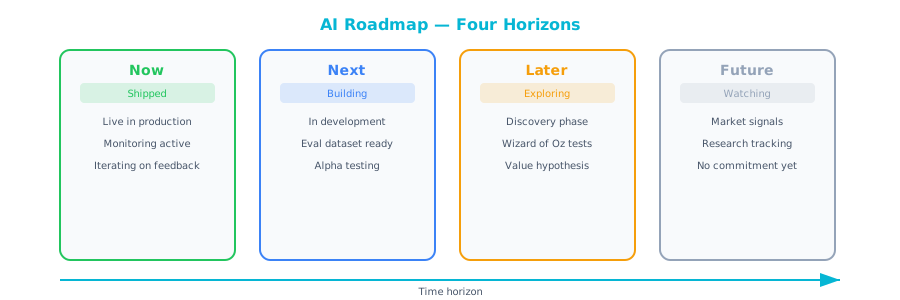
AI roadmaps benefit from explicit horizon segmentation, with longer time windows for AI features than traditional features and decreasing specificity as you look further out:
Now (current quarter): Specific initiatives with defined success criteria. AI features in this horizon have passed quality bars and are in the delivery or rollout phase. Commitments are specific and defensible.
Next (1–2 quarters out): Problem spaces you're investing in. AI features in this horizon are in active development or late discovery. Describe the problem being solved and the capability being built — not the specific feature form.
Later (3–4 quarters out): Research bets and dependencies. AI features in this horizon depend on model improvements, data accumulation, or technical work that isn't yet complete. These are intentional R&D investments, not planned deliverables.
Future (beyond 4 quarters): Vision and direction. Not a commitment. A signal of where you're heading.
This structure is honest. It tells stakeholders that your commitments get more specific as you get closer, and that uncertainty increases as you look further out. That's accuracy, not evasion.
Communicating Uncertainty to Stakeholders
Stakeholders — executives, board members, sales teams, customers — have learned to interpret traditional product roadmaps as commitments. When you shift to a roadmap that explicitly communicates uncertainty, you may encounter resistance, frustration, or demands for more specific dates.
This is a communication challenge as much as a planning challenge.
Framing Uncertainty as Rigor, Not Incompetence
The worst framing: "We cannot give you a date because AI is uncertain." That sounds like an excuse.
The better framing: "We have built our plan around quality gates rather than calendar dates, because we have seen teams ship AI features that met their dates but failed their users. Our commitment is to ship when the AI meets the quality bar — not to ship on a date and hope the quality catches up."
This reframes uncertainty as a quality standard. You're not saying you don't know. You're saying you won't compromise.
The Three Questions Stakeholders Actually Care About
Behind every demand for a specific date are three real concerns:
-
Are we making progress? Stakeholders need to know the team isn't spinning its wheels. Answer this with frequent, concrete evidence of progress: evaluation scores improving, user research completed, shadow mode data gathered.
-
Are we investing in the right things? Stakeholders need confidence that your AI investments are aligned with business strategy. Answer this with clear outcome definitions and explicit connections between AI features and business metrics.
-
When will I be able to tell customers/the board/the market about this? Stakeholders often need planning horizons for external communication. Answer this with confidence intervals rather than point estimates: "We expect to be able to announce this to customers in Q3 or Q4. We'll have more precision by the end of Q2."
The Stakeholder Communication Calendar
For complex AI features, build a formal cadence of stakeholder updates that keep everyone informed without creating pressure to over-commit:
| Update type | Frequency | Content |
|---|---|---|
| Progress brief | Monthly | What we learned, what metrics improved, what we adjusted |
| Decision review | At each quality gate | Go/no-go recommendation with data; next steps |
| Forecast update | Quarterly | Updated range estimate for key milestones; changes to plan |
| Exception report | As needed | When something significant changes — model limitation discovered, data issue found, quality ceiling identified |
Regularity reduces surprise. Stakeholders who receive predictable, data-driven updates learn to trust the process. The demand for false precision is usually a symptom of information hunger, not genuine calendar management needs.
The Research vs. Delivery Balance on Your Roadmap
AI product development has a natural tension between two modes: research mode, where you're exploring what's possible and generating learning, and delivery mode, where you're building, shipping, and iterating on features users can see.
Both modes are necessary. Pure research without delivery produces a team that generates insights but no user value. Pure delivery without research produces a team that ships features that hit quality ceilings they didn't anticipate.
How to Allocate
A useful planning heuristic for teams with at least one AI feature in production and one in development:
- 60% delivery capacity: Building, refining, and operating features in production.
- 25% applied research: Investigating improvements to current features, testing new model capabilities, evaluating new approaches to problems you're already working on.
- 15% exploratory research: Looking ahead to the next generation of capabilities, evaluating emerging model providers, exploring use cases not yet on the roadmap.
These ratios shift based on your product maturity:
| Stage | Suggested research/delivery ratio |
|---|---|
| Pre-launch: building first AI feature | 50% research / 50% delivery |
| Early production: first AI feature live | 30% research / 70% delivery |
| Growing product: multiple AI features | 25% research / 75% delivery |
| Mature product: AI deeply integrated | 15% research / 85% delivery |
Making Research Visible on the Roadmap
Research that doesn't appear on the roadmap gets cut when delivery pressure mounts. Make research explicitly visible as a roadmap item:
- Name it: "AI quality improvement research for document summarization"
- Define an output: "Evaluation report with recommended improvement strategy"
- Give it a timeline: "4-week spike, results by end of Q1"
- Define a decision gate: "Decision to proceed with Approach A vs. Approach B, or to accept current quality ceiling"
Research on a roadmap that has a defined output and a decision gate is defensible. Research that is "ongoing" and has no visible outcome is not.
Model Dependency: When Your Roadmap Depends on a Vendor's Improvements
Some AI product roadmaps have a hidden dependency that's rarely documented explicitly: they depend on model providers making improvements that the team doesn't control.
This isn't inherently a problem. Model capabilities have been improving rapidly, and many roadmap bets that seemed optimistic a year ago turned out to be conservative. But undocumented model dependency is a risk that can produce significant stakeholder disappointment when a vendor's model release is delayed, when the released model doesn't improve the specific capability you needed, or when the improvement comes from a different provider than you expected.
The Model Dependency Audit
For each AI feature on your roadmap, document explicitly:
- Does this feature depend on model capabilities that don't currently exist or are below current quality thresholds?
- If yes, what specific capability improvement is needed, and what is the basis for believing it will be available in your planning window?
- What is the fallback plan if the capability doesn't materialize on schedule?
Dependency levels:
| Level | Description | Planning treatment |
|---|---|---|
| No dependency | Feature can be built with current model capabilities | Standard roadmap item |
| Soft dependency | Feature would be better with future model improvements, but can launch at current quality | Plan launch at current quality with improvement later |
| Hard dependency | Feature cannot meet quality bar with current model capabilities | Research item only; do not commit to external launch until dependency resolves |
| Multi-vendor dependency | Feature performance depends on capabilities across multiple providers | Requires vendor management strategy and evaluation framework |
Managing Vendor Relationships for Roadmap Purposes
If your roadmap has hard model dependencies, maintain active relationships with your model providers:
- Request preview access or early access programs for upcoming model releases.
- Share your use case with provider product teams — they often include high-value use cases in benchmark evaluations for new models.
- Maintain fallback providers so that a single vendor's delay doesn't block your entire roadmap.
- Evaluate new model releases quickly (within days of launch for important dependencies) so improvements can be incorporated into your timeline without long lead times.
The 12-Month AI Product Roadmap Template
Use this structure as a starting point for your team's AI product roadmap. Adapt the specific format to your organization's planning tools and culture.
AI Product Roadmap: [Product Name] Period: [Q1 YYYY – Q4 YYYY] Last updated: [Date] Owner: [PM Name]
Strategic Context
AI product vision (1–2 sentences): What role does AI play in this product's future? What user outcome does the AI strategy serve?
Key business metrics AI is expected to drive: [List 2–3 specific business outcomes: retention, conversion, ARPU, NPS, etc.]
Model dependencies to watch: [List any external model capabilities your roadmap depends on, and the current assessment of when they will be available]
Now (Q1)
| Initiative | Type | Success criteria | Owner | Status |
|---|---|---|---|---|
| [AI feature name] | Delivery | [Specific metric target] | [Name] | [In progress / At risk / Complete] |
| [Quality improvement project] | Applied research | [Evaluation score target] | [Name] | |
| [Monitoring and operations item] | Operations | [SLA or cost target] | [Name] |
Q1 decision gates: [List specific go/no-go decisions expected this quarter]
Next (Q2–Q3)
| Initiative | Type | Outcome definition | Confidence | Dependencies |
|---|---|---|---|---|
| [AI feature or capability] | Delivery | [What user or business outcome it achieves] | High / Medium / Low | [Model, data, or team dependencies] |
| [Research bet] | Research | [Report, recommendation, or prototype output] | High / Medium / Low | [Dependencies] |
Q2–Q3 planning note: Timelines in this horizon are range estimates (±1 quarter) and may shift based on Q1 learnings.
Later (Q4)
| Initiative | Type | Direction | Confidence |
|---|---|---|---|
| [Longer-horizon capability] | Delivery / Research | [Problem we're trying to solve] | Low — directional only |
Q4 planning note: Items in this horizon are investment intentions, not commitments. They will be refined based on Q2–Q3 outcomes.
Future (Beyond 12 Months)
Vision items not yet on roadmap:
- [Capability or bet we're watching but not planning to build in this period]
- [Technology or market development that could change the roadmap significantly]
Risk Register
| Risk | Likelihood | Impact | Mitigation |
|---|---|---|---|
| Key model provider delays a model release we depend on | Medium | High | Evaluate alternative providers; design fallback scope |
| AI cost scaling exceeds forecast at growth targets | Medium | High | Implement caching and optimization in Q2; review pricing quarterly |
| Quality ceiling reached before target metrics achieved | Low | High | Define quality ceiling early through research; adjust feature scope rather than ship below bar |
| Regulatory changes affect AI data use in key markets | Low | High | Monitor EU AI Act implementation; quarterly legal review |
The most important thing about your AI roadmap is that it accurately represents what you know and what you don't — so your stakeholders are making decisions based on reality, and your team is protected from commitments that can't be kept without compromising quality.
An honest AI roadmap that communicates uncertainty is more valuable than a confident one that conceals it. That difference shows up when the uncertainty resolves, and with AI features, it always does eventually.