Chapter 01 of 18
Chapter 1: Why LLMs Matter for BAs and QAs
A Business Analyst who can harness Large Language Models doesn't just work faster — they think differently about what's possible. In this opening chapter, we explore why LLMs represent the most significant shift in analyst productivity since the spreadsheet, and why BAs and QAs are uniquely position
Part 1 — Foundations
Chapter 1: Why LLMs Matter for BAs and QAs
A Business Analyst who can harness Large Language Models does not just work faster. They think differently about what is possible. In this opening chapter, we explore why LLMs represent the most significant shift in analyst productivity since the spreadsheet, and why BAs and QAs are uniquely positioned to lead the AI-augmented workplace.
Reading time: ~20 min Project: LLM Impact Assessment
What You Will Learn
- Why LLMs are a transformative tool specifically for analysts, not just developers
- What LLMs actually do at a conceptual level — without the hype
- How analyst workflows shift from manual to augmented with LLM support
- Where LLMs fit across different phases of the software development lifecycle
1.1 The Analyst's New Superpower
For decades, Business Analysts and Quality Analysts have relied on a core toolkit: interviews, workshops, document templates, spreadsheets, and structured thinking. These tools are powerful but fundamentally limited by a single constraint — the analyst's available hours. Every requirements document must be written word by word. Every test case must be designed scenario by scenario. Every stakeholder communication must be drafted, reviewed, and refined by hand.
Large Language Models shatter that constraint. Not by replacing the analyst's judgment, which remains irreplaceable, but by amplifying it. An LLM can draft a first version of a requirements document in seconds, generate dozens of test case variations from a single user story, or transform a dense technical specification into a business-friendly summary. The analyst still decides what is right, what is missing, and what needs to change. But the starting point is no longer a blank page.
Consider the difference in practice:
| Task | Traditional Approach | LLM-Augmented Approach | Time Saved |
|---|---|---|---|
| Draft BRD from meeting notes | 4-6 hours manual writing | 30 min review + editing of LLM draft | ~80% |
| Generate test cases from user stories | 2-3 hours per epic | 20 min generation + 40 min refinement | ~65% |
| Analyze stakeholder feedback themes | 1-2 days manual categorization | 1 hour with LLM-assisted clustering | ~85% |
| Create data dictionary from schema | 3-4 hours of documentation | 15 min generation + 45 min validation | ~75% |
| Write acceptance criteria | 30 min per user story | 5 min per story with refinement | ~70% |
Key Insight: The time savings from LLMs are not about speed alone. When you spend 80% less time drafting, you can spend 80% more time thinking, questioning, and validating — the activities where analysts add the most value.
This is not theoretical. Organizations that have adopted LLM-augmented analyst workflows report not just faster delivery, but higher-quality artifacts. When analysts spend less time on the mechanical aspects of their work, they catch more gaps, ask better questions, and produce more thorough documentation. The superpower is not writing faster. It is thinking deeper.
1.2 What LLMs Actually Do
Before we explore applications, let us establish a clear, honest understanding of what LLMs are and are not. Strip away the marketing language and science fiction analogies, and what remains is both remarkable and bounded.
A Large Language Model is a statistical system trained on vast amounts of text. It learns patterns in language — how words relate to each other, how sentences flow, how ideas are typically structured in different contexts. When you give it a prompt, it generates a response by predicting, one token at a time, what text would most likely follow your input based on all the patterns it has learned.
Think of it as the world's most sophisticated autocomplete. But that undersells it. The patterns an LLM learns are not just about which word follows which. They encode structure, reasoning patterns, domain knowledge, and stylistic conventions. An LLM that has processed millions of requirements documents has implicitly learned what good requirements look like: their structure, their language patterns, their level of specificity.
Critical Distinction: LLMs do not "understand" in the way humans do. They do not have beliefs, intentions, or experiences. They are extremely good at producing text that looks like it was written by someone who understands. This distinction matters enormously for how you use and validate their output.
Here's what LLMs are genuinely good at:
| Capability | What It Means for Analysts | Reliability |
|---|---|---|
| Text generation | Drafting documents, emails, specifications from structured inputs | High (with review) |
| Summarization | Condensing meeting transcripts, long documents, research papers | High |
| Classification | Categorizing feedback, defects, requirements by type or priority | Medium-High |
| Extraction | Pulling structured data from unstructured text (names, dates, entities) | Medium-High |
| Transformation | Converting between formats (e.g., user stories to test cases) | Medium |
| Pattern recognition | Finding inconsistencies, gaps, or duplicates in documentation | Medium |
| Reasoning (structured) | Following logical chains when given clear frameworks | Medium (improves with prompting) |
And here is what they struggle with:
- Factual accuracy — LLMs can and do generate plausible-sounding but incorrect information ("hallucinations"). Every factual claim must be verified.
- Math and precise logic — While improving, LLMs can make errors in calculations, especially multi-step ones.
- Accessing current information — LLMs have a knowledge cutoff date and cannot browse the internet unless specifically equipped with tools to do so.
- Understanding your specific context — An LLM does not know your organization's domain, politics, constraints, or history unless you tell it.
1.3 From Manual to Augmented
The shift from manual to LLM-augmented work is not a binary switch. It is a spectrum. Understanding where you are on this spectrum, and where you should aim to be, is essential for a practical adoption strategy.
We can define four maturity levels for LLM adoption in analyst work:
| Level | Name | Description | Example |
|---|---|---|---|
| 0 | Manual | All work done by hand, no LLM involvement | Writing requirements from scratch in Word |
| 1 | Ad-hoc Assisted | Occasional use of ChatGPT or similar for one-off tasks | Pasting a paragraph into ChatGPT to improve wording |
| 2 | Systematically Augmented | Defined prompts and workflows integrated into daily practice | Using a prompt template to generate test cases for every sprint |
| 3 | Workflow Automated | LLMs embedded in tools and pipelines, with human oversight | CI/CD pipeline that auto-generates test cases and flags gaps |
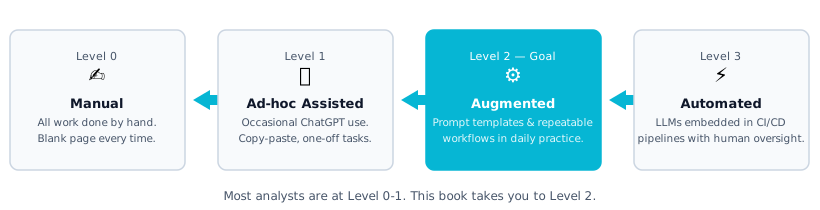
The Augmentation Spectrum — four maturity levels for LLM adoption in analyst work. This book targets Level 2: systematic, repeatable use of LLMs with defined templates and workflows.
Most analysts today are at Level 0 or Level 1. This book will take you to Level 2 and give you the foundations for Level 3. The goal is not to automate yourself out of a job. It is to elevate the work you do so that your time is spent on judgment, not on typing.
The Augmentation Mindset: Think of LLMs as a junior analyst who is fast, knows a lot of general knowledge, but has zero context about your project and sometimes confidently makes things up. You would not hand them a deliverable and ship it without review. But you would absolutely have them draft the first version.
The transition looks different for BAs and QAs, but the principle is the same:
For Business Analysts:
- Requirements elicitation remains human-led (workshops, interviews), but LLMs process the outputs faster
- Document drafting shifts from creation to curation — you review and refine rather than write from zero
- Stakeholder analysis and communication planning benefit from LLM-generated options and variations
- Gap analysis and impact assessment gain from LLMs' ability to cross-reference large document sets
For Quality Analysts:
- Test case generation becomes dramatically faster, with LLMs producing comprehensive edge cases
- Test data creation shifts from manual fabrication to LLM-assisted generation with constraints
- Defect reporting improves as LLMs help structure and clarify bug descriptions
- Regression analysis benefits from LLMs' ability to assess change impact across documentation
1.4 The BA-QA Advantage
Business Analysts and Quality Analysts have a natural advantage in working with LLMs that many other roles lack. This advantage is not discussed enough. It stems from three core skills that BAs and QAs already possess.
1. Structured Thinking
BAs and QAs are trained to break problems into components, define clear categories, and organize information systematically. This is exactly what effective prompting requires. When you write a prompt that says "Analyze this requirement and identify: (a) the primary actor, (b) the preconditions, (c) the main success scenario, (d) alternative flows, and (e) exception cases," you are applying structured thinking. Developers often jump straight to code. Analysts naturally decompose problems, and that decomposition is the foundation of great prompts.
2. Validation Discipline
QAs, in particular, have a professional instinct to question every output. "Is this correct? What's missing? What edge case would break this?" This skeptical mindset is essential when working with LLMs, whose outputs must always be verified. While others might accept LLM output at face value, a trained analyst knows to probe, test, and validate. This discipline transforms LLMs from a risky toy into a reliable tool.
3. Domain Translation
BAs spend their careers translating between business language and technical language. This skill directly maps to the art of prompt engineering — translating what you need into language the LLM can work with, and translating the LLM's output into something stakeholders can use. The BA skill of managing ambiguity, clarifying definitions, and bridging communication gaps is precisely what effective LLM interaction demands.
Career Perspective: The analysts who thrive in the AI era will not be those who resist LLMs or those who blindly trust them. They will be those who know how to direct, validate, and integrate LLM outputs into professional-grade deliverables. This is a skill set, and you are already halfway there.
1.5 Where LLMs Fit in the SDLC
LLMs are not limited to a single phase of the software development lifecycle. They can augment analyst work across every stage, from initial discovery through post-release monitoring. Understanding the full landscape helps you identify the highest-value opportunities in your own work.
| SDLC Phase | BA Applications | QA Applications | Chapters |
|---|---|---|---|
| Discovery & Planning | Stakeholder analysis, market research summarization, vision document drafting | Test strategy generation, risk assessment, quality attribute analysis | 5, 6 |
| Requirements | User story writing, acceptance criteria, BRD drafting, gap analysis | Testability review, requirements traceability, ambiguity detection | 5, 6, 7 |
| Design | Process modeling support, data dictionary creation, UX feedback analysis | Test case design, test data generation, boundary value identification | 7, 9, 10 |
| Development | Change request analysis, requirement clarification, impact assessment | Code review support, unit test suggestion, API test generation | 8, 10, 11 |
| Testing | UAT scenario creation, defect triage support, acceptance validation | Test execution analysis, defect reporting, regression suite optimization | 9, 10, 11 |
| Deployment & Ops | Release notes drafting, training material creation, process documentation | Production monitoring analysis, incident report classification | 12, 13 |
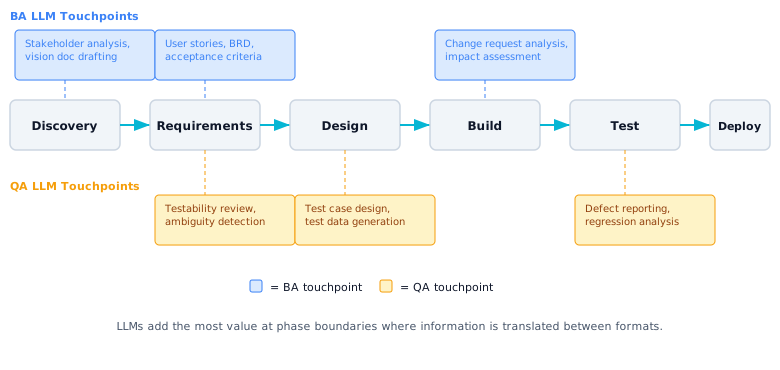
Where LLMs Fit in the SDLC — BA touchpoints (blue) focus on requirements and change analysis; QA touchpoints (amber) span from testability review through regression analysis. The highest-value opportunities lie at the handoffs between phases.
The key insight is that LLMs are most valuable at the boundaries between phases — the handoffs where information must be transformed from one format to another. Converting meeting notes into user stories. Transforming user stories into test cases. Translating defect reports into change requests. These translation tasks are where LLMs excel, and they are also where the most time is traditionally lost.
Start Where It Hurts: Don't try to introduce LLMs everywhere at once. Identify the single most time-consuming translation task in your current workflow and start there. Success breeds adoption.
1.6 Common Misconceptions
As LLMs have entered the mainstream, a fog of misconceptions has settled around them. Some come from hype, some from fear, and some from genuine misunderstanding. Let's address the most common ones that affect analyst adoption.
Misconception 1: "LLMs will replace BAs and QAs"
This is the fear that drives resistance. The reality is more nuanced. LLMs excel at generating and transforming text, but they cannot conduct a stakeholder interview, navigate organizational politics, exercise judgment about what requirements matter most, or understand the implicit context that makes a requirement feasible or infeasible. LLMs will replace analysts who refuse to learn them, not analysts who embrace them. The role evolves rather than disappears.
Misconception 2: "You need to be a programmer to use LLMs"
While this book does include Python code for building automated workflows, the most impactful LLM techniques for analysts require no programming at all. Prompt engineering, structured prompting, and interactive analysis can all be done through chat interfaces. The code skills are an accelerator, not a prerequisite.
Misconception 3: "LLM output is ready to use as-is"
This is perhaps the most dangerous misconception. LLM output is a draft — always. It requires human review, domain validation, and contextual adjustment. Treating LLM output as a finished deliverable is a professional risk. Treating it as a high-quality starting point is a professional advantage.
Misconception 4: "All LLMs are basically the same"
Different models have significantly different strengths. GPT-4o excels at nuanced instruction following. Claude is strong at careful analysis and long-context tasks. Gemini integrates well with Google's ecosystem. Open-source models like Llama offer privacy advantages. Choosing the right model for the right task matters, and we'll explore this in Chapter 2.
Misconception 5: "LLMs are too expensive for regular use"
Costs have dropped dramatically and continue to fall. A typical analyst's monthly LLM usage — even heavy usage — costs less than a single hour of their salary. The ROI calculation is not even close. The cost of not using LLMs is far higher than the cost of using them.
Data Privacy Reality Check: One legitimate concern that is not a misconception: data privacy. When using cloud-based LLMs, your prompts are sent to external servers. Always check your organization's data classification policy before sending sensitive information to an LLM. Many organizations now offer enterprise LLM deployments that keep data within organizational boundaries. Chapter 4 covers this in detail.
1.7 Driving LLM Adoption in Your Team
Knowing that LLMs are valuable is one thing. Getting your team to actually use them is another. Adoption is a change-management challenge, and it follows predictable patterns. If you are a lead BA, a QA manager, or simply someone who wants to bring LLMs into your team's daily practice, this section gives you a practical playbook.
Common Resistance Patterns
Before you can address resistance, you need to recognize it. BAs and QAs tend to push back on LLM adoption in three characteristic ways:
- Fear of replacement. "If the LLM can write requirements and test cases, what do they need me for?" This is the deepest objection, rooted in genuine anxiety about career relevance. The reality, that LLMs amplify analyst judgment rather than replacing it, must be demonstrated through experience, not just asserted in a slide deck.
- Skepticism about accuracy. "I tried ChatGPT once and it hallucinated three requirements that do not exist. I cannot trust it." Analysts who have been burned by a bad early experience often generalize that experience to all LLM use. They need to see that structured prompting with validation produces dramatically better results than naive copy-paste.
- Process inertia. "We have always written requirements this way and it works fine." Teams with established templates and workflows see LLMs as disruption rather than enhancement. The key is showing that the LLM fits inside their existing process, producing the same deliverables in the same formats, just faster.
| Objection | Response |
|---|---|
| "LLMs will replace my job." | LLMs replace the typing, not the thinking. Your judgment about what requirements matter, which test cases to prioritise, and how to navigate stakeholder politics is irreplaceable. The analysts who lose their jobs are the ones who refuse to learn, not the ones who adopt. |
| "The output is full of errors." | Without structured prompts, yes. With the techniques in this book — role-based prompting, validation checklists, and iterative refinement — LLM output typically needs less revision than a junior analyst's first draft. The key is treating it as a starting point, never a finished product. |
| "I do not have time to learn a new tool." | You do not have time to avoid it. Start with one task: the most tedious, repetitive deliverable you produce each sprint. Spend 30 minutes learning the prompt pattern for that task. You will recoup the investment within a single sprint. |
| "Our data is too sensitive for cloud AI." | This is a legitimate concern, not an excuse to avoid adoption entirely. Enterprise LLM deployments (Azure OpenAI, AWS Bedrock, on-premises models) keep data within your network. Chapter 4 covers privacy-safe options in detail. |
| "Management will expect us to do twice the work." | Frame the productivity gain in terms of quality, not speed. The pitch is not "we can write twice as many requirements" — it is "we can write the same number of requirements with fewer gaps, better edge-case coverage, and more thorough validation." |
| "I tried it and it did not understand our domain." | An LLM without context is like a new hire on day one: smart but uninformed. Providing domain context through system prompts, reference documents, and few-shot examples transforms generic output into domain-specific results. Chapter 3 covers this in depth. |
The Four-Step Adoption Framework
Successful LLM adoption follows a predictable path. Rushing to "everyone uses it for everything" without the middle steps is the most common failure pattern.
Step 1: Demonstrate Value (Weeks 1-2)
Pick a single, visible, time-consuming task — such as generating acceptance criteria from user stories or drafting test cases from requirements. Run a live demonstration where you complete the task with and without LLM assistance, side by side. Let the numbers speak: time taken, completeness of output, and number of edge cases covered. Do not ask people to change their workflow yet. Just show them what is possible.
Step 2: Pilot with Champions (Weeks 3-6)
Identify two or three team members who are curious about LLMs — your early adopters. Give them prompt templates for the demonstrated task and ask them to use LLMs for that one task during the next two sprints. Meet weekly to collect feedback: What worked? What failed? What prompts needed adjustment? Champions generate peer-to-peer credibility that no management directive can match.
Step 3: Standardise Workflows (Weeks 7-10)
Based on pilot feedback, create a team playbook: approved prompt templates, validation checklists, and guidelines for which tasks to augment and which to keep manual. Integrate LLM steps into your existing process documentation — they should appear as part of the workflow, not as a separate "AI initiative." Run a half-day workshop where every team member completes one task using the standardised workflow.
Step 4: Measure and Expand (Ongoing)
Track metrics that matter: time saved per deliverable, defect escape rate, requirement gap rate, and team satisfaction scores. Share results monthly with leadership and the team. Use the data to identify the next task to augment. Each cycle through Steps 1-4 adds a new LLM-augmented workflow to your team's practice.
Building the Internal Business Case
To secure management support and budget for LLM tools, frame the business case around three pillars:
- Time saved. Measure the hours your team spends on tasks that LLMs can accelerate. Even conservative estimates (50% time reduction on drafting tasks) translate to significant capacity gains. For a team of 6 analysts spending 15 hours per week on document drafting, a 50% reduction frees 45 analyst-hours per week — equivalent to hiring an additional analyst without the headcount cost.
- Quality improved. Track defects that escape to later phases. LLM-augmented requirements analysis catches ambiguities earlier, and LLM-assisted test case generation covers more edge cases. Quantify the cost of late-discovered defects (see Section 1.8) and show how LLM adoption reduces that cost.
- Cost reduced. Enterprise LLM subscriptions cost $20-60 per user per month. Compare this to the fully loaded cost of analyst time ($50-100+ per hour). If each analyst saves just two hours per week, the tool pays for itself within the first week of each month.
Tips for Getting Management Buy-In
- Lead with a pilot, not a proposal. Run a small proof of concept first. Present results, not plans.
- Use their language. Executives care about delivery speed, defect rates, and cost per story point — not prompt engineering techniques.
- Address security proactively. Have answers ready about data privacy, vendor agreements, and compliance. See Chapter 4 and the data privacy guidance in Chapter 10.
- Show, do not tell. A two-minute live demonstration of generating test cases from a real user story is more persuasive than a twenty-slide deck.
- Start with low-risk tasks. Internal documentation, brainstorming sessions, and draft generation are safe starting points that build confidence before tackling compliance-sensitive workflows.
Cross-Reference: For a deeper exploration of how AI transforms organisations and teams, see The AI-First Enterprise, Chapter 1: Why AI Changes Everything. For a comprehensive look at what agentic AI adds beyond basic LLM usage, see Agentic AI, Chapter 1: What Is Agentic AI?.
1.8 The Cost of Not Adopting
We've discussed the benefits of adoption, but the flip side deserves equal attention. In a competitive landscape where LLM adoption is accelerating across industries, choosing not to adopt carries real and growing costs.
Productivity Gap: Teams using LLMs are demonstrably more productive. A 2024 study by McKinsey found that knowledge workers using generative AI tools completed tasks 25-40% faster with equivalent or higher quality. As peers and competitors adopt these tools, not adopting means falling further behind with each passing quarter.
Talent Expectations: New analysts entering the workforce increasingly expect to use AI tools. Organizations that prohibit or fail to support LLM usage struggle to attract top talent. Meanwhile, experienced analysts who develop LLM skills command premium compensation.
Quality Debt: When analyst teams are under time pressure, and they always are, quality suffers. Fewer test cases get written. Requirements are less thorough. Edge cases go unexamined. LLMs do not eliminate time pressure, but they create breathing room for the careful work that prevents costly downstream defects.
Consider the economics of a single missed requirement:
| When Discovered | Average Cost to Fix | LLM Impact |
|---|---|---|
| During requirements phase | $100 - $500 | LLMs help surface gaps early through cross-referencing and completeness checks |
| During development | $1,000 - $5,000 | LLM-generated test cases catch mismatches between requirements and implementation |
| During testing | $5,000 - $15,000 | LLM-augmented testing increases coverage, catching defects before release |
| In production | $10,000 - $100,000+ | Compounding effect: better requirements + better testing = fewer production defects |
The cost of not adopting LLMs is not just lost productivity. It is the accumulation of preventable defects, missed requirements, and incomplete testing that results from analyst teams doing critical work under time pressure without adequate tooling.
The Bottom Line: LLM adoption for analysts is not about technology enthusiasm or following trends. It's a professional development decision with clear ROI. The question is not whether to adopt, but how quickly and effectively you can integrate these tools into your practice.
Project: LLM Impact Assessment
In this project, you will conduct a structured assessment of how LLMs could impact your own analyst workflow. This is both a practical exercise and a planning tool. The output will guide your learning priorities for the rest of this book.
Step 1: Map Your Current Activities
Create an inventory of your typical weekly activities. For each, estimate the time spent and categorize the type of work.
How to do this exercise (no code required): Create a simple spreadsheet or table with these columns for each of your weekly activities: Activity Name, Hours/Week, Involves Text Generation? (Yes/No), Involves Analysis? (Yes/No), and Data Sensitivity (Low/Medium/High). Score each activity's LLM potential from 1-5 using this rule: text-heavy tasks with low sensitivity score highest; tasks requiring stakeholder interaction or involving sensitive data score lower. Multiply the score by hours to find your biggest opportunities. Start with the highest-scoring, lowest-sensitivity activity for your first LLM workflow.
Step 2: Prioritize Your Opportunities
Modify the activities list to reflect your actual work. Run the script and identify your top three candidates for LLM augmentation. Consider starting with tasks that have high LLM potential and low data sensitivity — these give you the best learning opportunity with the least risk.
Step 3: Define Your Learning Goals
Based on your assessment, write a brief paragraph (3-5 sentences) describing which analyst activities you want to augment with LLMs by the end of this book, and what success would look like for each. Keep this document — you will revisit it in the capstone project.
Summary
- LLMs amplify analyst judgment rather than replacing it — they transform the analyst role from creator to curator of first drafts
- BAs and QAs possess three natural advantages for LLM adoption: structured thinking, validation discipline, and domain translation skills
- LLMs fit across every SDLC phase, with the highest impact at phase boundaries where information must be transformed between formats
- LLM output must always be treated as a draft requiring human review — never as a finished deliverable
- The cost of not adopting LLMs is measured in lost productivity, talent challenges, and preventable defects that compound across the development lifecycle
Exercises
Conceptual
A colleague argues that using LLMs for requirements writing is "cheating" and produces lower-quality work. Draft a response that addresses their concern while acknowledging the legitimate risks. What safeguards would you propose?
Coding
Extend the LLM Impact Assessment script to include a "risk score" based on data sensitivity and organizational readiness. Add a function that recommends which activities to augment first, second, and third based on the combined potential and risk scores.
Design
You're a QA Lead at a mid-size financial services company. Your team of 8 QAs spends 40% of their time writing test cases and 30% on defect reporting. Design a phased 3-month adoption plan for introducing LLM tools into your team's workflow. Consider training needs, pilot scope, success metrics, and risk mitigation.