Chapter 03 of 15
AI Strategy That Actually Works
How to build an AI strategy grounded in business value rather than technology enthusiasm — including a one-page strategy canvas you can complete in a single session.
Overview
Ask fifty companies to share their AI strategy and you will find that most of them are not strategies at all. They are tool adoption plans dressed up in strategic language. They describe which products the company plans to deploy, what the implementation timeline is, which vendors have been selected, and what the budget is. What they do not describe — clearly, specifically, verifiably — is what business value will be created, how it will be measured, and why AI is the right path to that value rather than something simpler.
This distinction is not semantic. It is the difference between spending $5 million on technology that changes what your company uses and spending $5 million on outcomes that change how your company competes.
Signal Capture: Start With Value, Not Technology
In the LegacyForward framework, Signal Capture is the discipline of identifying where genuine value exists before deciding how to capture it. It is the opposite of the technology-first approach that drives most AI failures.
Applied to executive AI strategy, Signal Capture asks a single foundational question before any tool is evaluated, any vendor is invited to present, or any budget is allocated:
Where in our business do we have untapped information that, if acted upon faster or more accurately, would create measurable competitive advantage?
This question is not about AI. It is about value. AI may or may not be the best mechanism to capture that value. Often there are faster, cheaper, more reliable ways to address the opportunity. But if there is an opportunity that depends on processing large volumes of information at speed, at scale, or with a consistency that humans alone cannot provide, then AI deserves serious evaluation.
A gold mining company does not start by purchasing mining equipment. It starts by identifying where the gold is — geological surveys, topographical maps, ore samples. Only after it has strong evidence that gold exists in a specific location does it commit to the capital cost of extraction equipment. AI strategy follows the same logic. The "geological survey" is the process of identifying high-value opportunities where information is underused. The "mining equipment" is the AI system. Most companies skip the survey and go straight to buying equipment.
The practical implication: your AI strategy process should begin with a structured survey of your business looking for specific types of opportunity — not with a vendor selection process or a technology evaluation.
The One Question Every AI Initiative Must Answer
There is a question that should appear on the cover page of every AI business case, answered in one or two sentences, in plain language, before the document goes further:
"Where does this create value we cannot achieve any other way?"
This question does three things. First, it forces specificity. "We cannot achieve any other way" is a high bar that requires genuine analysis, not vague claims. Second, it establishes uniqueness. If the value can be achieved through hiring more people, improving a manual process, or buying a simpler software tool, then AI is not the right answer. Third, it creates accountability. Someone is on record claiming that AI is necessary for this value to be created.
Not every AI initiative will have a perfect answer to this question. But the process of trying to answer it rigorously tends to produce better-scoped, better-justified initiatives than the alternative. It also surfaces the initiatives that should never have been funded — the ones where the honest answer is "we could achieve this without AI, but AI is fashionable right now."
Transformation vs. Automation: The Distinction That Saves Millions
The most expensive mistake in AI strategy is conflating transformation with automation. These are not different degrees of the same thing. They are different categories of investment with different risk profiles, different time horizons, and different organizational requirements.
Automation means using AI to do the same thing you are already doing — faster, cheaper, or with fewer people. Automating invoice processing. Automating first-level customer support. Automating document classification. These are legitimate, valuable initiatives with relatively straightforward success metrics.
Transformation means using AI to do something you could not do before, enabling a fundamentally different way of operating or competing. Identifying cross-sell opportunities across millions of customers in real time. Personalizing product recommendations at an individual level rather than a segment level. Detecting equipment failures before they occur rather than responding after.
Both categories can create value. But they are not interchangeable, and they should not be evaluated using the same criteria or managed using the same approach.
| Dimension | Automation | Transformation |
|---|---|---|
| Time to value | 3-12 months | 12-36 months |
| Risk level | Lower | Higher |
| Success measurement | Efficiency metrics (cost, speed, headcount) | Business outcome metrics (revenue, share, capability) |
| Organizational change required | Moderate | Significant |
| Investment range | $100K - $2M | $2M - $50M+ |
| Reversibility | Relatively easy | Difficult |
The strategy mistake happens when executives budget for automation but expect transformation — or when they approve transformation-level complexity and risk when automation would suffice. Clear categorization of each initiative prevents both errors.
Common Strategy Anti-Patterns
These are the patterns that appear in AI strategy documents most often and are most reliably associated with disappointing results.
The "AI Strategy" That Is Really a Tool Adoption Plan
Characteristic: The document lists specific AI products — Copilot, a specific LLM platform, a named vendor's suite — and describes how they will be deployed. There is a rollout timeline and a training plan. There is no articulation of which business problems will be solved or how success will be measured.
Problem: Tool adoption is a tactic. Strategy defines outcomes and then identifies the best path to those outcomes. A tool adoption plan may or may not be the right path; without the strategy layer, there is no way to evaluate it.
The Horizontal Strategy With No Vertical Application
Characteristic: The strategy identifies broad, cross-functional AI applications — "AI for productivity," "AI for decision support," "AI for customer engagement" — without specifying which productivity gains, which decisions, or which customer interactions.
Problem: Broad categories cannot be funded, measured, or governed. They are placeholders that feel strategic but do not enable execution. A horizontal AI strategy typically becomes a collection of disconnected pilots with no coherent direction.
The Strategy Driven by the Loudest Stakeholder
Characteristic: AI priorities are determined by which executive is most enthusiastic about AI, rather than by structured analysis of where AI creates the most value for the business.
Problem: Enthusiasm is not a strategy. The most AI-excited executive in a company is rarely overseeing the function with the highest AI value opportunity. Strategy should be driven by analysis of value, not by organizational energy.
The "AI First" Strategy
Characteristic: Every function is asked to find an AI use case. AI becomes the answer looking for questions. The implicit mandate is to use AI wherever possible, rather than where it genuinely excels.
Problem: Most business problems do not require AI. Forcing AI into problems that are better solved other ways produces expensive, complex solutions where simple ones would suffice — and consumes organizational capacity that could be focused on the genuine high-value opportunities.
The Competitor-Mirror Strategy
Characteristic: AI investment is determined primarily by what competitors are publicly announcing. If a competitor announces a customer-facing AI, the response is to build a customer-facing AI. The strategy is reactive rather than value-driven.
Problem: What competitors announce and what they are actually deploying successfully are often very different. Chasing announcements rather than value tends to produce expensive initiatives designed to match optics rather than create outcomes.
Building Your AI Strategy on a Single Page
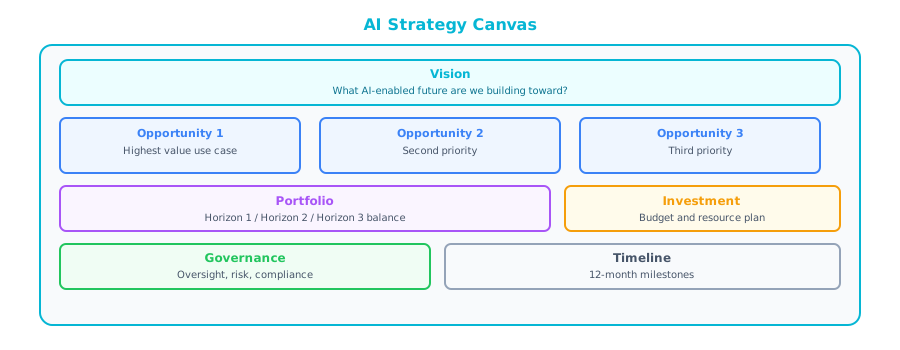
A good AI strategy does not require a hundred-slide deck. It requires clarity on a small number of essential questions. The following canvas can be completed in a single working session with your leadership team, and it produces a document that can actually guide decisions.
ONE-PAGE AI STRATEGY CANVAS
Company: _______________ Date: _______________ Owner: _______________
SECTION 1: STRATEGIC CONTEXT (What is the business trying to achieve?)
Our top three strategic priorities for the next 24 months are:
The primary competitive threats we face are:
Our biggest operational constraints are:
SECTION 2: VALUE OPPORTUNITIES (Where does information underuse create constraint?)
After surveying our business, the highest-value opportunities where AI could close the gap are:
| Opportunity | Current State | Target State | Estimated Value |
|---|---|---|---|
SECTION 3: INITIATIVE PORTFOLIO (What are we actually going to do?)
| Initiative | Category (Auto/Transform) | Timeline | Budget | Owner | Success Metric |
|---|---|---|---|---|---|
SECTION 4: CAPABILITY REQUIREMENTS (What do we need to be able to do?)
Data readiness priority: _______________
Talent strategy (hire/upskill/outsource): _______________
Governance requirements: _______________
Infrastructure decisions: _______________
SECTION 5: GUARDRAILS (What will we NOT do?)
We will not pursue AI initiatives that:
SECTION 6: REVIEW CADENCE
We will review this strategy on [date] and at [quarterly/bi-annual] intervals thereafter.
Success of the overall strategy will be measured by: _______________
The guardrails section deserves particular attention. The most disciplined AI strategies include explicit statements about what the organization will not do. This prevents scope creep, protects against enthusiast-driven expansion, and creates a framework for saying no to proposals that are exciting but not strategically aligned.
Examples of effective guardrails:
- "We will not build custom AI systems when vendor solutions that meet our requirements exist."
- "We will not deploy AI in customer-facing contexts without explicit human review of outputs."
- "We will not pursue AI initiatives without a defined data owner and a validated data readiness assessment."
- "We will not approve AI initiatives with a value hypothesis of less than $500,000 annually."
Making the Strategy Real: From Canvas to Roadmap
A strategy canvas produces direction. A roadmap converts that direction into sequenced, resourced action. The transition from canvas to roadmap requires three conversations that are often skipped:
The sequencing conversation: Given your portfolio of initiatives, which ones must come first because others depend on them? Data infrastructure investments typically need to precede analytics applications. Governance frameworks need to precede customer-facing deployments. Getting the sequence right prevents costly restarts.
The dependency conversation: What must be true for each initiative to succeed? For each item on the portfolio, identify the three or four critical assumptions about data, people, and organizational readiness. Decide how you will validate those assumptions before committing full investment.
The portfolio balance conversation: A healthy AI portfolio has initiatives across multiple time horizons. Quick wins, demonstrable within 90 days, build organizational confidence and fund future investment. Medium-term bets, 6 to 18 months, address material business problems. Long-term strategic investments, 18 or more months, create durable competitive advantage. If your portfolio is all long-term bets, you have no early proof points. If it is all quick wins, you are optimizing for optics rather than strategy.
The Strategy Test
Before your AI strategy is presented to the board or used to drive budget allocation, test it against these questions:
- Can every initiative in the portfolio be traced back to a strategic priority in Section 1 of the canvas? If not, what is it doing there?
- Does every initiative have a named owner who is accountable for the stated success metric? Not accountable for delivering the technology — accountable for the business outcome?
- If you removed the word "AI" from every initiative description and replaced it with "better process," would any of them stop making sense? If yes, the AI is the point rather than the value.
- Would your best customers care about any of these initiatives if they knew about them? If not, you may be optimizing internal operations rather than competitive position.
- Is there anything in the strategy that would genuinely surprise a well-informed competitor? If the answer is no, the strategy is not creating competitive advantage — it is maintaining competitive parity at substantial cost.
The Role of the Executive Sponsor
Every AI strategy needs an executive sponsor who is not the CTO or CIO. When AI strategy is owned exclusively by the technology function, it tends to produce technology roadmaps rather than business strategies. The technology function is excellent at identifying what AI can do. They are not the right function to determine what the business should do with it.
The most effective AI strategies are co-developed between business and technology leadership, with a business-side executive as primary sponsor. This structural choice sends a clear signal: AI is a business strategy, not a technology project. It also creates the accountability structure that distinguishes successful from unsuccessful initiatives. A business executive is on record claiming a business outcome, and their performance evaluation includes whether that outcome was delivered.
That accountability is not a burden. It is the mechanism that converts strategy from a document into a set of outcomes.