Chapter 01 of 15
What AI Actually Does (and What It Doesn't)
Strip away the vendor hype and understand what AI can genuinely do for your business today — and where it will let you down if you trust it too much.
Overview
There is a rule in commercial real estate: if you want to know what a building is actually worth, don't ask the broker who is trying to sell it. Get an independent appraisal. The broker is not necessarily lying. But their job is to present the asset in its best light, and yours is to know the difference between "best light" and "daylight."
AI in 2026 needs the same treatment. The demos are extraordinary. The press releases are breathless. The board has already asked why your company isn't doing more of it. Underneath all of that, there is a technology that is genuinely powerful in specific, well-understood ways — and genuinely unreliable in ways that most vendor presentations quietly skip over.
This chapter is your independent appraisal.
What AI Actually Is (In Plain English)
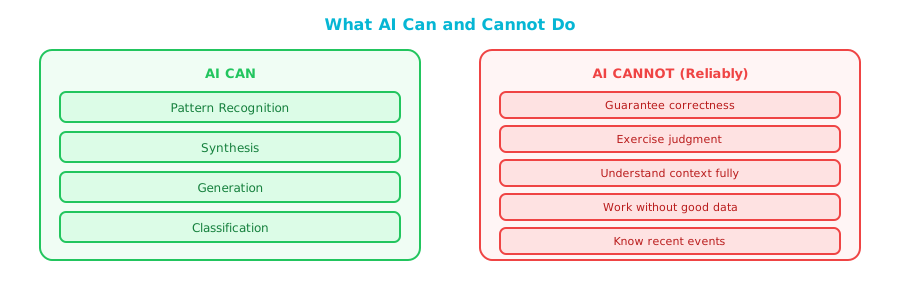
Artificial intelligence, as it exists today in most enterprise deployments, is a sophisticated pattern-matching and generation system. It was trained on enormous quantities of text, images, or data, and it learned to recognize patterns in that information and reproduce them in response to new inputs.
That is it. That description sounds underwhelming compared to the marketing, but it is the honest foundation you need before any strategy conversation.
The most commercially significant form of AI right now is the large language model (LLM). Think of it as a system that has read an enormous fraction of human-written text: billions of documents, books, articles, websites, and records. It learned how language patterns work. When you ask it a question, it generates a statistically likely continuation of that conversation based on everything it has read.
Imagine hiring a consultant who has read every business book, every industry report, every case study, and every analyst note ever published — but who has never run a company, signed a payroll check, or been responsible for a quarterly result. That consultant can synthesize, explain, draft, and summarize brilliantly. They cannot tell you what your specific customers want. They cannot guarantee their cited data is accurate. They cannot be held accountable the way a named executive can. AI is that consultant.
The 4 Things AI Is Genuinely Good At
These are not aspirational. These are capabilities delivering measurable value in production environments today.
1. Pattern Recognition at Scale
AI can scan thousands or millions of data points and surface patterns that would take human analysts weeks to identify. This includes:
- Detecting anomalies in financial transactions that suggest fraud
- Identifying customer churn signals across thousands of accounts before a human would notice
- Flagging contract language that deviates from standard terms across a portfolio of hundreds of agreements
- Spotting manufacturing defect patterns across production line sensor data
The key insight is scale. A skilled human analyst can recognize patterns. AI can do it across a dataset 1,000 times larger, in minutes rather than months. That is the difference that makes it valuable.
2. Synthesis and Summarization
AI can take large volumes of unstructured information — documents, emails, transcripts, reports — and produce coherent, structured summaries. Use cases that are working in production:
- Summarizing earnings calls, analyst reports, or board materials in minutes
- Distilling 500 customer support tickets into a prioritized list of recurring issues
- Condensing a 200-page due diligence report into a 5-page executive brief
- Creating meeting summaries with action items extracted automatically
The value here is throughput. Tasks that required a junior analyst two days now take two minutes. That analyst can then focus on evaluation, judgment, and action instead of document processing.
3. Generation of First-Draft Content
AI can produce first drafts of written content at a quality level that meaningfully reduces the time required to reach a final product. This includes:
- Marketing copy, email campaigns, and social content
- Internal policy documents and standard operating procedures
- RFP responses based on prior successful bids
- Job descriptions, performance review templates, and training materials
- Code (for technical teams) and formulas (for analysts)
The critical qualifier is "first draft." AI-generated content requires human review, especially for anything customer-facing, legally significant, or strategically sensitive. The value is in eliminating the blank page problem and compressing the drafting cycle.
4. Classification and Routing
AI can categorize inputs and route them to appropriate next steps with high accuracy and zero fatigue. Examples:
- Classifying incoming customer support requests by type, urgency, and department
- Sorting expense reports by policy compliance category
- Tagging and categorizing news, regulatory filings, or social media mentions
- Routing insurance claims to the appropriate adjuster or processing workflow
Classification is one of AI's highest-confidence capabilities and often one of its best return-on-investment use cases. The cost per classification decision drops to near zero, and the system doesn't have bad days.
The 5 Things AI Cannot Do
These are not temporary limitations that will be solved in the next release. They are structural properties of how current AI systems work. Your vendors are unlikely to walk you through them.
1. Guarantee Correctness
AI systems do not know when they are wrong. They produce outputs with the same confident tone whether those outputs are accurate or fabricated. In the industry, we call invented information "hallucinations" — but that word makes it sound more exotic than it is. It is simply the system generating a plausible-sounding response that does not correspond to reality.
In a customer-facing or compliance context, this is not a minor inconvenience. A hallucinated drug interaction in a healthcare summary, a fabricated citation in a legal document, or an invented product specification in a sales proposal are all business liabilities.
Every AI output that will be acted upon or shared externally requires a human review step. This is not optional. Any deployment plan that does not budget for it is not a realistic plan.
2. Replace Human Judgment in Complex Decisions
AI can inform decisions. It cannot make them. The distinction matters more than most executives realize.
Consider a hiring decision. AI can screen resumes, flag relevant experience patterns, and summarize interview transcripts. But the judgment call — whether this person will thrive in your culture, lead under pressure, or represent the company well to clients — requires context, intuition, and accountability that AI cannot provide.
The same applies to strategic decisions, M&A evaluations, major customer negotiations, and organizational changes. These are domains where the variables are ambiguous, the stakes are high, and someone needs to be accountable. AI is a tool to support that accountability, not a substitute for it.
3. Understand Context the Way Humans Do
AI operates on text. It does not understand the unspoken context that shapes every real business situation: the tension between two department heads, the fact that a key customer is on thin ice, or the strategic reason your company made an apparently irrational decision three years ago.
This is why AI systems can produce responses that are technically accurate but wrong for the situation. They lack the institutional context that experienced humans carry. The more context-dependent a task, the more carefully AI outputs need to be filtered through human judgment.
4. Work Without Data
AI systems require data to function, and the quality of that data determines the quality of outcomes. This is a consistent failure point:
- If your data is incomplete, AI outputs will be incomplete.
- If your data is biased, AI outputs will be biased.
- If your data is fragmented across a dozen systems that don't talk to each other, AI cannot access what it needs.
- If your data describes yesterday but your business has changed, AI will give you yesterday's answers.
The phrase "garbage in, garbage out" predates AI by decades. It is more relevant now than ever.
5. Stay Current Automatically
AI models are trained on data up to a certain date. After that, they stop learning unless they are updated. A model trained through mid-2024 does not know about regulatory changes from Q3 2025, your new product line launched last fall, or the market shift that happened in January.
This is the knowledge cutoff problem, and it catches organizations off guard constantly. Teams deploy an AI system, trust it as a current source of information, and do not realize it is operating on stale data until something goes wrong.
Solutions exist. Systems can be built to feed current data into AI at query time. But they require deliberate architecture and ongoing maintenance. This does not happen automatically.
Why Your Vendor Demo Worked Perfectly (And Production Won't)
Every executive who has sat through an AI vendor demo has seen the same thing: it works flawlessly. The AI answers every question with impressive accuracy. The interface is clean. The response time is fast. The outputs look exactly right.
Here is what you were not seeing.
The demo data was curated. The vendor selected examples where the AI performs best. The edge cases, the ambiguous queries, the situations where the model confidently produces the wrong answer — those were not in the demo script.
The demo environment has no legacy systems. Your production environment connects to a CRM customized in 2017, an ERP on a version your vendor hasn't supported in three years, and a data warehouse built by a team that is no longer with the company. The demo connected to clean, well-structured sample data.
The demo had no volume or variation. Real users ask questions in unpredictable ways. Real data has inconsistencies, gaps, and exceptions. Real usage patterns include edge cases the vendor never anticipated.
The demo had no governance requirements. In production, you need audit trails, access controls, data residency compliance, and accountability mechanisms. None of that appears in a demo.
The gap between demo and production is real, consistent, and predictable. It does not mean the technology is fraudulent. It means you are evaluating it in ideal conditions. Build your expectations accordingly.
The Non-Determinism Problem
Here is a concept that surprises most executives and creates genuine business challenges.
When you ask a human analyst to run the same calculation twice, you get the same answer. When you run the same SQL query twice, you get the same result. When you ask an AI the same question twice, you may get two different answers.
This is not a bug. It is a design characteristic. AI systems introduce a controlled degree of randomness in their outputs — called "temperature" in the technical literature — because pure determinism would make responses feel robotic. A small amount of variability makes the outputs more natural.
The business problem is that you now have a system that does not reliably produce the same output from the same input. For audit purposes, regulatory compliance, quality control, and customer trust, this matters.
Imagine if your accounting software gave you a slightly different balance sheet each time you ran the month-end close — not because the data changed but because the system had a small random element built in. Your auditors would not accept it. Your board would not trust it. But this is exactly how raw AI systems behave. That is why production deployments require additional engineering to constrain and validate outputs before they are acted upon.
Any AI initiative that touches regulated outputs, financial reporting, legal documents, or externally visible content requires explicit controls to manage non-determinism. This is engineering work, and it has a cost.
AI Capability vs. Business Reality
| AI Capability | What It Means | Business Reality | Where It Adds Value |
|---|---|---|---|
| Pattern recognition | Finds patterns in large datasets | Only as good as the data it sees | Fraud detection, churn prediction, quality control |
| Synthesis | Condenses large volumes of text | May omit or distort important nuance | Research summaries, document review, reporting |
| Generation | Produces first-draft content | Requires human review before use | Marketing, internal docs, proposals |
| Classification | Categorizes inputs accurately | Accuracy degrades on unusual inputs | Support routing, document tagging, compliance screening |
| Conversation | Handles natural language dialogue | Does not retain context across sessions unless engineered | Customer service, internal Q&A, search |
| Reasoning | Follows logical chains | Fails unpredictably on complex multi-step logic | Analysis support, not standalone decisions |
| Factual recall | Answers questions from training data | Knowledge has a cutoff date; hallucinations occur | General reference, not authoritative source |
| Code generation | Produces functional code | Requires review; introduces security risks | Developer productivity, not autonomous systems |
What This Means for Your Decisions
You do not need to be a technologist to make good AI decisions. But you do need to hold the technology to the same standard you would hold any other significant business investment.
When evaluating an AI initiative, apply these questions before any dollar is committed:
What specific capability is this using? If the answer is vague, push for specificity. Which of the four genuine capabilities is this using, and how?
What is the human review process? Every AI output that will be acted upon needs a defined review step. If the proposal does not include one, it is not complete.
What data does it require, and do we have it? If the answer assumes your data is cleaner or more connected than it is, the initiative will underperform.
How does it behave when it is wrong? All AI systems are wrong sometimes. The question is not whether the system will fail, but how it fails and what happens when it does. If the vendor has not answered this clearly, you do not have enough information to commit.
What would we do if the system were unavailable for a week? If the answer is "we would be paralyzed," you have created a critical dependency without adequate continuity planning.
These are not technical questions. They are the same due diligence questions you would apply to any business system. AI does not exempt an initiative from standard evaluation rigor.
AI is a genuinely powerful set of capabilities creating real competitive advantage in specific, well-understood applications. It is not magic, not omniscient, and not a replacement for human judgment. It is a tool — an exceptional one in the right context — that requires clear-eyed evaluation, proper deployment, and ongoing oversight.
The executives who will get the most value from AI in the next three years are not the most enthusiastic about the technology. They are the ones who understand it clearly enough to apply it where it genuinely excels, and disciplined enough to say no where it does not.