Chapter 05 of 15
Is Your Organization AI-Ready?
Assess your organization's readiness across five dimensions — data, talent, culture, governance, and infrastructure — and know where to start even if the score is low.
Overview
The most consistent finding across organizations that have succeeded with AI at scale is not that they had the best technology, the largest budgets, or the most experienced data science teams. It is that they understood their starting point clearly and built their AI program around that reality rather than against it.
Organizations that honestly assess their data problems and invest in fixing them before deploying AI get dramatically better results than those that deploy AI while pretending the data problem does not exist. Organizations that honestly assess their cultural readiness for AI-driven change and invest in building it get dramatically better adoption outcomes than those that treat adoption as an afterthought.
Readiness assessment is not an academic exercise. It is practical strategic intelligence that determines where to start, what to invest in first, and which failure modes to guard against most aggressively.
The 5 Readiness Dimensions
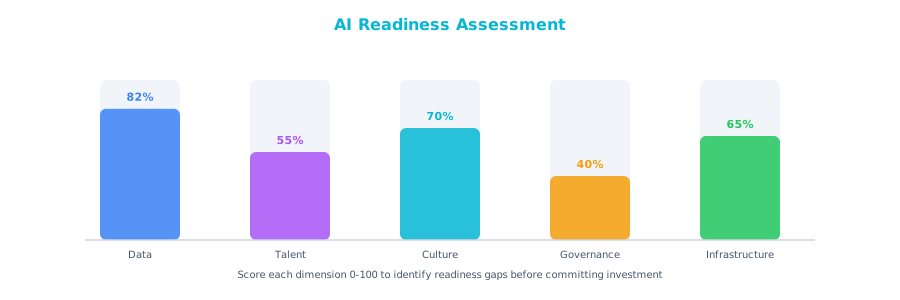
Dimension 1: Data Readiness
Data readiness measures whether your organization has the information infrastructure necessary for AI systems to function effectively. AI is only as good as the data it operates on, and data problems are the single most common cause of AI underperformance.
Data readiness has four components:
Availability: Does the data relevant to your AI use cases actually exist? Is it captured in accessible systems, or does it live in spreadsheets, paper records, or people's heads?
Quality: Is the data clean, consistent, and complete? Does it use standardized formats and coding conventions? Are there significant gaps, duplicates, or inconsistencies that would compromise AI outputs?
Accessibility: Can the data be extracted from the systems that hold it? Are there technical barriers (proprietary formats, legacy system constraints), contractual barriers (data sharing restrictions), or regulatory barriers (privacy requirements) that limit access?
History: Does your data history extend far enough back to train meaningful patterns? For many AI applications, two to five years of clean historical data is the minimum viable foundation. If your systems were migrated or restructured recently, the historical record may be incomplete.
Dimension 2: Talent Readiness
Talent readiness measures whether your organization has the human capability to implement, manage, and continuously improve AI systems.
At the leadership level, this means AI literacy — the ability to ask informed questions, evaluate proposals critically, and make decisions about AI investments with reasonable judgment. It does not mean executives need to understand the technical details of model architecture; it means they need a working knowledge of what AI can and cannot do.
At the practitioner level, this means having people who can translate business requirements into AI specifications, evaluate vendor proposals technically, oversee implementation, and manage production AI systems. This capability can be built through hiring, upskilling existing staff, or accessing through partnerships.
Dimension 3: Culture Readiness
Culture readiness measures whether your organization's norms, incentives, and behaviors support productive AI adoption.
This is frequently the least visible readiness dimension and the one most likely to be the actual constraint on AI success. Organizations with excellent data and strong technical talent frequently fail at AI because their culture produces the wrong behaviors. Siloed data ownership prevents AI systems from accessing the information they need. Resistance to workflow changes driven by job security concerns blocks adoption. A blame culture makes it impossible to acknowledge and learn from AI failures.
Key cultural questions: Does your organization learn from failure, or does failure create defensiveness? Do your incentive structures reward the adoption of new approaches, or do they reward existing processes? Do your data owners share information openly, or does data ownership create power dynamics that limit access?
Dimension 4: Governance Readiness
Governance readiness measures whether your organization has the structures, policies, and processes necessary to deploy AI responsibly and manageably.
This does not mean you need a complete AI governance framework before you start. It means you need to have started the conversation, have accountable parties for the policies that will be required, and have a plan for building governance in parallel with deployment rather than discovering the need for it after something goes wrong.
Key governance questions: Do you have a data privacy framework that covers AI applications? Is there a defined process for reviewing AI decisions that affect customers or employees? Is there clarity on who is accountable when an AI system produces an incorrect or problematic output?
Dimension 5: Infrastructure Readiness
Infrastructure readiness measures whether your technology environment can support AI systems technically — connecting them to the data and workflow systems they need, operating at the required performance levels, and integrating with existing platforms without requiring wholesale replacement.
For most organizations, this includes cloud computing capacity, data integration capabilities, and API connectivity to core business systems. Most organizations that have undertaken cloud migration in the past five years have adequate infrastructure for most AI applications; those still operating primarily on legacy on-premises infrastructure will face additional complexity.
10-Question AI Readiness Diagnostic
Answer each question with High (2 points), Medium (1 point), or Low (0 points).
Data Readiness
-
Our core business data is stored in structured systems that can be queried programmatically, not primarily in spreadsheets or paper records.
-
We have at least three years of clean, consistent historical data for our primary business processes.
Talent Readiness
-
At least one member of our leadership team can evaluate an AI vendor proposal critically and identify technical risks.
-
We have either internal technical staff experienced with AI/ML implementations or established relationships with partners who have this capability.
Culture Readiness
-
When a technology initiative does not perform as expected, our organization treats it as a learning opportunity rather than assigning blame to individuals.
-
Our data — customer data, operational data, financial data — is accessible across teams when there is a business need, rather than locked within departmental silos.
Governance Readiness
-
We have a current data privacy policy that is actively enforced and reviewed at least annually.
-
We have a defined process for reviewing technology changes that affect how decisions about customers or employees are made.
Infrastructure Readiness
-
Our primary business systems have modern API connectivity that allows integration with third-party tools.
-
We have an active cloud infrastructure relationship with at least one major cloud provider.
Scoring:
- 16-20 points: Strong foundation. Focus on initiative selection and execution quality.
- 11-15 points: Moderate readiness. Identify 2-3 specific gaps and address them before or alongside your first major AI initiative.
- 6-10 points: Significant gaps. Start with a capability-building phase before major AI deployment. Choose a small, low-risk pilot to build organizational experience.
- 0-5 points: Fundamental readiness issues. AI investment should be preceded by data infrastructure, governance, and organizational development. A small internal pilot can build experience while foundation is addressed.
What to Do If You Score Low
A low readiness score does not mean you cannot start with AI. It means you need to start differently.
If data readiness is your constraint: Begin with a data inventory and quality assessment. Identify one or two data sources that are relatively clean and accessible. Run your first AI initiative against those data sources rather than against the data that is most important strategically. Use the pilot to build experience while investing in improving the broader data foundation.
If talent readiness is your constraint: Do not attempt to hire a complete internal AI team immediately. Access capability through a trusted partner while simultaneously running an upskilling program for your existing technical staff. Use the partner engagement as a knowledge transfer opportunity. Set explicit expectations that your team members are learning alongside the partner, not just managing a vendor relationship.
If culture readiness is your constraint: This is the most nuanced gap to address and the one most likely to be underestimated. Culture change cannot be mandated — it has to be modeled. Leadership behavior that rewards honest assessment of AI performance, shares information across departmental boundaries, and treats AI failures as learning events rather than political liabilities is the primary driver of culture change. Targeted workshops help. Changed incentives help. Sustained leadership behavior is what actually shifts culture.
If governance readiness is your constraint: Establish minimum viable governance before deploying any production AI. This means: a named owner for AI policies, a clear definition of which AI applications require review before deployment, and a defined escalation process for AI-related concerns. This does not need to be a hundred-page policy framework. It needs to be clear enough that people know what to do when they are unsure.
If infrastructure readiness is your constraint: Identify whether your infrastructure gap is a blocker for your specific near-term AI use cases or a more general constraint. Some AI applications can be deployed as cloud-native tools that do not require deep integration with legacy infrastructure. Starting there while investing in infrastructure remediation for later-stage applications is a pragmatic approach.
The Talent Question: Hire, Upskill, or Outsource?
This question surfaces in every AI strategy conversation, and the answer depends on factors specific to your organization and ambitions.
Hire when:
- You are committed to AI as a core strategic capability for three or more years
- The competitive advantage you seek depends on proprietary data and models that require deep customization
- You have the management infrastructure to support a specialized technical team
- Salary and equity benchmarks in your market are competitive with what AI talent can earn at technology companies
The reality of hiring: AI practitioners — ML engineers, data scientists with production experience, MLOps specialists — are among the most competitively compensated roles in the market. Entry-level ML engineers command $130-180K base in major markets. Experienced practitioners are accessible primarily to technology companies and large financial institutions. If your compensation structure cannot compete, hiring will be chronically under-resourced.
Upskill when:
- You have existing technical staff (software engineers, data analysts, BI developers) who are motivated to develop AI skills
- Your primary AI use cases involve deploying and configuring existing vendor platforms rather than building custom models
- You have time for a 6-12 month capability development investment
- Retention of institutional knowledge in AI systems is important
The reality of upskilling: Not all technical staff want to transition to AI roles. The ones who do are often the highest performers, which means you are investing in development for people who could be hired away. A visible career development pathway, clear opportunities to apply new skills, and recognition of AI capability in performance evaluation are all necessary to make upskilling investment stick.
Outsource when:
- You need to move quickly and do not have time for a hiring or upskilling cycle
- Your AI use cases are specific and bounded — a specific initiative rather than an ongoing program
- You want to evaluate AI capability before committing to a permanent team
- You are in a regulatory environment where AI work requires specialized compliance expertise
The reality of outsourcing: Partner relationships produce the best results when they are structured as capability transfers rather than pure delivery agreements. If the partner builds your AI systems without your team deeply involved in the work, you will be dependent on that partner indefinitely. The best partnership structures include explicit knowledge transfer goals, joint teams where your people work alongside the partner's people, and a planned transition timeline.
Most organizations that have built effective AI programs over 18-36 months end up with some version of all three: a small core team of internal AI practitioners, hired or upskilled, supported by a partner relationship for specialized work and surge capacity, supplemented by vendor tools that reduce the custom engineering burden.
Building AI Literacy Across the Organization
One of the highest-return investments an organization can make in AI readiness is building a baseline level of AI understanding across the entire leadership population — not just the technical team.
AI-literate leaders ask better questions, make better investment decisions, and are more effective at identifying high-value opportunities. They are also more credible to their teams when they lead AI change initiatives, because they speak from understanding rather than assumption.
Effective AI literacy programs for senior leaders have four characteristics:
Business framing, not technical training. The goal is to help leaders make better business decisions involving AI, not to train them as data scientists. Content should be anchored in business decisions, business outcomes, and business risks — not in model architecture.
Case-study heavy. Abstract explanations of how AI works are far less effective than concrete case studies from comparable organizations that illustrate what worked, what failed, and why. The more industry-relevant the cases, the better.
Brief and repeated rather than long and one-time. A two-day training session is less effective than a series of 90-minute sessions spread over six months, each tied to current decisions the organization is facing.
Action-oriented. Each session should end with a specific, practical commitment: a question to ask in an upcoming vendor meeting, a decision framework to apply to a current initiative, a conversation to have with a direct report. Learning that does not produce changed behavior is not business investment.
Readiness Dimension Summary
| Dimension | Key Assessment Questions | Common Remediation Path |
|---|---|---|
| Data | Is core business data accessible, clean, and historical? | Data audit, quality improvement program, data architecture investment |
| Talent | Do we have AI literacy at leadership and practitioner level? | Upskilling program, strategic partner relationship, selective hiring |
| Culture | Do norms support sharing, learning, and change? | Leadership modeling, incentive structure review, cross-functional data sharing policy |
| Governance | Do policies and accountability exist for AI decisions? | Minimum viable AI governance framework, named policy owner, review process |
| Infrastructure | Can systems connect to and support AI applications? | Cloud infrastructure investment, API enablement of core systems |
Every organization that has built a successful AI program started with significant readiness gaps. The ones that succeed are not the ones that achieve perfect readiness before starting — that state never arrives. They are the ones that understand their gaps clearly enough to start in the right place, invest in closing the gaps systematically, and do not attempt AI applications that require capabilities they do not yet have.
The readiness assessment tells you where to start, not whether to start.