Chapter 10 of 15
What's Coming Next (and What to Ignore)
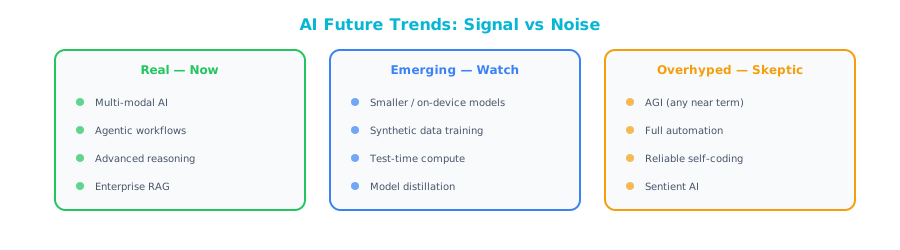
The AI landscape produces a new breathless announcement every two weeks. Here is how to separate the trends that will materially affect your business from the ones that will not — and a 30-minute monthly ritual that keeps you informed without consuming your calendar.
Overview
One of the defining challenges for executives in 2026 is that staying informed about AI requires filtering at a level that did not exist for previous technology cycles. The volume of news, announcements, research papers, vendor briefings, and breathless punditry is genuinely unprecedented. If you tried to read everything relevant, you would not have time to run your business.
The filter cannot be "ignore it all and let the team handle it," either. Executives who are most effective with AI are not those who know the most technical details. They are those who have developed reliable signal detection: the ability to recognize the trends that will materially affect their business and distinguish them from the noise that will not.
The Two Questions That Separate Signal from Noise
 Before reacting to any AI development, ask two questions.
1. Does this change what is possible for my business in the next 18 months?
Most AI news is about incremental capability improvements that do not meaningfully change what is already deployed or deployable. A new model that performs 8% better on a benchmark matters to researchers. It rarely matters to an enterprise choosing between already-capable models. The question is not "is this impressive?" but "does this cross a threshold that changes my strategy?"
2. Is there production evidence, or is this still experimental?
AI announcements typically precede production reality by 12 to 24 months for enterprise deployment. A capability demonstrated in a research paper in Q1 may be commercially available in Q3, but may not be reliably deployable in regulated enterprise environments until the following year. Separate "announced," "generally available," and "in production at enterprises like mine."
When a new drug is announced in Phase 1 clinical trials, the financial press often reports it as a breakthrough. The oncologist treating your family member does not start prescribing it. They wait for Phase 3 data, FDA approval, and evidence from real-world post-market surveillance. The announcement is real news. It is not actionable clinical guidance. AI announcements work the same way. The researcher's Twitter thread and the enterprise deployment are separated by 18 months and a lot of engineering reality.
Trends That Will Materially Affect Your Business
These are developments with production evidence, meaningful enterprise adoption, and demonstrable business impact. They warrant active monitoring and, in most cases, active investment.
1. Agentic AI (Already Covered — Now Accelerating)
Chapter 9 covered agentic AI as a current reality. What is accelerating in 2026 is the scope and reliability of agents: longer task horizons, better recovery from errors, richer tool access, and emerging frameworks for multi-agent coordination.
The competitive advantage gap between organizations with mature agentic deployments and those just starting will widen through 2026–2027. This is not future-trend watching — it is current-cycle competitive positioning.
The question to ask quarterly: Which of our competitors have deployed agents in customer-facing or operational contexts, and what do we know about the impact?
2. Multi-Modal AI: Beyond Text
Most enterprise AI in 2024 was text-in, text-out. Through 2025 and into 2026, commercially reliable multi-modal capability — AI that processes and generates images, video, audio, documents, and structured data in combination — has become production-ready.
The business implications are category-specific but often significant:
- Insurance and inspection: AI that can process photos of claims, construction sites, or equipment alongside text documentation and structured claims data, and produce an integrated assessment
- Retail and e-commerce: AI that understands product images and generates copy, manages visual catalog, and enables visual search
- Healthcare: AI that processes medical imaging alongside clinical notes and lab results in a unified clinical workflow
- Manufacturing: AI vision systems that perform quality inspection and connect findings to process data
- Legal and finance: AI that processes charts, contracts, exhibits, and supporting documents together rather than requiring text conversion first
The question to ask: In our core workflows, where are humans currently translating between formats — describing what they see in an image, transcribing what was said in a meeting, extracting numbers from a chart — and could multi-modal AI eliminate that translation step?
3. Reasoning Models: Better at Complex Problems
A distinct class of AI model — often called "reasoning models" or "o-series" type models — has emerged that uses additional computational steps to think through complex problems before responding. These models are meaningfully better than standard models at:
- Multi-step logical problems
- Complex mathematical reasoning
- Legal and regulatory analysis requiring careful chain-of-thought
- Strategic scenario analysis
They are also meaningfully slower and more expensive per query than standard models. This creates a practical architecture question: which of your use cases need deeper reasoning and should use reasoning models at higher cost, versus which need fast response and should use standard models?
For executives, the implication is that AI is no longer a single capability. It is a portfolio of capabilities at different cost and performance points — more like a professional services firm with different tiers of expertise than a single software tool.
4. AI-Native Software Replacing Traditional Enterprise Software
The most strategically significant trend that does not get enough executive attention is the rate at which AI-native competitors are emerging to challenge legacy enterprise software categories.
ERP, CRM, HRIS, legal research tools, financial modeling platforms: in almost every category, new entrants are building software where AI is the primary interface and primary capability, not a feature added to an existing system. These new entrants often have dramatically lower implementation costs, faster time to value, and better user adoption than incumbent systems.
The strategic risk: your competitors are considering replacements to the same legacy systems you are. If they adopt AI-native alternatives and you do not, the productivity gap is structural, not marginal.
The question to ask: Which of our core enterprise software contracts are up for renewal in the next 24 months, and have we evaluated AI-native alternatives in those categories?
5. Industry-Specific Models
General-purpose models (the ones most people use by default) are increasingly being complemented by models trained specifically on domain data: legal documents, medical literature, financial filings, engineering specifications.
These specialized models often outperform general models on domain-specific tasks — not because they are fundamentally more capable, but because their training data is more relevant. A model trained on case law and legal briefs will produce better contract analysis than a general model given the same prompt.
For organizations with specialized data and specialized workflows, the question is whether a general model with good prompting is sufficient or whether domain-specific fine-tuning or model selection would produce meaningfully better outcomes.
What to Ignore (or At Least Deprioritize)
AGI Timelines
Artificial General Intelligence — the science fiction version of AI that can do anything a human can do, across all domains, with general reasoning — is a topic of genuine academic debate and completely irrelevant to your business planning horizon.
The organizations making AGI predictions range from serious researchers who genuinely disagree about timelines (estimates range from never to 2030 to 2060+) to vendors with obvious incentive to make the technology sound more transformative than it is.
Nothing about AGI timelines should affect your Q2 budget, your 18-month roadmap, or your board presentation next month. When someone in a vendor briefing invokes AGI, treat it as a signal that they have run out of production evidence and moved to speculation.
Specific Model Benchmarks
The AI research community produces benchmark comparisons continuously — Model X outperforms Model Y on task Z by N percent. These benchmarks matter to researchers selecting and training models. For enterprise deployment decisions, they are almost always the wrong input.
What matters for enterprise deployment is real-world performance on your specific task, your specific data, in your specific operating environment. A model that tops the MMLU benchmark may underperform a less-hyped model on your customer service corpus. Always evaluate on your own tasks, not on reported benchmarks.
Blockchain + AI Combinations
Every two or three years, a new wave of vendors combines AI with blockchain in ways that solve neither problem well. The governance properties of blockchain and the optimization properties of AI rarely produce synergistic value in enterprise contexts. Evaluate any such proposal on whether the blockchain component is solving a specific, demonstrated problem — and in most cases, the honest answer is no.
The "Next ChatGPT" Launch Cycle
New foundation models launch several times per year, each accompanied by significant press coverage and vendor enthusiasm. For the majority of enterprise deployments, the practical capability differences between top-tier models are smaller than the press cycle suggests, and switching costs mean that the right behavior is often to evaluate a new model carefully before switching, not to chase each launch.
Establish a model evaluation calendar (quarterly or semi-annually) rather than a reactive posture to each launch announcement.
The Executive Landscape Map
Use this framework to categorize AI developments as you encounter them:
| Category | Description | Your Action |
|---|---|---|
| Act now | Production-ready, material business impact, competitors moving | Prioritize in current roadmap |
| Prepare | Approaching production-readiness, business impact likely in 12–18 months | Pilot program, skill development, vendor evaluation |
| Monitor | Interesting capability, business impact unclear or 2+ years out | Quarterly check-in; no investment yet |
| Noise | Hype, speculation, marketing, benchmark theater | No action |
Most AI news is Noise or Monitor. A well-calibrated executive spends the bulk of their AI attention on the Act Now and Prepare categories.
The 30-Minute Monthly AI Update Ritual
Run it on the same day each month — the first Monday is a common choice. It takes 30 minutes if you run it with discipline. It keeps you informed, calibrated, and credible with your board and team without consuming your schedule.
Minutes 1–5: Three Headlines
Before your ritual, ask one person (your Chief of Staff, a trusted AI-literate team member, or a designated AI scout in your organization) to send you three AI developments from the past 30 days that meet this standard: "production evidence or near-production, relevant to our industry or our competitors, worth five minutes of the executive's attention."
That pre-filtering is the leverage. You are not reading everything — you are reading three things that someone who knows your business already screened.
In these five minutes: read the three items. Apply the two questions: does this change what is possible in the next 18 months? Is there production evidence?
Minutes 6–15: Competitor and Vendor Scan
Open your competitor monitor (news alerts, analyst reports, earnings call summaries). Look specifically for:
- AI-related product announcements from competitors
- AI references in competitor earnings calls (particularly in the context of cost reduction or competitive differentiation)
- Vendor announcements from your top three AI vendor relationships
The question you are answering: is anyone in my competitive landscape doing something with AI that I should be doing? Is there a capability gap opening?
Minutes 16–22: Internal Pulse Check
Review a one-page summary (your AI program lead should produce this monthly) covering:
- Status of active AI initiatives: on track, at risk, or needs decision
- Any incidents or governance concerns in the past 30 days
- Any requests from the business for new AI capabilities that are sitting without a decision
If you do not have a program lead producing this, assign one. The monthly summary is 15 minutes of someone's time and 7 minutes of yours — it is worth it.
Minutes 23–28: One Decision or Action
The ritual ends with something concrete. Choose one:
- A decision you were deferring that now has enough information
- An email to follow up on a delayed initiative
- A signal you want to investigate further
- A question to ask in your next board meeting or exec team discussion
The ritual without an output is reading for its own sake. The output — even if it is just a reply to an email — keeps the rhythm productive.
Minutes 29–30: Update Your Personal Signal Map
Keep a simple running document (a notes file, a single spreadsheet tab) with your personal view of:
- What is in the Act Now category for your business right now
- What has moved from Monitor to Prepare in the past quarter
- What you have decided to stop watching
Updating this takes two minutes. Over 12 months, it becomes a record of how your thinking evolved — and a useful input into your annual strategy review.
Staying Calibrated on Vendor Claims
A significant portion of the noise you will encounter comes from vendors — both your existing software vendors (who are adding AI features to justify pricing) and new AI-native vendors (who are selling transformation). A few calibration questions cut through most of it:
| Claim | The Calibration Question |
|---|---|
| "Our AI is different / unique / proprietary" | Can you explain specifically what makes it different in terms of outcomes for my business? |
| "Our customers see X% improvement" | What is the sample size, what was the baseline, and can I speak to two reference customers in my industry? |
| "AI will transform your [function]" | Name three companies of similar size and complexity where this transformation has happened and is sustained. |
| "You need to move now before competitors" | What is the actual window, and what specifically happens if I wait 90 days? |
| "Our AI is enterprise-grade / secure / compliant" | Walk me through your data handling, your compliance certifications, and your liability posture if your model produces an incorrect output that causes me harm. |
The vendors who have good answers to these questions are worth your time. The ones who pivot to different claims or get defensive are telling you something.
Building Your Personal AI Literacy Over Time
Executive AI literacy is not a destination. It is an ongoing practice. The landscape shifts fast enough that what was current knowledge 18 months ago is now partial knowledge.
The most time-efficient way to maintain it:
One substantive read per month. Not a news article — an in-depth piece. An analyst report, an academic summary written for a general audience, a long-form case study from an industry peer. One per month. Over two years, that is 24 substantive pieces of learning, which puts you well ahead of most executives.
Two or three conversations per quarter. One with your internal AI team (what are they seeing that I am not?). One with a peer at a non-competing company (what are they investing in?). One with a vendor or researcher doing interesting work. These conversations consistently produce more insight per minute than reading.
One conference or event per year. Not a vendor conference — too promotional. An industry analyst event, a peer executive forum, or a university-affiliated AI summit for practitioners. The conversations in the hallway are often more valuable than the sessions.
The 30-minute monthly ritual plus this ongoing learning program is roughly eight hours per quarter. A small investment for the decision-making context it provides — and one that compounds noticeably over time.