Chapter 06 of 15
AI Risk, Regulation & Responsible AI
Six AI risks every board should understand, a regulatory landscape that is no longer theoretical, and a responsible AI program built around what actually prevents costly failures — not what looks good in a principles document.
Overview
Board risk oversight has expanded steadily over the past decade. Financial controls, cybersecurity, data privacy, climate, supply chain resilience — each landed on board agendas in response to risks that materialized before most boards understood them well enough to ask the right questions. AI is at that inflection point now.
The organizations that established serious cybersecurity oversight around 2015 were materially better positioned when WannaCry and NotPetya arrived. The same dynamic is playing out with AI risk. The gap between boards that have built real oversight capability and those that treat AI governance as a slide deck exercise will show up in actual business outcomes — regulatory fines, operational failures, litigation, customer trust damage.
There is also now a substantial and growing body of law that makes AI governance something other than optional. The EU AI Act is in force. U.S. states have passed legislation. Sector regulators have clarified how existing laws apply to AI in ways that create material compliance obligations. This chapter covers all three dimensions: the risks, the regulations, and a responsible AI program that functions in practice rather than just on paper.
Part One: The Six AI Risks Boards Must Understand
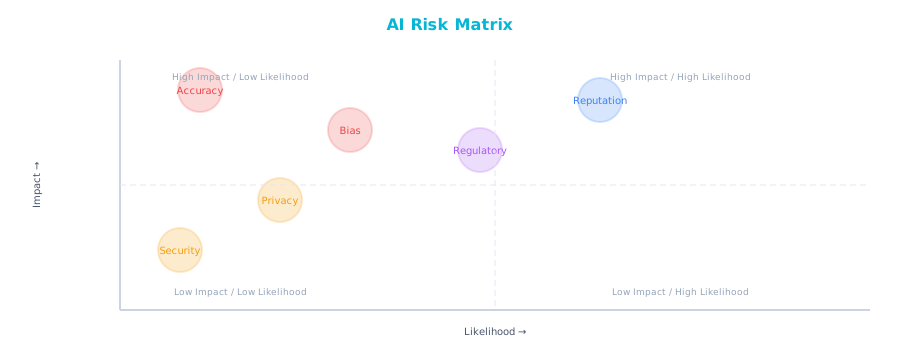
Risk 1: Accuracy Risk
What it is: AI systems produce incorrect outputs that are treated as correct — leading to decisions, communications, or actions based on false information.
In business impact terms: A financial institution deploys an AI system to summarize credit risk for loan applications. The system confidently summarizes a loan file with an incorrect debt-to-income ratio. A loan officer, trusting the summary, approves a loan that should have been declined. Multiplied across thousands of applications, this creates material credit losses.
The problem is not that AI is occasionally wrong — every information system has errors. The problem is that AI is wrong with confidence. Unlike a database that returns no result when data is missing, AI generates plausible-sounding outputs that look identical whether accurate or fabricated. There is no visible warning.
Board mitigation question: "For each AI system we have deployed that affects consequential decisions, what is the human review process that catches AI errors before they cause business impact?"
Risk 2: Bias Risk
What it is: AI systems systematically produce outcomes that disadvantage certain groups — defined by race, gender, age, geography, disability, or other protected characteristics — because the data they were trained on reflected historical discrimination.
In business impact terms: A major U.S. retailer deployed an AI pricing system that adjusted prices dynamically based on customer purchase history and location. An investigation revealed that pricing in predominantly minority zip codes was consistently higher than in comparable white zip codes — not because of a deliberate decision, but because the AI learned the pattern from historical pricing data that had historically discriminated. The resulting regulatory inquiry, class action, and reputational damage cost the company substantially more than the pricing optimization had saved.
Bias risk is particularly hard to see because the AI system is functioning correctly. It is producing outputs consistent with patterns in its training data. The patterns themselves encode discrimination, and the AI has now automated and scaled it. Imagine telling a new manager to make hiring decisions "the same way we've always done it." If your company had historically promoted men over equally qualified women, that manager following your instructions would continue to do so — not by making a discriminatory choice, but by executing your instructions accurately. AI behaves the same way when trained to replicate historical decision patterns without adjusting for historical bias. Intent is irrelevant. Outcome is what matters.
Board mitigation question: "For AI systems that affect decisions about customers, employees, or access to products and services, when was the last time we tested for differential outcomes across protected groups, and what did we find?"
Risk 3: Privacy Risk
What it is: AI systems process, expose, or generate personal data in ways that violate privacy law or individual expectations — creating regulatory and reputational liability.
In business impact terms: An organization deploys an AI system that ingests customer support conversations to improve response quality. Those conversations contain sensitive personal information: health conditions mentioned in passing, financial situations described, relationship details shared in the context of a service issue. The AI vendor's contract does not clearly specify how this data is stored, processed, or whether it is used to train shared models. Under GDPR, this creates potential fines of up to 4% of global annual revenue.
Privacy risk in AI runs higher than in traditional software because AI systems can infer sensitive information from non-sensitive inputs in ways that are difficult to anticipate and harder to audit.
Board mitigation question: "Does our AI use policy clearly specify what data can be used as input to AI systems, and has legal counsel reviewed it against our privacy obligations in all jurisdictions where we operate?"
Risk 4: Security Risk
What it is: AI systems create new attack surfaces that adversaries can exploit to manipulate outputs, steal sensitive information, or compromise operations.
In business impact terms: A company deploys an AI customer service chatbot with access to customer account information. An adversary discovers that carefully crafted queries can cause the AI to reveal details about other customers — a technique called prompt injection. Before the vulnerability is discovered, thousands of customer records are exposed.
A separate organization's employees regularly paste internal documents into a cloud-based AI productivity tool to generate summaries. Those documents include strategic plans, financial data, and personnel information. The vendor's terms of service include rights to process user inputs to improve their models. The organization has inadvertently disclosed confidential information through routine AI use.
Board mitigation question: "Has our security team reviewed the AI systems we have deployed for prompt injection vulnerabilities, data exposure risks, and the data handling practices of our AI vendors?"
Risk 5: Regulatory Risk
What it is: AI deployments run afoul of existing or new regulations governing automated decision-making, data use, consumer protection, or sector-specific requirements — creating fines, operational constraints, or forced remediation.
In business impact terms: The EU AI Act classifies certain AI applications as "high-risk" — including systems used in employment decisions, credit scoring, insurance pricing, and access to essential services. High-risk AI systems face stringent requirements: mandatory human oversight, technical documentation, conformity assessments, and registration in an EU database. Organizations that deployed these systems without these controls in place face fines of up to €30 million or 6% of global annual revenue.
Regulatory risk is dynamic. The compliance requirements are evolving faster than most organizations' legal and compliance functions can track. Organizations deploying AI without regulatory monitoring are accumulating latent compliance exposure that will eventually be realized.
Board mitigation question: "Who in our organization is responsible for monitoring AI regulatory developments and ensuring our deployments maintain compliance? When did they last brief the board?"
Risk 6: Reputational Risk
What it is: AI-related incidents — errors, bias findings, privacy violations, or failures — become visible to customers, media, or regulators in ways that damage brand trust, customer relationships, or employer brand.
In business impact terms: AI reputational incidents have a distinctive pattern. They are technical in origin but the narrative is always human. When an AI system makes a discriminatory hiring decision, the story is not about a statistical model — it is about whether your company values fairness. When an AI chatbot provides dangerous advice to a customer in distress, the story is not about a language model — it is about whether your company's technology put a vulnerable person at risk.
This makes AI reputational incidents frequently more damaging than comparable incidents in traditional software. They raise questions about organizational values, not just technical competence.
Board mitigation question: "For each customer-facing AI application we have deployed, do we have a defined incident response process that includes executive communication, customer notification where required, and remediation protocols?"
Part Two: How to Establish AI Risk Appetite
Risk appetite is the amount and type of risk your organization is willing to accept in pursuit of strategic objectives. A practical AI risk appetite framework addresses three questions.
What AI applications are categorically off-limits? These are deployments your organization will not make, regardless of business case, because the potential for harm is too high relative to the potential for benefit. Examples: AI systems that make final employment decisions without human review; AI systems that rely exclusively on AI-generated content in customer-facing communications.
What AI applications require senior leadership review? These are deployments that are permissible but require a defined approval process before deployment — including risk assessment, legal review, governance documentation, and an identified owner accountable for ongoing oversight.
What AI applications can proceed through standard processes? Lower-risk deployments — internal productivity tools, document summarization, research assistance — that can proceed through normal change management without additional AI-specific review.
Documenting these three categories, reviewing them annually, and routing all AI deployment proposals through the appropriate approval level creates a governance structure that is both rigorous and operationally practical.
Part Three: The Regulatory Landscape
For most of the past decade, AI operated in a largely unregulated space. That period is over.
The EU AI Act is in force. U.S. states have passed or are actively advancing AI-specific legislation. Sector regulators — in financial services, healthcare, employment, and consumer protection — have clarified how existing laws apply to AI in ways that create real compliance obligations. The question is not whether AI regulation applies to your organization. It almost certainly does. The questions are which specific requirements apply, what they demand, and what non-compliance costs.
The EU AI Act
The EU AI Act is the world's first comprehensive binding legal framework for artificial intelligence. It entered into force in August 2024, with provisions taking effect on a phased schedule through 2027. If you do business in the European Union — including if you offer products or services to EU customers from outside the EU — this law applies to you.
The Act classifies AI applications into four tiers based on potential for harm.
Unacceptable risk (prohibited): A small number of AI applications are banned outright. These include real-time biometric surveillance in public spaces, social scoring systems by public authorities, and AI that manipulates human behavior through subliminal techniques.
High-risk (heavily regulated): This is the tier that affects most large enterprises. High-risk AI includes systems used in:
- Employment decisions: recruiting, screening, performance evaluation, termination
- Credit and financial services: creditworthiness assessment, insurance underwriting
- Education: student assessment, access to educational institutions
- Access to essential services: benefits determination, public service routing
- Safety-critical infrastructure: healthcare diagnostics, transportation management
High-risk AI systems face substantial requirements: technical documentation, logging and audit trails, human oversight mechanisms, accuracy and robustness testing, conformity assessments, and registration in an EU database.
Limited risk: AI systems that interact with users — chatbots, AI-generated content — must disclose their AI nature. Users must be told they are interacting with AI.
Minimal risk: The majority of AI applications — spam filters, recommendation systems, productivity tools — fall here and face no specific requirements beyond applicable existing law.
The level of scrutiny scales with the potential for harm, much the way food safety regulations work. A chatbot helping users find restaurant recommendations faces different requirements than an AI system determining who gets credit. The more consequential the AI decision, the more documentation, oversight, and accountability the law demands.
Penalties for non-compliance: Violations of high-risk requirements: up to €15 million or 3% of global annual turnover. Violations involving prohibited applications: up to €35 million or 7% of global annual turnover.
U.S. State-Level AI Laws
The United States has no comprehensive federal AI law at the time of writing, but a growing body of state-level legislation creates real compliance obligations.
Colorado AI Act (SB 205, effective February 2026) applies to developers and deployers of AI systems that make or substantially assist "consequential decisions" relating to education, employment, financial services, essential government services, and healthcare. Requirements include impact assessments, consumer disclosure, opportunity to appeal automated decisions, and annual reporting on risk management practices.
California has enacted several AI-relevant laws. The California AI Transparency Act (SB 942) requires large AI providers to offer tools that allow users to detect AI-generated content. The California Consumer Privacy Act (CCPA/CPRA) applies to AI systems that process personal data of California residents, including automated decision-making that produces legal or similarly significant effects.
New York City Local Law 144, in force since July 2023, regulates "automated employment decision tools" used to screen or evaluate candidates for employment in New York City. Requirements include annual bias audits by independent auditors, public disclosure of audit results, and notification to job candidates that an automated tool is being used.
Industry-Specific Requirements
Healthcare (HIPAA and FDA): The Health Insurance Portability and Accountability Act applies directly to AI systems that process protected health information. Any AI tool touching PHI is subject to HIPAA's security and privacy requirements — and this includes AI vendor relationships. Business associate agreements must explicitly cover AI processing of PHI. The FDA has regulatory authority over AI/ML-based software as a medical device; AI systems that analyze patient data to inform clinical decisions may require FDA clearance.
Financial Services (SR 11-7 and Consumer Protection): The Federal Reserve's Supervisory Letter SR 11-7 on model risk management applies to AI systems, requiring model validation by independent parties, ongoing monitoring, model inventory maintenance, and board-level model risk governance. The Equal Credit Opportunity Act and Fair Housing Act prohibit discrimination in lending and housing — the fact that a discriminatory outcome was produced by an AI model does not exempt an institution from liability. The CFPB has clarified that existing adverse action notice requirements apply to AI-driven credit decisions.
What's Coming
Federal AI legislation in the U.S. is likely within two years. The most probable framework will adopt a risk-tiered approach similar to the EU Act, with sector-specific regulators taking primary responsibility for their domains.
Transparency requirements will broaden. The NYC Local Law 144 model — requiring disclosure when AI is used in consequential decisions and providing meaningful individual recourse — is likely to become a baseline standard across more jurisdictions.
AI liability frameworks will emerge. Currently, AI harms fall under existing product liability, negligence, and discrimination law — frameworks not designed for AI. Specialized liability frameworks are actively under development in the EU and being discussed in U.S. legislative circles.
International convergence will increase. The EU AI Act is already influencing regulatory frameworks in the UK, Canada, Japan, Brazil, and Australia.
Compliance Roadmap: Steps to Prepare Now
Step 1: Inventory your AI deployments (complete in 30 days)
Create a register of every AI system your organization uses — built internally, purchased from vendors, or accessed through API. For each system, document: what it does, what data it uses as input, what decisions or outputs it affects, and who the business owner is.
Step 2: Classify each deployment by risk tier (complete in 60 days)
Using the EU AI Act framework as a baseline, classify each deployment as high-risk, limited-risk, or minimal-risk. Identify which deployments affect employment decisions, financial decisions, healthcare decisions, or access to services.
Step 3: Assess compliance gaps for high-risk deployments (complete in 90 days)
For each high-risk deployment, assess whether current documentation, human oversight mechanisms, logging, and disclosure practices meet the applicable requirements. Legal counsel familiar with AI regulation should be involved.
Step 4: Review vendor contracts (complete in 90 days)
Review AI vendor contracts for data handling provisions, data residency, training data use, audit rights, and liability terms. Ensure that vendor compliance with applicable regulations is explicitly covered.
Step 5: Assign regulatory monitoring ownership (ongoing)
Designate a named individual — typically in legal or compliance — as responsible for monitoring AI regulatory developments. This person should report to leadership quarterly on material regulatory changes and their implications.
Step 6: Establish a compliance maintenance process (ongoing)
AI compliance is not a one-time project. Build AI compliance review into your annual governance cycle alongside other compliance obligations.
Regulation Reference Table
| Regulation | Who It Affects | Key Requirements | Effective Date |
|---|---|---|---|
| EU AI Act — High Risk | Any org using AI in employment, credit, healthcare, essential services for EU | Documentation, human oversight, audit trails, conformity assessment, registration | Phase-in through 2027; core requirements 2026 |
| EU AI Act — Limited Risk | Chatbots, generative AI tools, synthetic content | Disclosure that users are interacting with AI; content labeling | August 2026 |
| Colorado AI Act | Developers and deployers of consequential-decision AI in CO | Impact assessments, consumer disclosure, appeal rights | February 2026 |
| NYC Local Law 144 | Employers using automated hiring tools in NYC | Annual bias audit, public disclosure, candidate notification | In force since July 2023 |
| California AI Transparency Act | Large AI providers (>1M monthly users) | Provenance tools for AI-generated content | January 2026 |
| HIPAA | Healthcare orgs using AI that touches PHI | Business associate agreements, security and privacy requirements | In force; ongoing |
| Federal Reserve SR 11-7 | Banks and bank holding companies using AI as models | Model validation, inventory, governance, board oversight | In force; ongoing |
| ECOA / FHA | Lenders using AI in credit/housing decisions | Non-discrimination, adverse action notice | In force; ongoing |
| CFPB AI Guidance | Consumer lenders using AI credit models | Meaningful adverse action explanations beyond "model decision" | In force; ongoing |
Part Four: Responsible AI in Practice
"Responsible AI" has a reputation problem. In most organizations, it sits somewhere between compliance obligation and academic exercise. It is cited in board presentations, delegated to a working group that produces a principles document, and rarely connected to the actual decisions being made about which AI systems to build and how to deploy them.
This is expensive. AI ethics failures are not primarily a reputation problem. They are a business problem. They produce regulatory fines, litigation, operational failures, customer trust damage, and employee disengagement. Organizations that have built effective responsible AI programs treat them the way they treat quality management or financial controls — as disciplines that prevent costly problems, not as statements of virtue.
Fairness: What It Means and How to Check for It
Fairness in AI means that AI systems do not systematically produce worse outcomes for people based on characteristics that should not be relevant to the decision — race, gender, age, disability, national origin, religion, and similar protected characteristics.
The comparison test: Take any AI system that affects decisions about people. Ask: what is the average outcome for men vs. women? For white customers vs. Black customers? For customers under 35 vs. customers over 60? If outcomes are significantly different across groups, investigate why. A credit model that produces different approval rates for customers with very different credit histories is doing its job. A credit model that produces different approval rates for customers with identical credit histories who differ only by race is a legal and ethical problem.
The gut-check test: If a journalist published a story describing exactly how your AI system makes decisions — including which inputs it uses and what outcomes it produces for different groups — would the story be damaging? If yes, investigate further.
The audit trigger: Any AI system that affects consequential decisions about employees or customers should receive a formal fairness audit before deployment and annually thereafter. "Formal" means a defined methodology, conducted by someone not involved in building the system, producing a documented result that is reported to leadership.
Transparency: What You Owe Your Customers and Employees
Disclosure of AI use: Customers and employees have a reasonable interest in knowing when AI is used in decisions that affect them. If an AI system screens job applicants, the applicants should know. Under New York City's hiring AI law, employers must actively notify candidates. Under the EU AI Act, individuals have the right to disclosure when high-risk AI is used in decisions about them.
Explainability of decisions: When AI contributes to a decision that materially affects someone — a credit denial, a termination recommendation, a rejected insurance claim — they are owed a meaningful explanation. "Our AI model determined you were not qualified" is not a meaningful explanation. The operational question: if a customer or employee asks why an AI system made a particular decision about them, can you give them a real answer? If not, you have a transparency gap that is both an ethical problem and a potential legal liability.
Honesty about limitations: AI systems have limitations that users need to understand. A clinical AI assisting with diagnosis needs to communicate its confidence level. A customer service AI needs to transfer to a human when it encounters a situation beyond its capability rather than confidently providing an incorrect answer.
Accountability: Who Is Responsible When the AI Is Wrong?
The accountability question is the one most organizations handle least well. When an AI system produces an incorrect, biased, or harmful output, accountability is typically unclear. The technology team says the model behaved as designed. The business owner says the AI vendor is responsible. The vendor's contract caps their liability at fees paid.
The accountability owner: Every AI system in production should have a named individual accountable for its behavior — not accountable for having built it, but accountable for its ongoing performance. This person is responsible for monitoring, reporting, and escalating. They are also responsible for making the call to take a system offline if it presents unacceptable risk. This should be a business-side owner, not a technology owner.
The no-blame reporting obligation: The most effective AI accountability frameworks explicitly separate the obligation to report AI problems from the risk of personal consequences for reporting. Aviation safety works on exactly this principle: pilots who report near-misses and anomalies are protected from repercussions, because the industry learned that a culture where problems are concealed out of fear produces catastrophic failures. If team members fear that surfacing an AI issue will damage their careers, they will not surface AI issues until those issues become crises. The obligation to report must be protected.
The Minimum Viable Responsible AI Program
A minimum viable responsible AI program has five components.
1. A clear policy (30 days to create): A one-to-two page AI use policy answering: what AI applications are we building and using, what data can be used as AI inputs, what human oversight is required for which categories of output, and what is the process for reporting concerns.
2. A deployment review process (30 days to create): For any AI system before production deployment affecting customers or employees, a two-to-three hour review session with business owner, legal representative, and at least one person representing affected users, working through: Who could be harmed and how? Are outcomes distributed differently across demographic groups? Can we explain the basis for decisions in plain language? Who is accountable for this system's behavior?
3. An AI inventory (60 days to complete initially, ongoing): A register of every AI system in production, with named owners, risk classification, and review date. This is the foundation of everything else.
4. A fairness testing obligation (90 days to first execution): For every AI system that makes or influences decisions about people, an annual review of outcome distributions across relevant demographic groups.
5. An incident response process (90 days to create): A defined process for what happens when an AI system produces a problematic output. Who is notified? Who investigates? When and how are affected parties notified? How is the learning captured?
These five components constitute a functional responsible AI program. They do not require significant budget. They require commitment — leadership commitment to make them real rather than performative.
Responsible AI Principles Reference
| Principle | What It Means | Minimum Action | Full Program |
|---|---|---|---|
| Fairness | No systematic worse outcomes for protected groups | Annual outcome distribution review for people-affecting AI | Bias audits before deployment and annually, by independent reviewer |
| Transparency | Honesty about AI use and limitations | Disclosure when AI affects consequential decisions; plain-language explanation available | Comprehensive disclosure framework, explainability by design |
| Accountability | Clear ownership and responsibility for AI behavior | Named owner for each production AI system; documented escalation process | Executive accountability structure, board-level reporting |
| Safety | Preventing harm from AI errors | Human review for high-stakes AI outputs; defined incident response process | Pre-deployment testing, ongoing monitoring, automatic escalation triggers |
| Privacy | Respecting data rights in AI contexts | AI-specific data use policy; vendor contracts with explicit data handling terms | Privacy impact assessments for all AI deployments |
| Human oversight | Keeping humans appropriately in control | No fully automated consequential decisions without human review option | Tiered oversight model calibrated to decision stakes |
Board-Level AI Risk Reporting Template
The following template provides the structure for a quarterly AI risk report to the board — designed to give board members the information they need to exercise effective oversight without requiring technical expertise to interpret.
AI RISK REPORT — BOARD OF DIRECTORS
Period: [Quarter and Year] Prepared by: [Chief Risk Officer / CTO / CISO] Reviewed by: [CEO]
AI Portfolio Summary
- Number of AI systems in production: [N]
- Number of AI systems in pilot: [N]
- Number decommissioned since last report: [N]
- Total AI investment this period: [$X]
Risk Events This Period
- Accuracy incidents (AI errors that reached end users): [description, impact, remediation]
- Bias or fairness findings: [description, impact, remediation]
- Privacy incidents involving AI: [description, impact, remediation]
- Security events related to AI: [description, impact, remediation]
Regulatory Developments
- New regulations or guidance relevant to our AI deployments: [summary]
- Compliance actions taken or required: [summary]
- Upcoming compliance deadlines: [list]
Governance Actions
- AI risk appetite reviewed: [Yes/No, date]
- New AI deployments approved this period: [list with risk category]
- AI deployments under enhanced monitoring: [list with reason]
Key Metrics
- Human review coverage for high-stakes AI outputs: [%]
- AI incidents reported vs. prior period: [trend]
- Employee AI training completion: [%]
- Fairness audits completed this period: [N]
Questions for Board Discussion [Two to three specific questions where board input is sought]
Responsible AI programs succeed or fail based on leadership behavior, not policy documents. Ask the governance questions in meetings — every time, not once as a demonstration. When a new AI initiative is presented, ask who could be harmed and how it was tested for fairness. When teams learn these questions are consistent, they start preparing to answer them before they arrive at leadership.
Reward early problem reporting. When a team member surfaces an AI problem before it reaches customers or the press, recognize that behavior explicitly. Be willing to slow down a deployment because a fairness or safety concern has not been resolved — that is the most powerful signal a leader can send about how seriously the organization takes this.
The board's role in all of this is oversight, not operations. Ensure that management has established the right risk management framework, that accountable parties are named and resourced, that risk appetite is set and communicated, and that material risk events are reported with appropriate speed and transparency.
The compliance posture that serves you long-term treats regulation as an alignment problem rather than a burden to be minimally satisfied. Documentation, human oversight, bias testing, transparency, and accountability are not just regulatory requirements. They are the practices that produce reliable, trustworthy AI systems — the kind that create durable business value instead of expensive remediation projects.