Chapter 18 of 24
Which Systems Are AI-Ready (and Which Are Not)
A practical framework for assessing your technology landscape: which systems can support AI integration now, which need preparatory work first, and which to leave alone until later.
Overview
The most practical question in enterprise AI is not "what can AI do?" It is "what can AI do given the systems we actually have?" The answer varies by organization, and it is determined largely by the characteristics of the existing technology landscape.
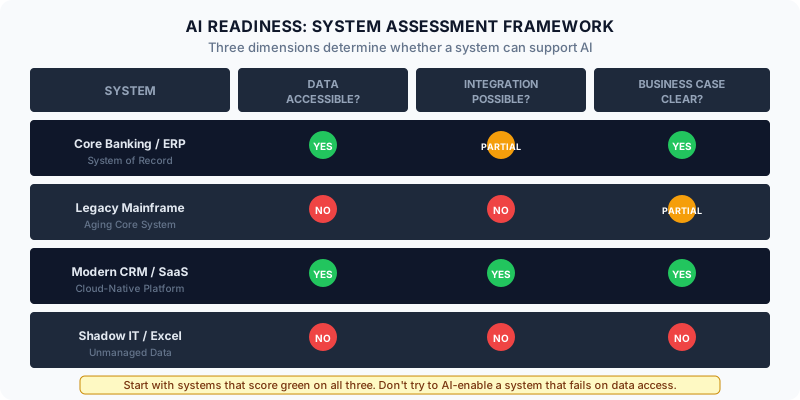
Some systems are well-suited to AI integration: modern APIs, clean data, documented business rules, stable interfaces. Others are not — proprietary protocols, poor data quality, interfaces that are fragile or undocumented. Understanding the difference before starting saves enormous time and prevents the common pattern of launching an AI project with enthusiasm, then discovering mid-stream that the foundational systems are not ready.
What Makes a System AI-Ready
A system is AI-ready when it can provide data to an AI system efficiently, receive AI outputs in a way the process can use, and be integrated with without creating unacceptable risk.
Modern, documented API. The system exposes a well-documented API — ideally REST, or at minimum SOAP or a messaging interface that is stable and supported. The API has predictable behavior, returns data in a consistent format, and has enough throughput to support the query volumes AI systems require.
Clean, consistent data. The data is accurate, reasonably complete, and consistent over time. There are no major known quality problems that would distort AI training or inference. Key entities — customers, products, transactions — have unique, stable identifiers that can be used to join data across systems.
Stable interfaces. APIs and data exports do not change frequently in ways that break integrations. Either a versioning approach exists, or at minimum a change management process gives advance notice of interface changes.
Clear data semantics. The meaning of data fields is documented or well-understood. Codes and flags are explained. The business rules governing how data is created and modified are documented or can be explained by people who have that knowledge.
Appropriate access controls. The system's access controls can be configured to allow AI systems to read — and write, if needed — without requiring workarounds or bypassing security.
What Makes a System Difficult
Certain characteristics make a system hard or impossible to integrate with for AI purposes without significant prior investment.
No API or batch-only exports. Systems that can only export data as periodic batch files — a flat file generated nightly — are not suited to real-time AI applications. They can still be used for AI work on daily or historical data, but not for real-time inference or continuous learning.
Proprietary protocols. Some older systems communicate using protocols specific to their vendor or era, requiring specialized connectors. If the organization lacks the expertise or tooling for those connectors, integration becomes a substantial project before AI work can even begin.
Poor data quality. Systems with significant known quality problems — high rates of missing fields, duplicates, inconsistent values — require data cleaning work before the data can be trusted. Additional work that must be planned for, not discovered.
Undocumented business logic. If the system contains pricing rules, eligibility logic, or calculation methods that nobody currently understands or has documented, any AI system trying to learn from or replicate that logic is operating without a map. Particularly common with older systems where the original developers are long gone.
High change risk. Some systems are so fragile or so tightly coupled to everything else that integrating with them carries significant risk of causing problems elsewhere. Not necessarily to be avoided — but to be assessed thoroughly for impact before any integration work begins.
A Three-Dimension Assessment
For each system an AI initiative might interact with, a practical assessment covers three dimensions:
Data access: Can you get the data from this system? How? At what frequency? With what quality? Score this from straightforward (modern API, clean data) to blocked (no access path without significant investment).
Integration stability: How stable is the interface? How much will changes to this system affect your AI integration? Score from stable (versioned API, predictable behavior) to fragile (no versioning, frequent undocumented changes).
Data quality: How reliable is the data for AI purposes? Score from production-ready (known quality, minimal issues) to requires remediation (significant quality work needed before use).
Systems that score well on all three are good candidates for AI integration now. Systems that score poorly on one dimension need targeted investment there before AI work begins. Systems that score poorly on all three are best approached later — either after preparatory work or by designing AI applications that avoid depending on them.
The Paradox
In most enterprises, the systems most AI-ready tend to be the modern ones: cloud-based SaaS tools with APIs designed for integration, modern data platforms built with analytics in mind, systems implemented or significantly upgraded in the last five years.
The systems least AI-ready tend to be the most important. The core legacy systems hold the deepest, most historically rich data. The data you most want for AI is often in the systems that are hardest to integrate with.
The resolution is not to ignore legacy systems or wait until they are replaced. It is to invest in extraction layers — middleware, integration platforms, data pipelines — that make the data from legacy systems available to modern AI applications without requiring changes to those systems themselves. The legacy system keeps running. AI gets its data. This is not a workaround. It is the strategy.