Chapter 17 of 24
What 'Data Readiness' Actually Means
Every enterprise has data. Very few have data that is ready for AI. The gap between those two things is where most AI initiatives spend their first six months.
Overview
"We have the data" is one of the most optimistic — and frequently incorrect — statements made at the start of an enterprise AI initiative.
Every enterprise has data. Large enterprises have enormous amounts of it. Transaction records going back decades. Customer records in the millions. Operational data from every system that has ever run in the organization. The data exists. What most enterprises do not have is data that is ready to use for AI. The gap between those two things is where most AI projects run into their first serious problems.
The Four Dimensions
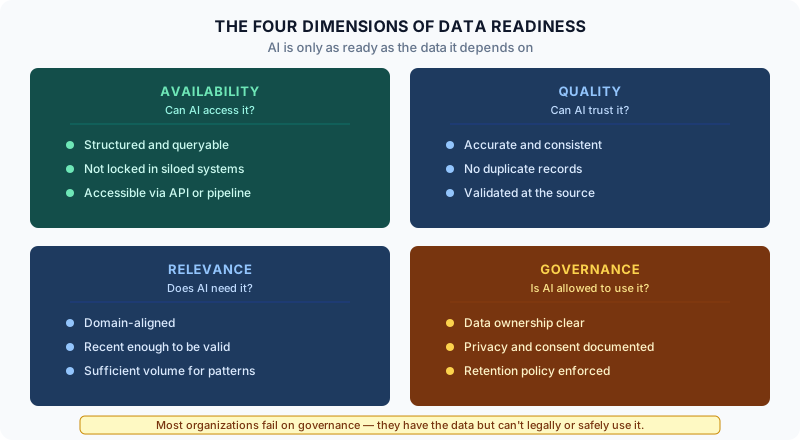
Data readiness is not a single thing. It is a combination of four distinct qualities, each of which needs to be present for data to be genuinely useful for AI.
Availability is the most basic question: can you actually get to the data? It sounds obvious, but data that exists is not always accessible. It may be in a system with no API or export capability. It may require specialized knowledge to extract from a legacy system. It may be protected by access controls that require a formal request process with a multi-week wait. Or it may technically be accessible but only through a mechanism that is too slow for AI workloads.
Quality is whether the data is accurate, complete, and consistent. Quality problems in enterprise data are extremely common and often invisible — until you try to use the data for something other than its original purpose. Records with missing fields. Duplicate customer records created by different systems over time. Addresses in inconsistent formats. Dates stored differently across systems. Codes that mean different things in different parts of the system because their meaning changed at some point without updating historical records.
Relevance is whether the data actually captures what you need for the specific AI use case. You can have high-quality, easily accessible data that is simply not the right data. If you want to predict customer churn, you need data about customer behavior — what customers do, how they interact with the product, what their support history looks like. If your systems capture only transactional outcomes and not the behaviors that lead to them, the data is not relevant to the use case, regardless of its quality.
Governance is whether the data can legally and organizationally be used for this purpose. Is there consent to use customer data for AI modeling? Are there regulatory restrictions on how this data can be processed? Has a documented data owner approved its use? Is there a record of what transformations have been applied? Governance failures discovered mid-project are expensive.
Why Data Quality Problems Are Invisible Until AI
One of the counterintuitive things about data quality is that poor quality is often invisible in the operational system that created the data — and becomes highly visible when the data is used for analytics or AI.
Consider a CRM with duplicate customer records. The sales team using it every day may barely notice. They work with their own accounts. The duplicates are elsewhere in the system, created by other teams, and nobody is looking at the aggregate picture.
When an AI model trains on that CRM data, the duplicates become a significant problem. The model may learn from conflicting records about the same customer. It may count one customer as two, inflating certain metrics. It may fail to connect behaviors that would be visible if the data were clean.
The operational team does not know about this because they never look at the data the way AI does — across the whole dataset, looking for patterns and relationships. This is why AI projects so consistently surface data quality problems that were not previously known. The scrutiny of AI-scale analysis reveals problems that have existed for years but went unnoticed because nobody was looking at them from this angle.
The Data Readiness Assessment
Before committing significant resources to an AI initiative, any organization should conduct a data readiness assessment — a structured evaluation of the four dimensions above for the specific data the initiative requires.
The assessment should answer:
- Where does the required data live? In what systems? In what formats?
- How would it be accessed for AI purposes? What are the technical mechanisms?
- What is the known data quality? Have quality assessments been done recently?
- Are there governance requirements that affect how this data can be used?
- What transformations would be required to make the data suitable for modeling?
The output is not a yes or no answer. It is a realistic picture of what work needs to happen before the data is actually ready — which is the most honest available estimate of how long the AI project will really take and what it will really cost.
Organizations that skip this step frequently discover mid-project that the data they assumed was available is not, or that the quality problems are more severe than expected. Timelines slip, budgets expand, and confidence in the initiative erodes. This is avoidable.
What Good Data Readiness Looks Like
A mature organization with strong data readiness for a given AI initiative would have:
- Clear documentation of where the relevant data lives and how to access it
- Recent quality assessments with known, quantified issues and remediation plans
- An established data pipeline that extracts, transforms, and loads the data into an analytics-ready environment on a known schedule
- A governance structure that defines ownership, approved uses, and privacy controls
- A data catalog explaining what each dataset contains, what its provenance is, and who to contact with questions
Most enterprises are not here. Building these capabilities takes time and sustained investment. But the gap between where an organization is and where it needs to be is the most honest measure of how ready it actually is for AI at scale.
The board presentation rarely mentions data readiness. The project post-mortem almost always does.