Chapter 06 of 24
Cloud Is Infrastructure, Not Magic
Cloud computing is a powerful and important shift in how organizations consume technology. It is also widely misunderstood. Here is what cloud actually is — and what it is not.
Overview
Cloud computing is the most over-hyped and under-explained technology of the last twenty years. The term is used to describe everything from storing photos on your phone to running complex machine learning workloads across thousands of servers. It has been sold as a solution to problems it does not solve, and blamed for problems it did not cause.
The reality is simpler and more useful than the hype: cloud computing is a model for consuming computing infrastructure — storage, processing power, networking — as a service rather than owning and operating that infrastructure yourself.
That is it. It is important, but it is not magic.
What Cloud Actually Provides
Before cloud computing became widely available, organizations that needed computing infrastructure had to buy it. They purchased servers, stored them in data centers, hired people to manage them, bought software licenses, and maintained all of it themselves. If their needs grew, they bought more hardware. If their needs shrank, they were stuck with hardware they were not using.
Cloud computing changed this by allowing organizations to rent computing infrastructure from large providers — primarily Amazon Web Services (AWS), Microsoft Azure, and Google Cloud Platform (GCP). Instead of buying a server, an organization can provision one in minutes, use it for as long as needed, and then shut it down and stop paying.
The economic model is fundamentally different. Instead of large upfront capital expenditures on hardware, organizations pay for what they use on an ongoing basis. Instead of a months-long procurement process to buy servers, computing capacity can be added in minutes. Instead of maintaining data centers, the cloud provider handles the physical infrastructure.
The Three Service Models
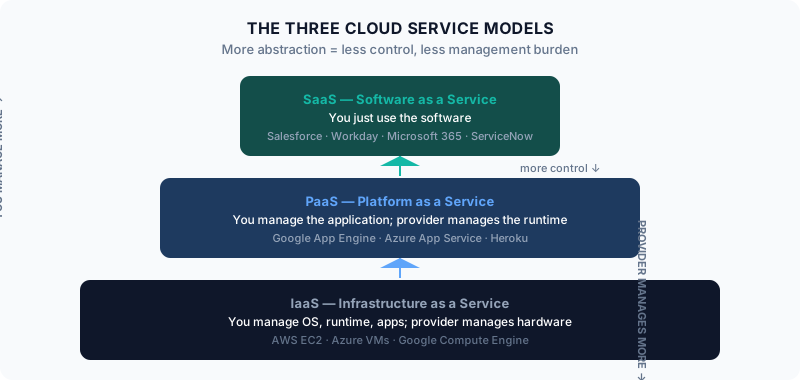
Infrastructure as a Service (IaaS) is the most basic level. The cloud provider supplies virtual machines — essentially computers you can access over the internet. You control what software runs on them, how they are configured, and how they connect to each other. AWS EC2, Azure Virtual Machines, and Google Compute Engine are IaaS offerings. This is closest to running your own servers, just without owning the physical hardware.
Platform as a Service (PaaS) goes a step further. The cloud provider manages the underlying infrastructure — the operating system, the runtime environment, the scaling — and you focus on deploying your application. Google App Engine is an example. PaaS reduces operational overhead but also reduces control; you cannot configure the underlying environment in the same way you can with IaaS.
Software as a Service (SaaS) is what most people interact with every day without thinking of it as cloud computing. Salesforce, Microsoft 365, Workday, and ServiceNow are applications delivered over the internet that you use without managing any infrastructure. The cloud provider or software vendor handles everything. You just use the software.
What Cloud Does Not Solve
Cloud computing solves certain problems very well. It eliminates the need to own and manage physical hardware. It makes it easy to scale computing resources up and down. It provides access to sophisticated managed services — databases, machine learning tools, messaging systems — that would be expensive and time-consuming to build and maintain independently.
What cloud does not solve is organizational or process complexity.
Moving an application to the cloud does not automatically make it more reliable, faster, or easier to maintain. An application with poor architecture will have poor architecture in the cloud. A database with data quality problems will have data quality problems in the cloud. A process that requires seven approvals will still require seven approvals even if it is running in the cloud.
This is one of the most common misunderstandings in enterprise technology. Organizations sometimes expect that migrating to cloud will modernize their systems. In many cases, what happens is a "lift and shift": the existing system, with all its complexity and limitations, is simply moved from a physical server to a virtual one. The costs are often lower and the operational burden may be reduced, but the application itself is unchanged.
True modernization — changing the architecture, improving the code, fixing the data — requires separate effort on top of the cloud migration. Cloud provides the platform. The work of improving what runs on that platform is a different project.
Hybrid Cloud and Multi-Cloud
Most large enterprises do not run entirely in the cloud or entirely on-premises. They run in a hybrid: some systems in the cloud, some in their own data centers.
This is not an intermediate state on the way to "full cloud." For many organizations, hybrid is the permanent destination. Regulatory requirements may mandate that certain data stays on-premises. Some legacy systems cannot be migrated to the cloud without a rewrite. Some workloads are genuinely cheaper and more manageable on owned hardware. The economics of cloud versus on-premises depend on the specific workload, and the calculation is different for every organization.
Many organizations also use multiple cloud providers — AWS for some workloads, Azure for others, Google Cloud for machine learning. This is called multi-cloud. It introduces its own complexity, as different providers have different services, different APIs, different pricing models, and different operational tooling. It also reduces dependence on any single vendor and allows organizations to use each provider where it has particular strengths.
Cloud and AI
The rise of cloud computing is directly connected to the rise of enterprise AI, for a simple reason: training and running AI models requires enormous amounts of computing power. Before cloud, only the largest organizations could afford the hardware infrastructure for significant AI workloads. Cloud made that infrastructure available to any organization willing to pay for it.
The major cloud providers have also built AI services on top of their infrastructure: managed machine learning platforms, pre-trained models accessible via API, and data processing pipelines. This has lowered the barrier to experimenting with and deploying AI considerably.
But the same caveat applies: cloud provides the platform. If the data needed for AI is in a legacy system that cannot easily connect to the cloud, or if the data quality is poor, or if the business process around the AI system is not designed well, cloud does not fix those problems. The infrastructure is the easy part. The hard part is everything else.