Chapter 07 of 24
SaaS Sprawl: When Every Team Bought Their Own Tool
The ease of buying cloud software has created a new problem: organizations now run hundreds of overlapping, disconnected tools. Understanding SaaS sprawl is essential for understanding modern enterprise data complexity.
Overview
There was a time when buying enterprise software was hard. You needed to get IT involved. You needed to go through procurement. You needed budget approval. The process took months and involved vendors, contracts, and significant internal political capital. This friction was annoying, but it had a side effect: it kept the technology landscape somewhat coherent. When buying software was hard, organizations bought less of it.
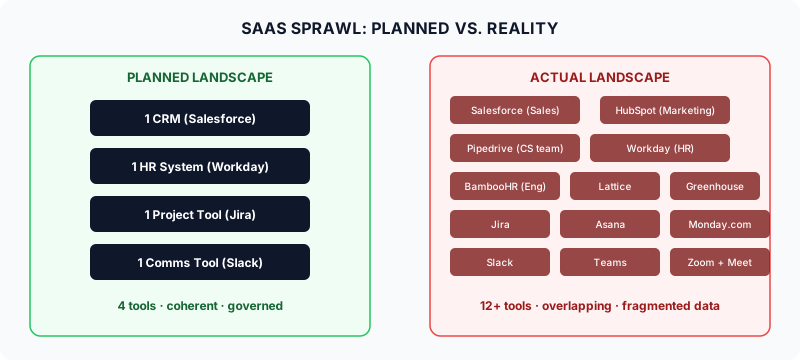
Then software-as-a-service changed the economics. A team could sign up for a new tool with a credit card. The software ran in the browser. IT did not need to install anything. The monthly subscription cost was low enough to be approved at a department level without going through the capital expenditure process. Suddenly, buying software was easy.
And organizations bought a lot of it.
What SaaS Sprawl Looks Like
A mid-size company today might have hundreds of active SaaS subscriptions. Marketing uses a content management system, an email marketing platform, a social media scheduling tool, a webinar platform, an A/B testing tool, and an analytics platform — and those are just the ones the marketing team knows about. Sales uses a CRM, a sales engagement platform, a conversation intelligence tool, a proposal software, and a data enrichment service. Engineering uses a project management tool, a code repository, a CI/CD platform, a logging service, and an error tracking tool.
Each of these tools was acquired by a team that had a legitimate need and found a tool that solved it. The problem is that they did not coordinate with each other. Now the company has three different tools for project management, four different tools for video conferencing, two different CRMs that the sales and customer success teams are using in parallel, and a customer data platform that does not talk to the CRM that does not talk to the marketing automation tool.
The customer who called in last week shows up in the CRM with one record, in the helpdesk tool with another record, and in the marketing platform with a third. These records have conflicting information because they were created independently and have never been synchronized.
This is SaaS sprawl. It is the natural outcome of distributing purchasing power to individual teams without enforcing architectural coherence.
The Data Problem
The deeper issue with SaaS sprawl is data. Every SaaS tool holds some data about the business. Salesforce holds customer and deal data. Workday holds employee data. ServiceNow holds IT service request data. HubSpot holds marketing engagement data.
In a coherent architecture, these systems would share a common view of key entities — particularly the customer and the employee. A customer would have one record across all systems, and changes made in one system would propagate to others. In practice, data in SaaS tools frequently diverges. The same customer has different contact information in the CRM and the support tool. The same employee has different job titles in HR and in the directory.
This data fragmentation is one of the most underappreciated challenges for enterprise AI. AI systems that need to understand "the customer" or "the employee" as a unified entity have to reconcile data from multiple systems. That data was created independently, is stored in different formats, and has been updated on different schedules. This reconciliation process is called master data management, and it is hard, time-consuming, and never quite finished.
Shadow IT: The Unofficial Technology Layer
Related to SaaS sprawl is shadow IT: technology that is in use within the organization but is not sanctioned, supported, or even known about by IT.
Shadow IT exists because people have needs that official systems do not meet. A finance team that cannot get a report out of the ERP system fast enough builds one in Excel. A marketing team that finds the official project management tool too rigid uses a personal Trello board. A sales team that wants to share competitive intelligence uses a shared Google Doc that nobody told IT about.
Some shadow IT is benign. A shared spreadsheet for tracking meeting schedules does not create significant organizational risk. Other shadow IT is not benign. When sensitive customer data ends up in a personal Dropbox account because the official file sharing system was too slow, that is a data security and compliance problem. When critical business calculations are happening in an Excel spreadsheet that one person maintains and nobody else understands, that is an operational risk.
The challenge is that shadow IT exists for real reasons. The official systems often genuinely do not meet the needs of the teams using them. Eliminating shadow IT without addressing those needs just drives it further underground.
Managing Sprawl
Large organizations increasingly have a function — sometimes called IT asset management, sometimes SaaS management, sometimes sitting within IT governance — focused on tracking and managing the portfolio of tools in use.
The practical activities include maintaining an inventory of all active tools, understanding which tools overlap in functionality, consolidating where possible, establishing standards for data security review before a new tool is acquired, and creating processes for decommissioning tools that are no longer needed.
None of this is glamorous work, but it has significant implications for data quality, security, and the organization's ability to build coherent analytics and AI systems on top of its data.
For AI practitioners, the lesson is straightforward: before assuming you know where the relevant data is, invest time in mapping the actual tool landscape. The data you need for an AI application may be spread across three different SaaS tools, two Excel spreadsheets in someone's personal folder, and a legacy system that predates the internet. Understanding that landscape upfront is always better than discovering it halfway through a project.