Chapter 13 of 24
Integration Spaghetti: Point-to-Point vs. Platform
When systems connect directly to each other without a coherent integration architecture, the result is fragile, expensive to maintain, and nearly impossible to understand — and it happens the same way in almost every enterprise.
Overview
At some point in its growth, almost every enterprise IT organization draws an honest architecture diagram — systems and all the connections between them. The result usually looks like a plate of spaghetti. Lines cross in every direction. Systems connect to other systems without apparent logic. Integrations overlap and branch in ways nobody planned and nobody can fully explain.
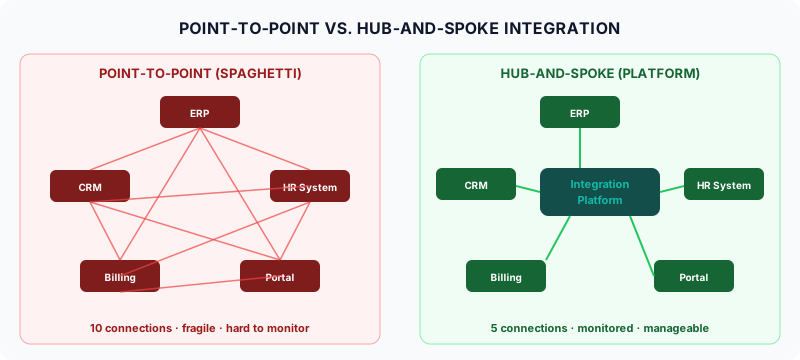
It is almost always the result of the same pattern: integration decisions made one at a time, to solve immediate needs, without a coherent architecture governing how systems should connect.
How It Happens
Imagine an organization with five core systems: an ERP, a CRM, an HR system, a billing platform, and a customer portal.
The CRM needs customer financial data from the ERP. An integration is built — a nightly batch job that extracts the data and loads it into the CRM. Done.
A year later, the billing platform needs the same customer data from the ERP, plus deal information from the CRM. Two more integrations.
Another year. The customer portal needs account information from billing and support history from the CRM. Two more.
The HR system needs to sync employee data to the ERP for payroll. Another one.
Each integration solved a real problem. But look at what has been built: a web of direct connections, each built independently, each with its own logic, its own error handling, its own schedule. If the ERP's data format changes, multiple integrations may break simultaneously. If the CRM's API goes down, everything that reads from it fails. There is no central place to see what is running and what is not. Tracing whether the customer portal is showing current data requires following a chain through multiple integrations, each with different latency and failure behavior.
This is point-to-point integration. With five systems, it is manageable. With fifty systems — as in many large enterprises — it is the spaghetti problem.
The Geometric Problem
The reason spaghetti compounds so fast is mathematical. With n systems that all need to connect directly to each other, the maximum number of connections is n × (n − 1) / 2. Five systems: ten connections. Ten systems: forty-five. Fifty systems: 1,225.
Not every system needs to talk to every other system, but in a large enterprise the actual count can easily reach hundreds or thousands. Each integration is a potential point of failure. Each requires monitoring, documentation, and maintenance. The aggregate cost is enormous, and almost none of it appears in any budget line labeled "integration maintenance."
Platform-Based Integration
The alternative is hub-and-spoke. Instead of systems connecting directly to each other, they all connect through a central integration platform.
The platform sits in the middle. It receives data from source systems, applies transformation rules to convert data between formats, and routes it to the destination. Instead of n-squared connections, you have n connections — one from each system to the platform.
The advantages are meaningful. Monitoring is centralized: all integrations are visible in one place and failures are immediately apparent. When one system's data format changes, the fix happens in the platform, not in every downstream integration. New integrations can often be built faster because connections to existing systems are already established.
Integration platforms come in several varieties. An Enterprise Service Bus (ESB) is the traditional on-premises approach: a heavyweight integration layer handling routing, transformation, and orchestration. More modern alternatives include Integration Platform as a Service (iPaaS) — cloud-based platforms like MuleSoft, Dell Boomi, or Azure Logic Apps that provide similar capabilities with less infrastructure overhead. For high-volume, real-time data flows, event streaming platforms like Apache Kafka serve a related role.
The Trade-offs
Platform-based integration is better than spaghetti. It also introduces its own problems.
The platform becomes a single point of failure. If it goes down, all integrations stop. That means the platform itself must be highly available and carefully managed — which requires investment and expertise.
The platform adds latency. Data routed through a hub takes longer to arrive than data transferred directly. For use cases that genuinely need data in milliseconds, a platform may introduce unacceptable delay.
And a platform does not substitute for good integration design. A poorly designed integration running through a well-managed platform is still a poorly designed integration. The platform improves manageability. It does not replace thoughtful architecture.
What This Means for AI
AI systems need data, and data reaches AI systems through integrations. The integration architecture is not a background concern — it directly shapes what an AI system can do and how reliably it can do it.
An AI system pulling real-time data from multiple operational systems is entirely at the mercy of the integration layer. Spaghetti means inconsistent data, delayed data, or missing data — and the AI system's outputs will reflect that.
When planning an AI initiative, one of the first questions to ask is: how does data flow from source systems to the AI? Through what integrations? What is the latency? What happens when one of those integrations fails? The answers shape the design of the AI system as much as any model selection or algorithm choice.