Chapter 19 of 24
The Coexistence Imperative: Why You Can't Rip and Replace
Replacing legacy systems entirely sounds reasonable until you understand what it actually costs and how often it fails. Coexistence is not a fallback — it is the strategy.
Overview
"Why don't they just replace it?"
It gets asked at almost every enterprise AI project kickoff. The legacy system that holds the data is old, hard to integrate with, and runs on technology most modern developers have never worked with. Why not replace it with something modern, clean the data, and start fresh?
Because rip-and-replace rarely works. The exceptions are so expensive, so risky, and so time-consuming that they prove rather than challenge the rule.
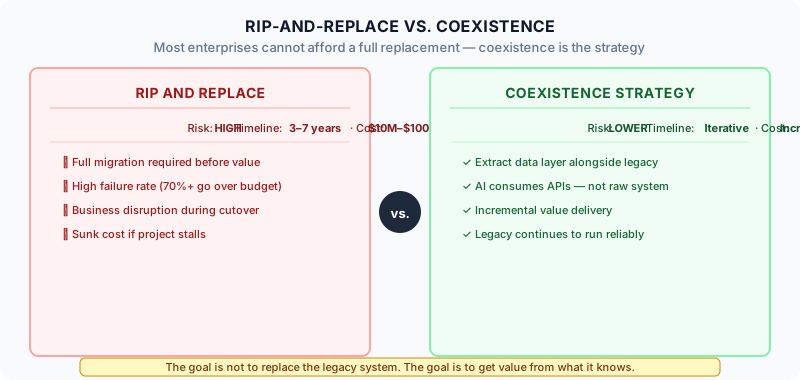
Four Reasons Legacy Stays
Four fundamental reasons explain why legacy systems persist even when organizations know they need to modernize — and all four apply simultaneously to most large enterprises.
Risk. Core legacy systems run critical business operations. A core banking system processes millions of transactions per day. A manufacturing ERP controls production across dozens of facilities. A government benefits system issues payments to millions of people. Replacing one of these means conducting a high-wire act: moving everything from the old system to the new while keeping the business running. During the parallel-operation window, data may be inconsistent, processes may behave differently, and errors in one system may not be visible in the other. If the cutover fails, the consequences are immediate and severe.
Cost. The visible cost of a legacy system — licenses, maintenance fees, aging hardware — is often far lower than the cost of replacing it. A full ERP replacement for a large organization can cost hundreds of millions of dollars and take five to ten years. A core banking migration may cost more. When leadership compares running the legacy system for another decade against the cost and risk of replacement, continuing to run it frequently wins.
Regulation. In regulated industries, changing systems requires regulatory oversight. New systems must demonstrate they meet the same requirements as the systems they replace. In some cases, the software itself must be formally validated before going to production. For organizations in multiple regulated jurisdictions, this compounds considerably.
Institutional knowledge. Legacy systems encode decades of business logic that is often not documented anywhere outside the system. Replacing a system requires fully understanding that logic and replicating it in the new one — but the people who understand it may no longer be at the organization. Reconstructing undocumented business logic from a running system is an enormous, painstaking undertaking. Getting it wrong means the new system does not actually do what the old system did, a gap that may only surface after the cutover.
The Real Cost of Failed Replacements
The history of enterprise IT is full of cautionary tales.
A major airline attempted to replace its reservation system. The project ran years over schedule, failed to fully migrate customer data, and caused significant operational disruption when the new system went live. The organization spent years dealing with the fallout.
A global bank attempted to replace its core banking platform across multiple countries simultaneously. The project was eventually abandoned after years of work and hundreds of millions of dollars spent, with the original legacy system still running.
A state government attempted to replace its benefits administration system. The new system, when launched, failed to process claims correctly, leaving vulnerable citizens without payments for months.
These are not stories about bad technology or incompetent teams. They are stories about the genuine difficulty of replacing systems that are deeply embedded in operations, at scale, with continuity requirements that leave no room for error.
Coexistence as Strategy
Coexistence means designing AI and modernization initiatives to work with existing systems rather than requiring their replacement.
This is not settling for second best. It is the mature, realistic, frequently optimal approach.
Coexistence looks like building an extraction layer between the legacy system and the AI system — a data pipeline that pulls data from the legacy system, transforms it, and makes it available to modern tools without requiring the legacy system to change. The legacy system keeps doing what it does. The AI system gets what it needs.
Coexistence looks like building a modern experience layer on top of a legacy backend — a new interface, a new API, or a new workflow that makes the legacy system more accessible without touching its core. The COBOL is still running underneath. The modern application is what users see.
Coexistence looks like identifying bounded AI use cases that can be implemented without requiring deep changes to legacy systems — AI that augments a process, provides a recommendation, or automates a narrow task, rather than AI that requires replacing the system the process runs on.
What It Requires
Integration discipline. Coexistence depends on reliable integrations between legacy systems and modern components. This means investing in integration platforms, monitoring, and the engineering practice to build integrations that are stable and maintainable over time.
Data architecture. A clear strategy for how data flows between legacy and modern systems: what is the single source of truth, how frequently is data synchronized, and how are conflicts resolved when the two systems disagree.
Clear boundaries. Every coexistence architecture needs explicit decisions about which system does what. If the legacy system and the modern system both manage parts of the same process, there need to be clear rules about which takes precedence and how they hand off to each other.
Patience. Coexistence is a medium-term strategy. The legacy system may eventually be replaced — but on a realistic timeline, after thorough preparation, with the modern layer already running. That transition takes years. Organizations that understand this commit to coexistence as a real strategy rather than an admission of failure.
The practitioners who know how to extract value from the stack that exists rather than the stack they wish they had are the ones who actually deliver results in enterprise environments.