Chapter 13 of 18
Organizational Change — Leading the AI Transformation
The architecture is the easy part. The hard part is the eighty percent — the teams that don't trust the system, the executives who expected magic, the managers who see AI as a headcount threat. This chapter covers what most architecture books skip entirely.
Overview
The Hardest Part Isn't Technical
You can design the perfect AI architecture. Pick the right models, build an elegant RAG pipeline, set up a gateway with sub-second routing, implement monitoring that would satisfy any SRE. None of it matters if the organization is not ready to receive it. Brilliant technical designs gather dust because the people side was never addressed: teams that did not trust the system, executives who expected magic, middle managers who saw AI as a threat to their headcount.
Roughly eighty percent of the real difficulty in an AI transformation lives here. This chapter covers what most architecture books skip.
The Architect's Expanding Role
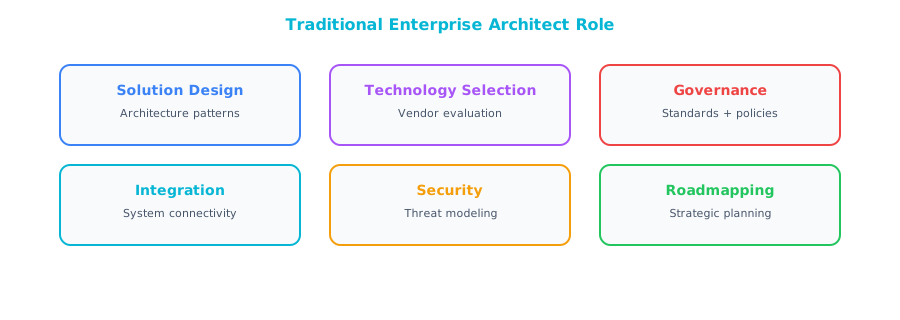
Before AI
After AI
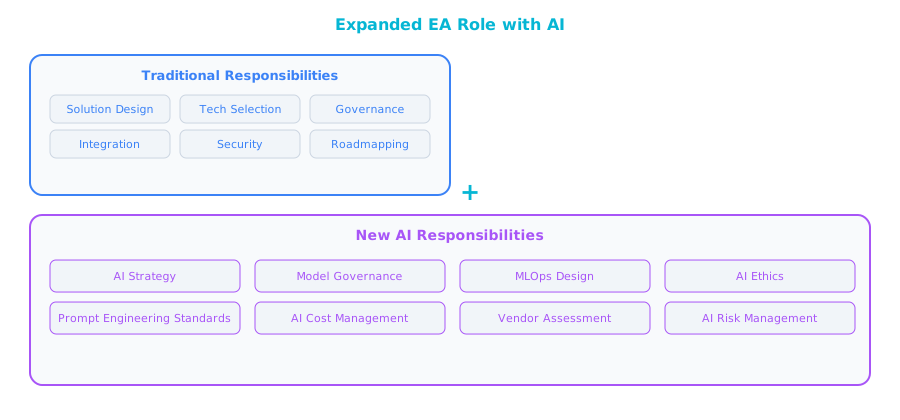
The "After AI" version does not replace any of the traditional responsibilities. It adds an entirely new layer on top. You are not just adding AI to your tech stack — you are fundamentally expanding what it means to be an enterprise architect. Where you once focused primarily on systems and standards, you now find yourself in conversations about ethics, talent development, cross-functional enablement, and strategic roadmapping at a level that would have seemed outside your remit a few years ago.
The key is recognizing that you do not need to become an expert in all of these areas overnight. You need enough fluency to ask the right questions, make informed decisions, and guide teams that will develop deep expertise in each domain. Think less about doing everything and more about ensuring everything connects coherently.
Building the AI Team
Getting team structure right is one of the most consequential decisions you will make early in an AI transformation. Get it wrong and you either create a bottleneck that starves the business of AI capabilities, or you scatter talent so thinly that no one achieves anything meaningful.
Team Structure Options
Option 1: Centralized AI Team (Center of Excellence)
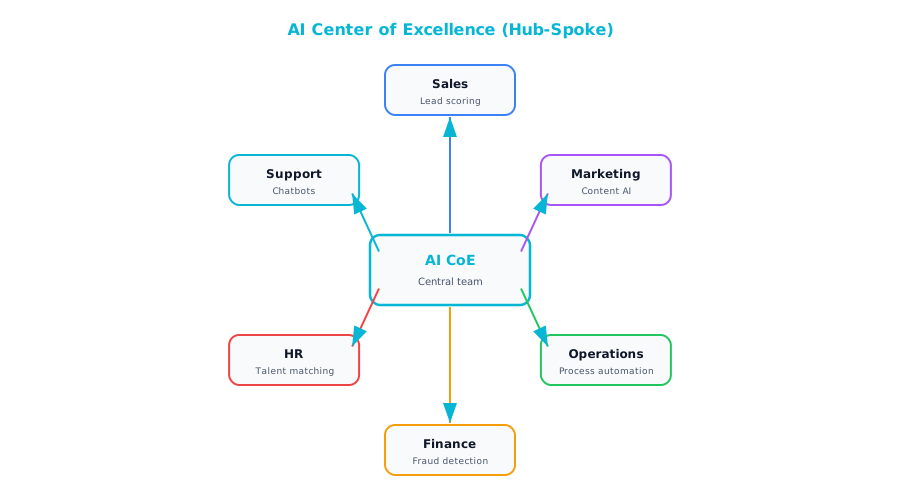
The centralized model puts all AI talent in a single team — a Center of Excellence that serves the entire organization. This works well early because it gives you consistent standards, a shared body of knowledge that grows with every project, and efficient use of what is almost certainly a scarce talent pool. When you only have three or four people who genuinely understand how to deploy an LLM-based system in production, scattering them across business units means each one reinvents the wheel in isolation.
The downside: a centralized team inevitably becomes a bottleneck. Business units start queuing up for access, and the team can drift into an ivory-tower mentality where they optimize for technical elegance rather than business impact. They may also lose touch with domain realities, building solutions that look good in demos but miss the actual workflow. This model suits the first year or two, when the priority is establishing foundations rather than scaling.
Option 2: Embedded AI Engineers
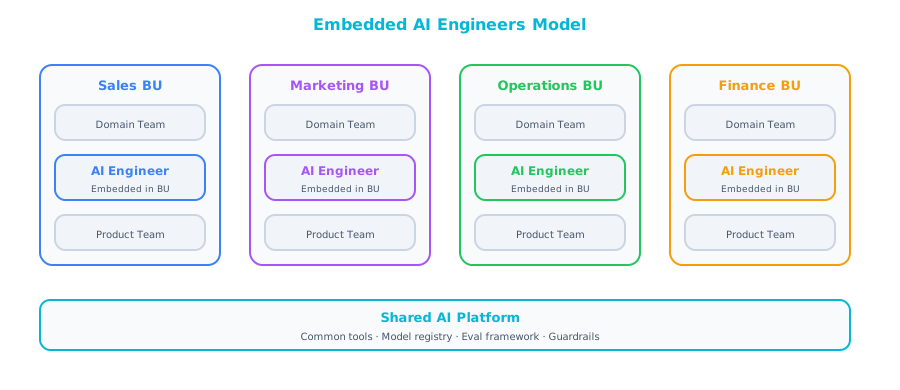
The embedded model places AI engineers directly inside each business unit, sitting alongside product teams, sharing the same priorities and domain context. An AI engineer who spends every day inside the claims processing workflow will build better AI for claims processing than someone parachuting in from a central team for a six-week engagement.
The failure modes are different. Without a unifying force, each business unit develops its own standards, its own tooling, its own infrastructure. You end up with three different vector databases, four different prompt management approaches, and no shared learning across teams. This approach works best in mature organizations that have already built strong platform foundations and clear architectural standards that embedded engineers can follow without constant oversight.
Option 3: Hub and Spoke (Recommended)
        ┌───────────────────────┐
        │    AI Platform Team   │  ← Sets standards, builds shared infra
        │  (Architects, MLOps,  │
        │   Platform Engineers) │
        └───┬──────────┬────────┘
            │          │
    ┌───────▼──┐   ┌──▼────────┐
    │  BU-A    │   │  BU-B     │  ← AI engineers embedded in business units
    │  AI Team │   │  AI Team  │     Use shared platform, follow standards
    └──────────┘   └───────────┘
The hub-and-spoke model works best for most organizations past the initial experimentation phase. The hub is a central AI platform team — architects, MLOps engineers, platform builders — who set standards, maintain shared infrastructure, and ensure consistency. The spokes are AI engineers embedded in each business unit, close to the problems, iterating quickly, deeply familiar with their domain.
What makes it work is that neither group has to carry the full burden. Embedded engineers bring business context and speed; the platform team brings consistency and shared tooling that prevents duplication. An AI engineer in the supply chain team does not figure out model monitoring from scratch — the platform team built that already, and the embedded engineer plugs into it.
The trade-off is real: this model requires a relatively mature AI platform, and there is genuine coordination overhead in keeping hub and spokes aligned. You need regular touchpoints, clear documentation, and a culture where embedded engineers see the platform as an enabler rather than a constraint.
Key Roles You Need
| Role | What They Do | Where to Find Them |
|---|---|---|
| AI Enterprise Architect | Design AI integration, governance, platform | That's you (reading this book) |
| ML Engineer | Build and deploy models and pipelines | Hire or retrain backend engineers |
| Data Engineer | Build data pipelines for AI | Likely already have them |
| AI Product Manager | Define AI-powered features, manage trade-offs | Retrain existing PMs |
| Prompt Engineer | Design and optimize LLM prompts | New role — train internally |
| AI Ethics Lead | Responsible AI policies and audits | Legal/compliance + technical hybrid |
A few of these deserve specific comment.
ML Engineers: your best bet is often retraining strong backend engineers who already understand production systems, testing, and operational reliability. Those skills transfer. The ML-specific knowledge can be acquired.
Prompt Engineers are a genuinely new discipline, still evolving rapidly. People who understand your business domain and your customers' language will write better prompts than someone hired purely for technical prompt engineering skills. Develop this capability internally.
The AI Ethics Lead sits at the intersection of legal, compliance, and technology. It requires a rare combination of technical understanding and policy thinking, and it will only become more important as AI gets embedded deeper into business-critical workflows.
Managing Stakeholder Expectations
The Hype Problem
Here is a scenario that has played out in virtually every organization: the CEO sees a ChatGPT demo at a conference and now wants AI everywhere — customer service, product development, finance, HR, yesterday. Your job is to channel that enthusiasm into achievable outcomes without extinguishing it. Executive sponsorship is one of the strongest predictors of AI program success, but it needs to be shaped rather than left to run wild.
What executives typically expect is close to science fiction: AI that reads minds, replaces entire departments, generates billions with minimal investment. What AI actually delivers today is valuable but more prosaic — automation of routine tasks, dramatically better search across enterprise knowledge, faster document processing, assisted decision-making that helps experts work faster and more consistently. The gap between expectation and reality is where organizational disappointment festers.
Four strategies close that gap consistently.
First, show rather than tell. Build a working demo in two weeks — not polished, but functional. A chatbot that actually answers questions about your company's products, drawing on internal documentation, is worth more than fifty slides of architecture diagrams. When an executive can type a question and get a useful answer, the conversation shifts from "can AI really do this?" to "how fast can we scale this?" That is the conversation you want.
Second, frame AI as augmentation rather than replacement. The language matters. Telling a VP of Operations that "AI will replace your team" triggers immediate resistance even if the economic analysis is sound. "AI will help your team handle three times the volume without adding headcount" conveys the same benefit but positions AI as a tool that makes people more effective rather than a threat that makes them redundant. In practice, augmentation is also the more accurate description of what AI does.
Third, set cost expectations early and explicitly. One of the most common sources of executive frustration is discovering that an AI system costs significantly more to run than anyone anticipated. State clearly what the AI feature will cost per month at projected volume. That transparency builds trust and prevents the sticker shock that can turn an AI champion into an AI skeptic overnight.
Fourth, publish a roadmap. Quick wins in Q1 demonstrate value. Strategic integration in Q2-Q3 shows how AI connects to core business processes. Platform investment in Q4 sets the foundation for sustainable scaling. Stakeholders need to see not just what you are delivering but where you are heading.
Handling Resistance
Resistance comes in many forms. The most important thing you can do is treat it as legitimate rather than dismissing it as obstruction. People raising concerns usually have valid reasons rooted in genuine experience.
| Source of Resistance | Root Cause | Your Response |
|---|---|---|
| "AI will take our jobs" | Fear | Show AI augmenting their work, not replacing it. Involve them in design. |
| "Our data isn't ready" | Valid concern | Agree, and show how the AI project will drive data cleanup. |
| "We tried ML before, it failed" | Past trauma | Show what's changed (LLMs are fundamentally different from 2018-era ML). |
| "We don't have the skills" | Skill gap | Start with managed services, upskill in parallel. |
| "It's too expensive" | Budget concern | Show the cost framework from Chapter 12. Start small. |
When someone says "AI will take our jobs," involve them directly in the design process. When a claims adjuster helps define how AI should assist with claims review, they see firsthand that the AI handles routine cases while they focus on complex, judgment-heavy ones. They shift from feeling threatened to feeling empowered — and often become your strongest advocates.
When someone says "our data is not ready," they are usually right. But reframe the relationship. In many organizations, an AI project is the most effective catalyst for data cleanup, because it creates a concrete, high-visibility reason to fix issues that everyone has been tolerating for years. The AI project does not wait for perfect data. It drives the organization toward better data as a natural byproduct of making the AI work.
The "we tried ML before and it failed" objection deserves particular empathy — it often reflects genuinely painful experience. Many organizations invested heavily in machine learning initiatives between 2016 and 2020, built elaborate data science teams, and ultimately saw very few models make it to production. What is important to communicate, without being dismissive, is that LLMs represent a fundamentally different paradigm. The barrier to value has dropped dramatically. You do not need six months of feature engineering to get a useful result. A well-designed prompt and a good retrieval pipeline can deliver meaningful value in weeks.
AI Skills Development
Building an AI-capable organization requires deliberate investment in skills at every level. The most common mistake is treating it as a purely technical challenge: send the engineering team to a machine learning bootcamp and call it done. Architects, developers, and business stakeholders each need different skills, at different depths, learned through different methods.
For Your Architecture Team
The goal is not turning every architect into a machine learning researcher. It is ensuring they can make informed design decisions, evaluate trade-offs, and have productive conversations with specialists.
| Skill | Priority | How to Learn |
|---|---|---|
| How LLMs work (conceptual) | High | This book, chapters 1-3 |
| Prompt engineering basics | High | Hands-on practice (2-3 days) |
| RAG architecture | High | Build a demo (1 week) |
| AI cost modeling | High | Chapter 12 + spreadsheet exercise |
| MLOps concepts | Medium | Chapter 6 + MLflow tutorial |
| Python basics | Medium | 2-week intensive (for notebook fluency) |
| Fine-tuning concepts | Low | Chapter 10 (conceptual understanding) |
Understanding how LLMs work is non-negotiable. You need to grasp what these models are good at, where they fail, and why, so your architectural decisions are grounded in reality rather than marketing materials. Prompt engineering and RAG architecture are equally high-priority because they underpin the vast majority of enterprise AI applications you will be designing.
AI cost modeling belongs in the same tier. Cost is often the factor that determines whether an AI initiative survives past its pilot phase, and every architect should be able to model it with confidence.
Fine-tuning sits at low priority for most architects. The situations that genuinely call for it are rarer than you might think, and the decision to fine-tune is typically informed by the results of simpler approaches that should be tried first.
For Your Development Teams
| Skill | Priority | How to Learn |
|---|---|---|
| Calling LLM APIs | High | 1-day workshop + practice |
| Prompt engineering | High | 2-day workshop + prompt library |
| RAG implementation | Medium | 1-week sprint building internal Q&A |
| Vector databases | Medium | Tutorial + hands-on |
| Guardrails and safety | High | Security team training (1 day) |
Getting developers comfortable calling LLM APIs and writing effective prompts is the highest-return investment you can make. A one-day workshop that gets them calling an API, experimenting with prompts, and seeing how small changes produce dramatically different outputs builds the foundation for everything else. Pair it with a curated prompt library — proven templates for common tasks — and your developers will be productive quickly.
Guardrails and safety deserve special emphasis because they are high-priority but consistently overlooked. Every developer building AI-powered features needs to understand how to prevent prompt injection, how to validate AI output before it reaches users, and how to implement appropriate content filtering. A single day of focused training, led by your security team, can prevent the kind of incidents that erode organizational trust in AI for years.
For Business Stakeholders
Business stakeholders do not need to understand transformer architectures or vector similarity search. They need accurate intuitions about what AI can and cannot do, how to evaluate whether AI output is trustworthy, and how to think about the ethical implications of deploying AI in their domains.
| Skill | Priority | How to Learn |
|---|---|---|
| What AI can and can't do | High | Lunch & learn series |
| How to evaluate AI output | High | Guided exercises with real examples |
| AI ethics basics | High | Workshop with case studies |
| Prompt writing for business users | Medium | 2-hour hands-on session |
A lunch-and-learn series works well for foundational AI literacy because it is low-commitment, can spread over several weeks, and creates a regular forum for questions. Guided exercises with real examples — showing stakeholders actual AI outputs alongside ground truth and asking them to evaluate accuracy, completeness, and relevance — build the critical evaluation skills that prevent organizations from blindly trusting AI output.
A workshop on AI ethics, built around case studies from your own industry, ensures that the people making deployment decisions understand the responsibilities that come with putting AI in front of customers or using it to inform high-stakes business decisions. Run it with case studies, not slides. Abstract principles do not land the way a specific story does.
The AI Transformation Roadmap
Transformation does not happen all at once, and attempting to do everything simultaneously is a reliable way to accomplish nothing. The organizations that succeed follow a phased approach that builds capability progressively, each phase creating the foundation for the next.
Phase
Foundation (Months 1-3)
The first three months are about establishing the basics. Appoint an AI architect with the authority and organizational access to drive decisions across business units. Conduct an honest assessment of data readiness — not a six-month data strategy exercise, but a practical evaluation of whether the data you need for your first use cases is accessible, clean enough to be useful, and governed in a way that permits AI consumption.
Build your first AI prototype during this phase. The best candidates are typically a RAG system over internal documentation or a document classification workflow: something that delivers visible value quickly and teaches the end-to-end mechanics of deploying an AI system. In parallel, establish the basics of AI governance — a policy document covering acceptable use, a risk classification framework, and a lightweight review process that can evolve as the program matures.
Start skills development early. Do not wait for a full team and a mature platform. Cultural readiness takes time and benefits enormously from an early start.
Phase
Scale (Months 4-9)
Months four through nine are about moving from experimentation to operational reality. Deploy three to five AI use cases in production — not prototypes or demos, but genuine production systems with monitoring, support processes, and clear ownership. Build the shared AI platform: the gateway, monitoring infrastructure, prompt registry, and other components discussed in earlier chapters, so that business units can build AI applications without each team solving the same infrastructure problems independently.
This is also the right time to establish the hub-and-spoke team structure. Implement cost monitoring and optimization so you have clear visibility into what your AI systems cost and the levers available to manage those costs. Conduct your first responsible AI audit — a systematic review of deployed AI systems against governance policies, focused on identifying gaps and areas for improvement.
Phase
Mature (Months 10-18)
In the maturity phase, AI stops being a special initiative and starts becoming part of how the organization operates. AI-augmented workflows are embedded across major business processes — not as bolt-on experiments, but as integral parts of how work gets done. Advanced patterns like multi-step agents and multi-model routing are deployed where the business case justifies the complexity.
The AI platform evolves into a self-service capability where business units can build and deploy within established guardrails, without requiring direct involvement from the central team for every project. Continuous improvement becomes a core discipline: systematic evaluation processes, regular prompt optimization cycles, and a clear methodology for deciding when a use case warrants architectural changes.
By the end of this phase, AI should be a standard consideration in every architecture review — not discussed in separate meetings, but sitting alongside scalability, security, and cost as a first-class design concern.
Companion Notebook
 Build an AI project ROI calculator. Input your use case parameters (volume, current cost, error rate) and model the business case for AI implementation with different adoption scenarios.