Chapter 15 of 18
Your Transition Roadmap — From EA to AI EA
Fourteen chapters about transforming your enterprise. This last one is about transforming yourself. A concrete 90-day plan, an honest assessment of the skills gap, and the five pitfalls that claim most experienced architects who make this transition.
Overview
This Chapter Is About You
Fourteen chapters about technology, architecture patterns, governance frameworks, and organizational design. All of that was about transforming your enterprise. This final chapter is different.
You have been an Enterprise Architect — perhaps for years, perhaps for decades. You have designed systems that process millions of transactions, guided organizations through cloud migrations, and navigated the tangled politics of technology decisions in large, complex enterprises. And now you are looking at a landscape that is shifting underneath your feet, wondering how to evolve your career so that you are not just relevant, but leading.
The good news: you are not starting from zero. The transition from Enterprise Architect to AI Enterprise Architect is not a career change. It is a career expansion. Think of it less like learning a new profession and more like a jazz musician picking up a new instrument. The theory of music is the same. The ear is already trained. You just need to learn where the keys are.
The Skills Gap — Honestly Assessed
Before you can close a gap, you need to see it clearly.
What You Already Have
The hardest parts of AI Enterprise Architecture are not about AI at all. They are about architecture. And you already have those skills.
| Skill | Why It Matters for AI |
|---|---|
| Systems thinking | AI doesn't exist in isolation — you see the full picture |
| Integration design | Connecting AI to existing systems is the hard part |
| Governance frameworks | AI governance is governance — with new concerns |
| Stakeholder management | AI projects fail politically more often than technically |
| Risk assessment | AI introduces new risks you're trained to evaluate |
| Vendor evaluation | You know how to cut through sales pitches |
| Non-functional requirements | Latency, security, scalability apply to AI too |
| Architecture documentation | Model cards, AI registers — just new artifacts |
Do not underestimate the value of these skills. Every week, a brilliant ML engineer builds a model that never makes it to production because nobody designed the integration properly, nobody thought about the governance implications, and nobody managed the stakeholders who needed to approve the deployment. That is the gap you were born to fill. The world has plenty of people who can fine-tune a transformer. What it needs are people who can take that model and make it work inside a real enterprise, at scale, with all the messy constraints that implies.
What You Need to Add
| Skill | Depth Needed | Time to Acquire |
|---|---|---|
| How LLMs work (conceptual) | Deep understanding, not math | 1-2 weeks |
| Prompt engineering | Practitioner level | 1 week + ongoing practice |
| RAG architecture | Design and evaluate | 2 weeks |
| Data architecture for AI | Extend existing knowledge | 2 weeks |
| MLOps concepts | Architecture level | 1 week |
| AI cost modeling | Practical application | 2-3 days |
| Python fluency (reading) | Read and understand, not write production code | 2-4 weeks |
| Responsible AI | Framework-level | 1 week |
Add all of that up: roughly eight to twelve weeks of focused learning. That is not a sabbatical or a master's degree. It is a quarter of dedicated professional development — the kind of investment you have made before when cloud computing arrived, or when microservices reshaped how we build systems. The wave is bigger this time, the timeline is compressed, and the reward for being early is enormous.
The 90-Day Plan
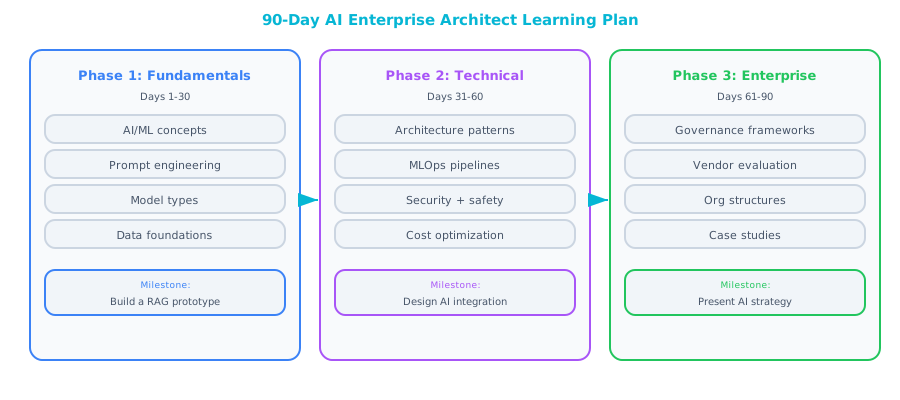
Theory is comfortable, but plans create momentum. What follows is a ninety-day plan that takes you from "interested in AI" to "operating as an AI Enterprise Architect." Three phases, each building on the last, each ending with a concrete milestone.
Days 1-30: Learn the Fundamentals
The first thirty days are about building your conceptual foundation and getting your hands dirty. You cannot architect what you do not understand, and you cannot understand AI systems by reading about them alone. You need to build things — small, imperfect, instructive things.
Week 1: Conceptual Foundation. Read the first three chapters of this book if you have not already. Run the companion notebooks. Yes, even if you struggle with Python. The struggle is the learning. Set up a development environment: Python, Jupyter, and API keys for at least one LLM provider. This is your workshop.
Week 2: Hands-On with LLMs. Stop reading and start building. Create a simple chat application using an LLM API. It does not need to be fancy — it just needs to work. Experiment with prompt engineering techniques: zero-shot, few-shot, chain-of-thought. Feel the difference between a lazy prompt and a well-crafted one. By the end of the week, build a basic RAG pipeline using a vector database. This single exercise will teach you more about AI architecture than any conference talk ever could.
Week 3: Architecture Patterns. Now that you have a feel for the technology, zoom out. Read Chapters 4 and 5, covering data architecture and integration patterns. Then do something that will feel very natural to you: take three existing systems in your enterprise and map them to potential AI integration patterns. Which ones are candidates for RAG? Which ones could benefit from LLM-powered summarization or classification? Draft a data readiness assessment for one of them. You are starting to think like an AI Enterprise Architect.
Week 4: Cloud and Cost. Ambition without economics is fantasy. Read Chapter 8 on cloud platforms and Chapter 12 on cost management. Run the cost calculator notebook with your enterprise's expected volumes — real numbers, not hypothetical ones. Compare pricing across two or three cloud providers for the use case you identified in Week 3. By the end of this week, you can have a credible conversation about what an AI deployment will actually cost.
Milestone: At the end of thirty days, you can explain how a RAG system works to a technical audience, build a working demo, and estimate costs for a real deployment. You are conversational. Not an expert yet, but no longer on the outside looking in.
Days 31-60: Apply to Your Enterprise
The second thirty days are about taking everything you learned and applying it to the enterprise you actually work in. This is where your existing EA skills become your superpower. Anyone can build a demo. Only an Enterprise Architect can connect that demo to the real world.
Weeks 5-6: Assessment. Conduct a thorough AI readiness assessment of your application portfolio — data landscape, integration points, governance gaps, organizational readiness. Identify the top five AI opportunity areas: the ones sitting at the intersection of high business value and genuine feasibility. Then present your findings to your leadership team. This is your first act as an AI Enterprise Architect. Do it with the rigor and clarity your stakeholders expect.
Weeks 7-8: Design. Pick your top opportunity and design a complete AI architecture for it. A component diagram, a data flow, a security model, a cost estimate. Address governance, responsible AI, and operational concerns. Get feedback from other architects, data engineers, and security. Share your design early and iterate on what you hear.
Milestone: At the end of sixty days, you have a concrete AI architecture proposal sitting on your desk. Not a vague vision document, not a vendor-supplied slide deck. A real architecture that you designed and can defend, decision by decision, trade-off by trade-off.
Days 61-90: Build and Lead
The final thirty days are about moving from design to reality.
Weeks 9-10: Prototype. Build a working prototype, or lead the team that builds it. Take the quickest path to value: a managed LLM API, a vector database, and a simple user interface. Do not over-engineer it. The goal is to put something real in front of real users and get their feedback. That feedback will be worth more than another month of design.
Weeks 11-12: Governance and Scale. With a working prototype in hand, shift attention to organizational scaffolding. Draft an AI governance framework for your organization. Propose a team structure using the models from Chapter 13. Create an AI architecture roadmap with a phased approach: start small, prove value, then expand deliberately. Present all of it to executive leadership — the prototype, the governance framework, and the roadmap in a single coherent narrative.
Milestone: At the end of ninety days, you are operating as an AI Enterprise Architect in practice, not just in title. A working prototype that demonstrates feasibility, a governance framework that demonstrates maturity, a roadmap that demonstrates vision. That is a powerful combination.
Common Pitfalls in the Transition
Every transition has its traps, and this one is no different. The same pitfalls claim victims over and over.
Pitfall 1: Trying to Become a Data Scientist
The most common mistake, and the most costly in terms of wasted time. You do not need to train models from scratch. You do not need to understand transformer attention mechanisms at a mathematical level. You do not need to write production-grade Python. Trying to acquire those skills will burn months that you could have spent on work that actually matters.
What you need is the ability to understand these concepts well enough to make sound architectural decisions and to have informed, productive conversations with the ML engineers on your team. A useful litmus test: Can you explain to a business stakeholder why RAG is a better fit than fine-tuning for their particular use case? Can you push back credibly when a vendor makes bold claims about model accuracy? Can you design a system that handles model failures gracefully, with fallbacks and circuit breakers and degraded-mode behavior? If you can do those things, you are ready. The linear algebra can wait.
Pitfall 2: Waiting Until You're "Ready"
There is a particular kind of perfectionism that afflicts experienced professionals. You have spent years being the expert in the room, and the idea of stepping into a space where you are a beginner feels deeply uncomfortable. So you read one more book, take one more course, watch one more conference talk. You are preparing, you tell yourself. But what you are actually doing is hiding.
You will never feel ready. AI is moving too fast for anyone — including the people who build these models — to feel fully caught up. The landscape shifts every few months in ways that invalidate yesterday's assumptions. Start before you feel ready. You will learn more in two weeks of building than in two months of studying.
Pitfall 3: Going Solo
AI architecture is a team sport. You need data engineers who understand the data landscape — where the quality is good, where it is terrible, where the bodies are buried. You need security architects who can assess AI-specific risks like prompt injection and data leakage through model outputs. You need business stakeholders who can validate use cases and champion the work when budget conversations get difficult. You need at least one ML engineer who can build what you design.
Start building your coalition with the data engineering team. They are usually the most natural allies because they already think about data quality, pipelines, and governance every day. When you walk in and start talking about data readiness for AI, they will be the first to nod in recognition.
Pitfall 4: Over-Engineering the First Project
Your instincts as an Enterprise Architect will tempt you to design a comprehensive, scalable, enterprise-grade AI platform for your first project. Resist that temptation. Your first AI project should be almost embarrassingly simple. An internal Q&A chatbot that answers questions about company documentation using RAG. A document classification system that routes incoming requests to the right department. A meeting summarization tool that saves people thirty minutes a day.
What your first project should not be is an AI-powered autonomous decision engine with multi-agent orchestration, real-time learning, and cross-domain knowledge synthesis. That project will take a year, consume enormous political capital, and probably fail — not because the technology is not ready, but because the organization is not ready for it yet.
A small, successful AI deployment does more for your credibility and your organization's AI maturity than a grand vision that never ships.
Pitfall 5: Ignoring the Politics
AI touches every part of the organization in ways that few technologies have before. It changes workflows, redistributes expertise, and raises uncomfortable questions about the future of certain roles. People will feel threatened. Budgets will be contested. Credit for successful projects will be claimed by many and shared by few.
Navigate this landscape with the same care you bring to your technical designs. Frame AI as a tool that helps everyone do their job better — because that is what it is — rather than as a replacement for anyone. Give credit generously, especially to the teams who provide the data and domain expertise that make AI systems work. Be strategic about your first project: make it a visible win for someone who has political capital and organizational influence. When a senior leader's pet problem gets solved by the AI system you architected, your next project gets funded more easily.
Building Your Portfolio
As you make this transition, build a portfolio of artifacts that demonstrate your AI Enterprise Architecture competence — tangible proof points for a new role, a promotion, or the credibility to lead AI initiatives.
| Artifact | What It Shows |
|---|---|
| AI reference architecture for your enterprise | You can design at the enterprise level |
| Working RAG prototype | You understand the technology hands-on |
| AI governance framework | You think about risk, ethics, and compliance |
| Cost model for an AI deployment | You make practical, business-aware decisions |
| AI readiness assessment | You can evaluate and prioritize opportunities |
| Model card for a deployed AI system | You understand documentation and lifecycle |
You do not need all six on day one. Build them over time as you work through real projects, and each one will reinforce the others.
Certifications Worth Considering
| Certification | Provider | Value |
|---|---|---|
| Google Cloud Generative AI Leader | Validates GenAI knowledge, fast to earn | |
| Google Cloud ML Engineer | Deep technical credential | |
| AWS ML Specialty | AWS | Comprehensive ML on AWS |
| AI Engineering Professional | Various | Emerging credential |
Certifications signal commitment. When a hiring manager or CTO sees that you invested time in structured AI learning, it tells them you are serious about this transition. The preparation process also provides a structured learning path that fills gaps you might not know you had. Think of them as a complement to hands-on experience, not a replacement for it.
The Future of AI Enterprise Architecture
AI agents are going to become mainstream in enterprise environments. When they do, architects will design agent platforms the same way they design microservice platforms today — orchestration layers, security boundaries, observability, well-defined interfaces between agents. The foundational patterns are already emerging, and the architects who understand them early will have a significant head start.
AI-native applications are next: systems designed around AI capabilities from the beginning, rather than having AI bolted on as an afterthought. This is analogous to the shift from "cloud-enabled" to "cloud-native" that happened over the last decade. The architectural patterns are fundamentally different when AI is a first-class citizen in your design.
Regulation is accelerating. The EU AI Act is already reshaping how organizations deploy AI in Europe, and industry-specific regulations are following close behind. Organizations that built governance frameworks early will have an enormous competitive advantage over those scrambling to comply after the fact.
Costs will continue falling while capabilities continue rising. What costs ten dollars today will cost ten cents in two years. As costs fall, use cases that are economically marginal today will become no-brainers, and the demand for architects who can design and deploy these systems will grow accordingly.
The AI Enterprise Architect role is going to become as standard and essential as the Cloud Architect role is today. That transition took about a decade for cloud. For AI, it will happen faster because the business pressure is more intense and the technology is more accessible. The skills you are building now — bridging AI technology and enterprise architecture, translating between data scientists and business stakeholders, designing systems that are both innovative and responsible — will be in demand for the next decade and beyond.
Final Thoughts
You have spent your career designing the systems that run businesses. You have wrestled with legacy integrations, navigated vendor lock-in, balanced competing stakeholder demands, and somehow kept the lights on while pushing the architecture forward.
The systems you design next are going to be more capable, more autonomous, and more complex than anything you have worked on before. The enterprises that deploy these systems well — that get the architecture right, govern responsibly, scale thoughtfully — will be the ones that thrive in the decade ahead.
Those enterprises will succeed because they had architects who understood both worlds: the reliability, rigor, and discipline of enterprise architecture, and the possibilities, patterns, and pitfalls of artificial intelligence. Architects who could hold the tension between innovation and governance, between ambition and pragmatism, between what AI can do and what it should do.
You have the foundation. This book gave you the extension. The companion notebooks gave you the hands-on experience. Now go build something. Start small, start Monday, and do not wait until you feel ready.
Companion Notebook
 A structured assessment tool: input your enterprise's current state (data maturity, team skills, infrastructure, governance) and generate a prioritized AI readiness report with recommended next steps.