Chapter 01 of 18
Why AI Changes Everything for Enterprise Architecture
AI does not add a new box to your architecture diagrams. It changes what the boxes do — introducing non-deterministic components, inverting the relationship between code and data, and expanding the build-vs-buy decision into a four-way tradeoff. Here is what that means for how you design.
Overview
The Shift You Are Feeling
You have been through several tectonic shifts in enterprise architecture. Mainframes giving way to client-server models. On-prem data centers migrating to the cloud. The monolith carved up into microservices. Each transition was significant — entire careers were reshaped, vendor landscapes redrawn, organizations spent years and millions of dollars adapting. But the fundamental job of the enterprise architect did not change. You were still designing systems that needed to be reliable, scalable, secure, and aligned with what the business was trying to accomplish. The tools changed; the craft remained.
AI is a different kind of shift.
It does not simply add a new box to your architecture diagrams or introduce another integration point to manage. It changes what the boxes do. When you place an AI-powered component into your architecture, you are introducing something that does not follow deterministic logic the way a traditional service does. It makes predictions. It generates content. It sometimes gets things spectacularly wrong. It improves with data rather than code changes. That is a fundamentally different contract between you and the component you are responsible for.
What Is Actually New
Non-Deterministic Components
In traditional enterprise systems, determinism is the bedrock. You send the same input into a function, a stored procedure, or a REST endpoint and you get the same output back every single time. That predictability is what makes testing possible, what makes debugging tractable, and what allows you to write SLA guarantees with a straight face. When something goes wrong, you can trace the request through your systems, reproduce the issue, and fix the root cause.
AI-powered components break that contract. You send the same input into a language model or a prediction engine and you get back something that is probably similar to last time, but not necessarily identical. The model might phrase its answer differently. It might surface a nuance it missed before. It might hallucinate a fact that sounds plausible but is entirely fabricated. On its best day, it might produce something genuinely brilliant that no deterministic system could have generated. This is not a bug to be fixed. It is the fundamental nature of how these systems work, and your architecture needs to be designed around it.
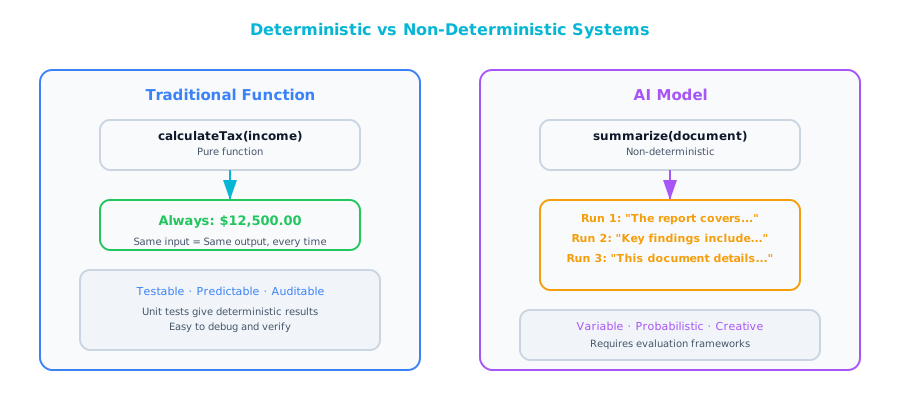
Replacing a traditional component with an AI-powered one is like replacing a stored procedure with a human expert. The expert is usually right, often creative, and occasionally produces insights that surprise everyone. But the expert is also sometimes wrong, can be inconsistent across similar situations, and needs a support structure: peer review, escalation paths, quality checks. Your architecture needs to provide that same support structure for AI components.
Data as a First-Class Architectural Concern
In traditional enterprise architecture, data is something you model during design, store in databases, and move between systems through ETL pipelines, APIs, and message queues. It is important, but it is often treated as plumbing rather than the system's primary asset. The code is what makes your application intelligent.
In AI-driven architecture, that relationship is inverted. The data determines how well your AI components perform, what biases they carry into production, and how quickly they improve over time. A brilliantly engineered model trained on poor data produces poor results. A relatively simple model trained on high-quality, well-curated data can deliver remarkable performance.
Your data architecture can no longer just move information from point A to point B. It needs to become a refinement system — one that cleans, labels, versions, and continuously improves the quality of data flowing through it. Data pipelines in an AI-enabled enterprise are not just about availability and throughput. They are about the ongoing cultivation of your organization's most strategically important asset.
The Build vs. Buy Calculus Changes
Every enterprise architect has a well-developed instinct for the build-versus-buy decision. You weigh the cost of building something internally against the cost and constraints of purchasing a vendor solution, factoring in maintainability, vendor lock-in, time to market, and alignment with core competencies. A framework you have applied hundreds of times.
With AI, that two-option decision expands into four: build vs. fine-tune vs. prompt vs. buy.
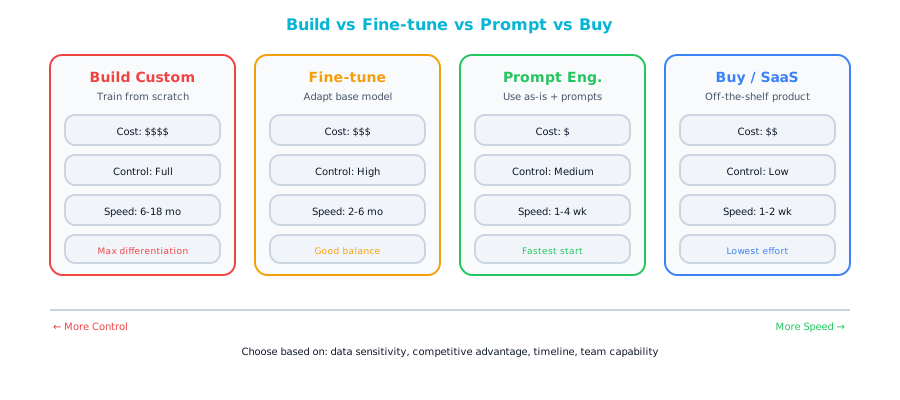
You might build a model from scratch if you have proprietary data and unique requirements, but that demands significant investment in ML engineering talent and infrastructure. You might take a pre-trained foundation model and fine-tune it on domain-specific data — less expensive, but still requires meaningful technical capability. You might skip model training entirely and prompt a commercial large language model with carefully designed instructions, which is fast and flexible but gives you less control and creates a dependency on an external provider. Or you might buy a fully packaged AI solution from a vendor — the fastest path, but often the least customizable.
Each option carries radically different implications for cost, control, capability, latency, data privacy, and long-term maintainability. The right answer varies not just across organizations but across use cases within the same organization.
The Build vs. Fine-Tune vs. Prompt vs. Buy Decision Framework
This expanded decision space comes up in virtually every AI initiative.
START: Do you need AI for this use case?
│
├─ Is there a commercial product that solves this well?
│  ├─ YES → Does it meet your data privacy requirements?
│  │  ├─ YES → Does the vendor's roadmap align with yours?
│  │  │  ├─ YES → BUY (commercial AI product)
│  │  │  └─ NO  → Consider PROMPT or FINE-TUNE
│  │  └─ NO  → Must you keep data on-premises?
│  │     ├─ YES → FINE-TUNE or BUILD (self-hosted)
│  │     └─ NO  → PROMPT with data filtering
│  └─ NO  → Do you have domain-specific training data?
│     ├─ YES (>1,000 labeled examples) → FINE-TUNE
│     ├─ YES (but limited) → PROMPT with few-shot examples
│     └─ NO  → Can a general-purpose LLM handle it with good instructions?
│        ├─ YES → PROMPT
│        └─ NO  → BUILD (custom model)
| Approach | Cost | Time to Value | Control | Data Requirements | Best When |
|---|---|---|---|---|---|
| Build (train from scratch) | Very high ($500K–$5M+) | 6–18 months | Complete | Large proprietary dataset (100K+ examples) | You have truly unique data and requirements that no existing model addresses, and the competitive advantage justifies the investment |
| Fine-tune (adapt a foundation model) | Medium ($10K–$200K) | 1–3 months | High | Moderate domain-specific dataset (1K–50K examples) | The base model understands your domain but needs to match a specific style, format, or level of domain expertise that prompting alone cannot achieve |
| Prompt (instruct a commercial LLM) | Low ($1K–$50K/year) | Days to weeks | Limited | Minimal (examples for few-shot, documents for RAG) | The task is well-served by a general-purpose model with good instructions, and you need fast iteration with minimal infrastructure investment |
| Buy (commercial AI product) | Medium–high ($50K–$500K/year) | Days to weeks | Lowest | None (vendor provides) | A mature vendor product addresses your exact use case, and the time saved by not building outweighs the loss of customization and the vendor dependency |
Three examples that show when each approach was the right call:
The law firm that chose Prompt. A mid-size law firm needed to summarize lengthy legal contracts for partner review. Their first instinct was to fine-tune a model on historical summaries, but when they tested a well-designed prompt with Claude, the output quality was already strong enough for their needs. They invested two weeks in prompt engineering, built a RAG pipeline grounding the model in their contract templates, and deployed at a fraction of the cost of fine-tuning. Contract summarization is a general language task — the model already understood legal language; it just needed good instructions and the right context.
The healthcare company that chose Fine-Tune. A healthcare analytics company needed to extract structured clinical data from physician notes — diagnoses, medications, dosages, procedures — formatted to their proprietary data model. Prompting a general-purpose LLM got them about 70% accuracy, which was not remotely good enough for clinical use. They fine-tuned Llama on 15,000 annotated physician notes and achieved 94% accuracy. Fine-tuning was right because the task demanded specific domain knowledge and a precise output format that prompting could not deliver.
The manufacturer that chose Buy. A global manufacturer needed predictive maintenance for factory equipment. Building a custom solution would take 12 months and a team of five ML engineers. Instead, they purchased a specialized industrial AI platform trained on equipment data from hundreds of factories, which integrated with their sensor infrastructure out of the box. The vendor's model was 80% accurate from day one and improved as it ingested their data. The time-to-value advantage — weeks instead of a year — was decisive, and the competitive advantage was in having predictive maintenance, not in having built it themselves.
The lesson across all three: start with the simplest approach that might work, and only move toward more complex and expensive options when you have evidence the simpler approach is insufficient. Prompting is your default. Fine-tuning is your escalation path. Building from scratch is your last resort. Buying is your fast path when a vendor has already solved the problem well enough that building would waste your team's time.
Continuous Learning vs. Versioned Releases
Traditional software ships in versions. You develop a release, test it against acceptance criteria, deploy it to production, and monitor until the next release cycle. The software does not change its behavior between releases unless something is broken. That model has served well for decades.
AI systems do not necessarily follow that pattern. Models can improve continuously as they are exposed to more data, which sounds good until you realize they can also degrade over time — a phenomenon called model drift. The world changes, user behavior shifts, new edge cases emerge, and a model that performed well six months ago starts making increasingly poor predictions. Your release management, testing, and monitoring strategies all need rethinking. You need to detect when a model's performance is drifting, trigger retraining pipelines when it does, validate the retrained model against quality benchmarks, and deploy the updated model without disrupting the broader system.
What Stays the Same
The vast majority of your architectural thinking still applies. This tends to get lost in the hype around AI transformation. The principles you have spent years developing do not suddenly become irrelevant. They become more important.
Non-functional requirements still matter enormously. Your stakeholders still care about latency, throughput, availability, and security. A language model that takes eight seconds to respond might be technically accurate but will create a poor user experience. A recommendation engine that is available 99% of the time but goes down during peak shopping hours costs the business real money.
Integration patterns still apply. AI components need to talk to the rest of your enterprise through APIs, events, queues, and batch processes, just like everything else. The patterns you already know — request-reply, publish-subscribe, saga, circuit breaker — are all still relevant. You are applying them to components that behave a little differently than what you are used to.
Governance is more important than ever. When systems make autonomous decisions affecting customers, employees, and partners, the need for oversight, auditability, and accountability intensifies. If your organization operates in a regulated industry, the governance requirements around AI can be significantly more demanding than what you have dealt with for traditional systems.
Stakeholder management is still roughly eighty percent of the job. You are still translating between business leaders who want results, data scientists who want resources, compliance officers who want guardrails, and operations teams who want stability.
The difference is that you now need to extend all of these frameworks to cover AI-specific concerns. It is an expansion of your existing craft, not a replacement of it.
The Enterprise Architect's Advantage
Enterprise Architects are uniquely positioned to lead AI transformation. Not data scientists. Not ML engineers. Not consultants selling AI strategy workshops.
Data scientists can build excellent models. ML engineers can deploy those models into production. But neither role is trained to think about how an AI component fits into the sprawling, messy, politically complex reality of a large enterprise.
You know how to integrate new capabilities into existing systems without breaking what is already working. You understand the thousand small decisions that determine whether a new component becomes a productive member of the enterprise ecosystem or an expensive headache nobody trusts.
You know how to navigate the organizational politics of technology adoption. The real obstacles to AI adoption are rarely technical — they are organizational: turf wars over data ownership, disagreements about accountability, fear of job displacement, competing priorities across business units. You have navigated these dynamics with cloud migrations, ERP implementations, and platform consolidations. The terrain is familiar even if the technology is new.
You know how to design governance frameworks that enable innovation without letting chaos take root. This is the most critical skill in the AI era, because the pressure to move fast is immense and the consequences of moving fast without guardrails are severe.
Your job is not to become a data scientist. Your job is to become the architect who knows how to design systems where AI and traditional components work together reliably, governed appropriately, and in service of real business outcomes.
Real-World Example: The Insurance Company
A large insurance company decided to use AI to streamline claims processing. They brought in a talented data science team, gave them access to historical claims data, and asked them to build a model that could classify incoming claims automatically. After several months, the team produced a model that classified claims with 94% accuracy. They presented the results to leadership and declared victory.
Then the Enterprise Architect started asking questions.
What happens to the 6% of claims that are misclassified? In insurance, a misclassified claim is not a minor inconvenience — it can mean a legitimate claim denied or a fraudulent claim paid out. The architecture needed a human review workflow with clear escalation paths, SLA tracking, and feedback loops so reviewers' corrections could improve the model over time.
How does this AI component integrate with the existing claims management system, built fifteen years ago on a technology stack that predates the current generation of APIs? The team needed an API gateway and event bus to mediate between the new AI service and the legacy system, handling format transformations, error conditions, and retry logic.
What happens when insurance regulations change — as they inevitably do — and the model needs retraining to reflect new classification rules? The architecture needed an MLOps pipeline capable of retraining the model, validating its performance against a test suite that included the new regulatory scenarios, and deploying the updated model with minimal disruption.
Who is accountable when a customer challenges an AI-driven claims decision? The architecture needed an audit trail that could reconstruct exactly why the model made a particular classification, along with an explainability layer that could present that reasoning in terms regulators and customers could understand.
What about data lineage? Where did the training data come from, how was it selected, and were there biases in the historical claims data that could lead the model to systematically disadvantage certain groups of policyholders? The architecture needed a data governance framework that tracked provenance, identified potential biases, and ensured compliance with fairness requirements.
The model, impressive as it was, turned out to be roughly ten percent of the total solution. The architecture — the integration, the governance, the operational processes, the human-in-the-loop workflows — was the other ninety percent. That pattern repeats throughout this book.
Companion Notebook
 — Compare a rules-based classifier with an LLM-based classifier on the same task. See the difference in behavior, consistency, and failure modes.